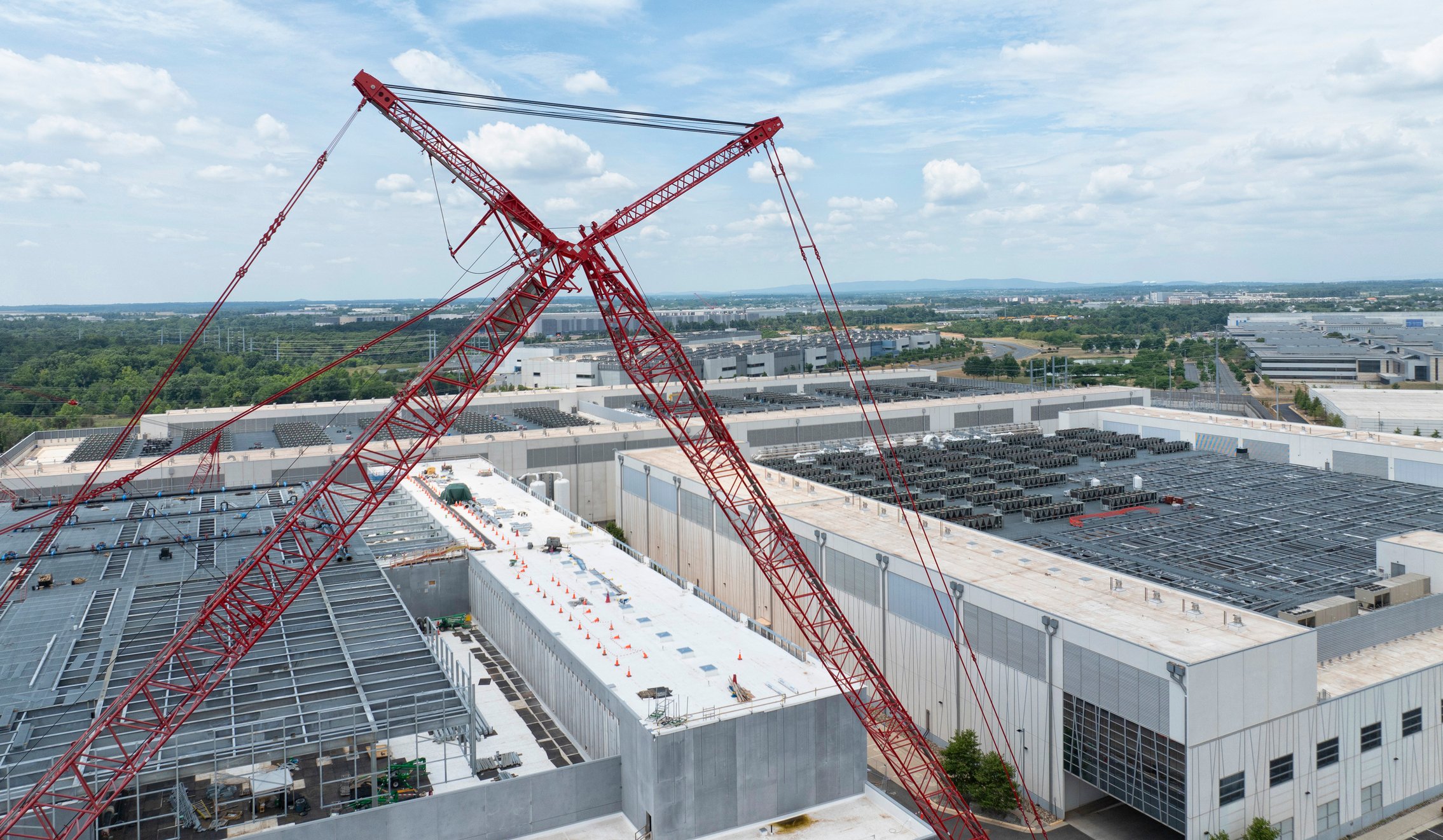
The largest US “hyperscale” tech companies operate enormous data centers and cloud operations, and they are spending heavily to compete in AI. Goldman Sachs Research projects that the five highest-spending US hyperscale enterprises will have a combined $736 billion of capital expenditures in 2025 and 2026 (as of July 16).
Source: Company data, Goldman Sachs Research
Hyperscale refers to large tech companies that are directly involved in operations for cloud computing and AI. Data shows capex for the five highest-spending US hyperscalers (as of July 16).
The growing demand for data centers requires immense investment
HYPERSCALE COMPANY CAPITAL EXPENDITURES
↓
“You have the biggest companies almost living in fear of being disrupted and deploying capital to play as much offense as they're playing defense.”
Eric Sheridan
Goldman Sachs Research

Goldman Sachs Exchanges podcast
Demand in the global data center market is forecast to grow substantially in the next half-decade or so, according to Goldman Sachs Research. Our analysts estimate current demand to be approximately 62 gigawatts (GW), comprised of cloud workloads (58%), traditional workloads (29%), and AI workloads (13%).
AI is projected to grow to 28% of the overall market by 2027, while cloud drops to 50%, and traditional workloads fall to 21%.
Source: 451 Research, part of S&P 500 Global Market Intelligence; Goldman Sachs Research
Our analysts expect “a dramatic shift in mix from different workloads due to the rapid expansion of generative AI.”
Jim Schneider, Carly Davenport, and Brian Singer
Goldman Sachs Research
AI is projected to comprise 28% of the data center market
Goldman Sachs Research's baseline forecast for global data center demand
↓
Over the next five to six years, we forecast substantial demand growth in the global data center market.”
Jim Schneider, Carly Davenport, and Brian Singer
Goldman Sachs Research
“
↓
Data centers from the pre-AI era are increasingly ill-suited for the demands of today's AI workloads, and the era of simple retrofitting is coming to an end. That's because modern AI workloads require multiple GPUs working in concert, according to the Goldman Sachs Global Institute. In 2022, a cutting-edge AI system integrated eight GPUs into a single server. By 2027, the leading system will likely have 576 GPUs in a filing-cabinet-size rack, requiring a whopping 600 kilowatts (kW), enough to power 500 US homes. Specialized GPUs began superseding general purpose central processing units (CPUs) earlier this decade, ramping up power demand.
Source: Nvidia. Apart from average estimates, power data for racks are based on Nvidia specifications. 2025 and later are estimates. AI server racks refer to GPU racks. General purpose racks refer to CPUs.
AI requires a new kind of data center
MODERN AI WORKLOADS WILL REQUIRE MUCH MORE PROCESSING POWER
↓
“Retrofitting existing facilities to support these massive jumps in power density is becoming complex and compromised. We will need new, purpose-built AI infrastructure to power the next generation.”
Frank Long
Goldman Sachs Global Institute

Goldman Sachs Global Institute
Goldman Sachs Research forecasts that data center power demand will increase from 1%-2% of overall global power demand in 2023 to 3%-4% by the end of the decade. In the US, the weighting of power demand from data centers in the overall will increase even more, likely more than doubling by 2030 from 4% in 2023.
Source: Masanet et al. (2020, Cisco, IEA, Goldman Sachs Research) • Includes AI and exclude cryptocurrency.
Global power demand from data centers is soaring�
GLOBAL DATA CENTER ELECTRICITY CONSUMPTION
↓
If global data center growth in 2030 vs. 2023 levels were its own country, it would be a top 10 global power consumer.”
Jim Schneider, Carly Davenport, and Brian Singer
Goldman Sachs Research
“
↓
Goldman Sachs Research estimates that 40% of the increase in power demand from data centers will be met by renewables, and there will be a modest amount of nuclear capacity that’s targeted for AI. The bulk of the remaining 60% is expected to be driven by natural gas. This will increase global carbon emissions by 215-220 million tons through 2030, equivalent to 0.6% of global energy emissions.
Source: IEA, Goldman Sachs Research
Data centers will be powered with natural gas, renewables, and nuclear�
DATA CENTER EMISSIONS AS % of 2022 GLOBAL ENERGY EMISSIONS
↓
“Longer term, we see potential for a significant reduction of data center emissions intensity and potentially in absolute emissions” as more nuclear power comes online and AI computing shifts to using AI models as opposed to training them.
Jim Schneider, Carly Davenport, and Brian Singer
Goldman Sachs Research
Asia Pacific and North America have the most power demand for data centers and square footage online today, most notably in Northern Virginia, Beijing, Shanghai, and Texas. Goldman Sachs Research finds that capacity is centered around regions with high compute and data traffic, as well as robust corporate demand.
In Europe, a surge in connection requests received by energy providers indicates that technology companies are planning to build new data centers. The increasing need for electricity for the infrastructure is reversing more than a decade of falling demand for power in the region.
Source: 451 Research, Goldman Sachs Research
A surge in connection requests for data centers in Europe
REGIONAL DATA CENTER SUPPLY AND UTILIZATION
“Inflecting power demand is monumentally important, because it’s been declining for 15 years in Europe"
Alberto Gandolfi�head of European utilities research