

Talks at GS
FedEx founder & chairman Fred Smith on transforming global logistics
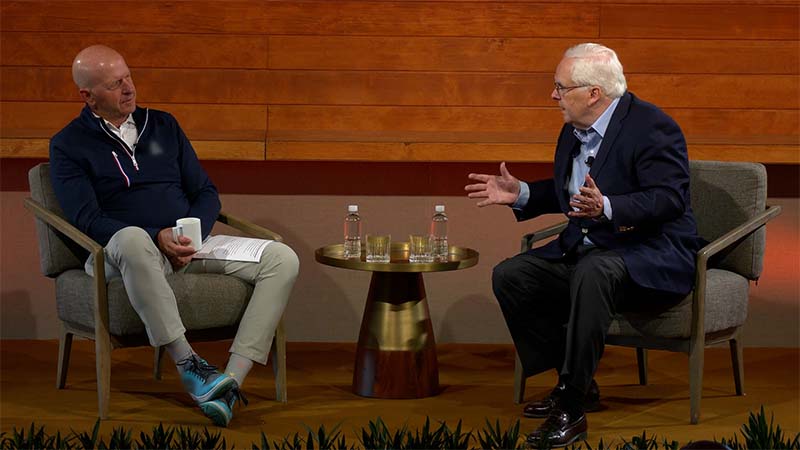
Fred Smith founded the original Federal Express network in 1973 with the goal of transforming logistics and transportation in the US. Today, FedEx is the world’s largest express transportation company, serving more than 220 countries and territories worldwide. Goldman Sachs Chairman & CEO David Solomon joins Mr. Smith to discuss how his time in the Marines inspired the launch of FedEx, the impact of geopolitics on global supply chains, and the necessity of innovation in the AI age. This Goldman Sachs Talks was filmed on October 17, 2024 at 2024’s Builders and Innovators Summit.
Transcript:
Fred Smith: I love that phrase, you know, if you don’t like change, you’re going to hate extinction. You’ve got to change.
[MUSIC INTRO]
David Solomon: Good morning, Fred.
Fred Smith: Good morning.
David Solomon: When you think about entrepreneurs who have built great American companies, people who have had kind of a vision for something that was new and disruptive, you know, you’re certainly at the top of my list. So, first of all, I want to thank you for coming out and being here with all of us. Let’s please give Fred a very, very warm welcome and thanks.
And I have to start, even though I’ve heard the story a couple of times in different ways, but you’ve just got to--how did it start? How did FedEx come to be? How did Fred Smith come to be? Just take us through a little bit, you know, at the beginning, talk about the entrepreneurial origins of FedEx.
Fred Smith: So, thank you for having me here, David. And on behalf of over half a million FedEx teammates around the world, we’re honored to be here. And particularly with a bunch of amazing entrepreneurs. And a very, very large number of FedEx customers. So, we genuflected every shipment you give us, I can promise you. And every one of us is trying to keep our purple promise.
But to your point, my father died when I was four and my mother didn’t remarry until I was about 15. She married an Air Force general. And he taught me to fly. So, I went to Yale in 1962. And let me hasten to tell you, in case you don’t know it, you did not have to be smart to go to Yale in 1962. That’s not self deprecating language. That’s the facts.
So, I, along with a couple of professors, reconstituted a very famous flying club, the Yale Flying Club during World War I provided about 3/4 of all naval aviators for the United States. So, it was a long tradition of flying at Yale. And I flew plans out at the New Haven airport, usually well to do prep school guys going to see their girlfriends up in Massachusetts or Virginia or some place.
But increasingly, I was hired to fly little small parts because the high tech industry of the world in those days was around 128 in Boston, not Silicon Valley. And up in northern New York. And people are amazed to find out that they made IBM 360 mainframe computers in Armonk, New York, just north of your office up there.
So, I would be flying these parts and pieces from Xerox in Rochester to Pittsburgh or wherever the case may be. And I would sort of sit in amazement there and saying they’re hiring me and this whole damn airplane to carry this little part.
So, what I was actually seeing was the beginning of the automation of society. So, I wrote a paper about it, which I have no idea what I got. And I was asked one time, you know, what’d you make on it. And I said, “I don’t remember.” And they kept pressing. I said, “Well, I guess I got my usual C.” And so, that became lore. I don’t know whether it’s true or not. But I’m smart enough to know a good PR story. And I just lean in.
David Solomon: You don’t know if the C is true. But the paper is absolutely true.
Fred Smith: The paper was true. But it wasn’t the full-blown concept for Federal Express in those days. And the Vietnam War was on. I was in the Marine Corps’ officer program. So, I had to go into service for four years.
And the military, just like lumber and everything, is a supply/push system. You cut the trees down. You make them into 2x4s. You put them in the lumber yard. The contractor comes and gets lumber. Builds the house. The military is the ultimate example of that. You get the beans, bullets, and blankets. You push them forward to the regiment, to the company, and so forth.
When you automate something, it’s the exact opposite. It’s demand/pull. So, when I came back out of the service, the things that I had seen up in New England when I was an undergraduate there in the early ‘60s had exploded. And everything was automating. Diagnostic machines at hospitals. Cockpits of airplanes had become, you know, electronic as opposed to pneumatic. And I picked the idea up again.
I did a study of the Federal Reserve system, which moved checks in those days. It’s not electronic bits and bytes. And that’s where the name Federal Express came from. And it was a microcosm of the US economy. And the only way to solve the problem was the way banks or telecommunications company, and the mathematical topology of putting a single hub and connecting them, which is extraordinarily efficient. If you take one transaction out of context, it looks ridiculous that you take checks, you know, from Wall Street all the way up to midtown and back to a bank across the street. But once you look at the network as a whole, it’s usually-- and that’s how telecommunications systems have always worked. So, I just applied it to the movement of goods.
I’d served in both a ground unit and an aviation unit in the Marine Corps. So, it was not unusual for me to put the pick up and delivery and the planes together. Nobody had ever done that. And I had three separate marketing studies because one thing I found out in the service is that you better do your reconnaissance. You better do your homework.
And so, we started a company. And we just were chasing the market from that point forward because the automation and these high-tech devices were just profound.
And then kind of the punctuation on all of it, and I’ll pause, is that when I left Asia in December 1969, I never thought I was going to go back. But by the early ‘80s, all the manufacturing that had been underway in these high-tech companies, Burrows, Sperry, Univac, IBM, Xerox, it all migrated either to the West or to the Asian manufacturing centers, the four tigers.
So, we just followed our customers. And that’s how we became such a big force internationally. That’s sort of the Cliff Notes version of it.
David Solomon: Yeah, it’s an unbelievable story. And what’s interesting to me, I mean, companies constantly, constantly evolve. They have to constantly evolve. But when you look at the core of what FedEx does, the core of what FedEx does, does not look that different today--
Fred Smith: You’re absolutely right.
David Solomon: -- than it looked-- than it looked 50 years ago. And it’s really remarkable in that context. You know, you talked about being a pilot. And I’m sure, you know, in the early days when you set this up and you developed it operationally, some of, you know, your knowledge as a pilot, and the fact that as you were describing, you’re moving things around, it gave you this on the ground experience as an entrepreneur.
As this thing scaled to the degree that it scaled, how did you start to manage this enterprise? Most people build businesses, you know, they start adding bricks to them. This was like a full house the moment you started. So, how did you scale and manage, you know, the scale of the way this is? You said you were chasing it. How were you able to adapt to something that got so big so quickly?
Fred Smith: Well, I think at the end of the day, being in the military was very, very fortuitous for me because I got a very good education at Yale, and I think that Yale taught me how to think.
But I learned how to do a lot of stuff in the service. And I saw it at a grand scale. And, you know, if Julius Caesar came into this room today and we described the FedEx global system, our headquarters in Singapore and in Dubai and Amsterdam, and we have specialists in aviation and computers and data systems and one thing and another, he would understand that organization because basically he invented it. Because you have functional heads, and you have geographic heads. And that’s where matrix management came from.
So, I understood organizations at scale. And I think, while I didn’t go to graduate school, a lot of people came and said, “Well, you made a bad grade at Harvard Business School.” And of course, I hate Harvard. And I didn’t go to Harvard. I’m kidding there. I love Harvard. So, I would always say, “No, no. I didn’t go to Harvard. I went to USC.” And I just left the M out of the USMC. But that’s where it came from. And as I said, my father passed away. So, my uncles were very influential.
And what I tried to do is to read about all the great captains in military and business and so forth. And I think I was a pretty good student of organizations. And then I tried to get exposure elsewhere. I served on five other New York stock exchange companies, a couple of major philanthropic boards. And everybody has the same problem. And I would say Goldman Sachs does just like any other big enterprise. It’s how do you mitigate the advantages of scale versus focus? And where do you stop in terms of your core competencies in an adjacency or in-depth?
That’s really the whole thing about going into business, is those parameters. So, that’s how I did, is I tried to understand what the key elements were as a company got bigger, more complex, broader in terms of geography and product line.
David Solomon: Yeah. I want to talk a little bit about talent. You were-- you were an early champion of diversity and inclusion. You were hiring veterans, you know, out of Vietnam. Some of the early African American pilots in your fleet. Talk about retaining talent. Talk about how entrepreneurs should think about retaining talent. And also, you know, creating a talent culture. Because I know that’s something that was super, super important to you, has been at FedEx.
Fred Smith: Yeah. Well, I think at the end of the day, again, going back to my military experience, I saw the extreme importance of competence. And incompetence was disastrous, literally. And so, we have a very strong culture at FedEx. I was talking out at the airport with one of our guys out there. My guess is FedEx has more long tenured employees than any institution in the world. By far. And I think the reason for that is that we’ve always focused on the customer end of the business. And the front-line employees.
So, we’ve always looked at the top management as facilitators of what the people that are out there dealing with our customers are doing. And that requires a lot of work. And it requires a lot of commitment. And somebody one time said, “I never met anybody that wouldn’t keep their word as long as it didn’t cost him any money.” And a lot of times when you have this commitment to your folks, it means you’ve got to put up or shut up. And that’s hard to do in business, you know, when it costs you money.
But we have consistently over the years tried to do right by our folks. Today I’ll give you a perfect example of that. So, for years we operated our air express system and our ground system separately because of the genealogy of the company, the latter having been acquired in 2000.
So, we had to spend a lot of money to modernize our airplane fleet, you know, because we’d built the company from scratch in mostly used planes. And then we could turn now to putting these units together.
Well, we began that process in 2021. Going out into the field with all of our top management and said, “This is coming. Don’t be afraid of it. You know at FedEx you have to change.” We just pound that into people all the time. I love that phrase, you know, if you don’t like change, you’re going to hate extinction. You’ve got to change.
So, our folks are ready for that. And they’re accepting of it for a very simple reason, David, they know we’re going to do right by them to the maximum extent possible, even if it costs us some money.
So, when I went around to all of our stations and our other managers and said, “This is coming. We’re going to put these units together. But it’s going to be driven by data. It’s not going to be that you came from this side of the house or this side of the house. Secondarily, we’re going to stay true to our corporate philosophy, People, Service, Profit, which is that keep the emphasis on the front-line employee. Provide great service. Profits will come as a natural function of that. So, we’re going to be guided by PSP. And wherever possible, we’re going to accommodate our needs. And the markets we serve are so humongous. I mean, we’re a $90 billion company. We’ve got plenty of work for everybody who wants it. You may have to move here, there, or the other.”
So, we just pounded away those three things. And we did it for two years before we actually did it. So, that’s why I’m saying sometimes you got to spend some money to make sure the culture is ready for the change that you’re going to execute.
David Solomon: Yeah. Good advice. And I’ve always loved, you know, that line, if you hate change, you’re going to hate extinction. But it’s really, really true.
Fred Smith: Yeah. But you see it all the time in your customers and--
David Solomon: See it all the time. I want to shift, talk a little bit about technology. Obviously, everybody today, no matter what your business is, is wrestling with, you know, a step function increase in compute and technology accelerating the way we do and we think about different things. And everybody’s wrestling with this.
But if you look back at your history and you think about the way you’ve adopted, you know, new technologies, you know, to continue to move FedEx along, whether it’s laser barcodes, scanning devices, handheld compute devices. I mean, you constantly were at the forefront of finding ways to use these advances in technology to move your business forward. How did you think about that? And how does FedEx keep itself in a position where it makes these shifts in its processes with technology, it seems from the outside, relatively seamlessly? I’m sure it’s not on the inside. But you seem to really stay in front of that and are very, very adaptive.
Fred Smith: Well, I think you’re right. And I think that’s one of the biggest untold stories about FedEx. So, relatively early on, it became quite obvious to me that we had to have technological excellence at a level far beyond my capability.
So, I ended up, it’s a long story in hiring Jim Barksdale. I don’t know, some of you may know Jim, but for all intents and purposes, Jim Barksdale invented the internet. I mean, Jim had worked for us and he was hired away by Craig McCaw to basically revolutionize mobile telephony. And McCaw was acquired by AT&T, and it was the cornerstone of AT&T mobility.
So, Jim called me up. He had made a lot of money at FedEx making us the technological leader, including developing, as you just said, the ability to track and trace things when they’re in motion. That changed logistics completely. Because once you could see something in motion as well as at rest in a warehouse, your ability to run much smarter logistics systems was made possible.
So, Jim, I met him, and he said, “I’ve got this offer to go to this company called Netscape.” And I’d just coincidentally, our CIO who was a wiz had been up at the University of Chicago and briefed me on this new technology called Mosaic. Well, that’s what went into Netscape. That’s what created the browser. And one of the first pieces of real work that you could do on the internet was track and trace FedEx packages.
We had gotten to the point where we were buying more PCs than any entity in the world. And we were putting them in our customers’ offices so the shipping managers could track and trace and prepare the shipping labels and so forth. Thank God the internet came along, or we’d be still buying the damn PCs.
So, Jim took that position. And he began a tradition at FedEx of the finest technological folks that you could imagine. I could just list them off.
And lately, our CEO now, Raj Subramaniam who has been my partner for 32 years, he's a digital savant. And he’s an engineer and MBA and he has a assembled a team that really was into AI and this kind of extreme data a long time before people realized it.
I’ll give you a couple of anecdotes and it’ll put this in perspective. First of all, FedEx moves about $2 trillion worth of goods every year. $2 trillion. We’re moving about 6 percent of the GDP of the United States as we sit here. There are 22 777s going across the Pacific both ways, 20 across the Atlantic. We move packets, packages, and pallets. We’re moving items from Shein from China, from Walmart. We’re moving Chewy.com stuff for your pets. We’re moving pallets and NVIDIA chips. We’re taking washing machines across the threshold into your house. We see the economy at a granular level almost like no one else. I’m convinced of that. And I’ve talked to Jerome Powell about this. And I think they agree with that.
And a little anecdote I’ll tell you. One of the very smart hedge fund guys was talking to Raj and his head of what we call data works, our digital unit that has people all over the world working on these digital solutions said, “Okay, well you know so much stuff, what do you know about dogs?” And so, Shree the head of data works said, “Big ones or small ones?” We can tell you what you’re buying every day. I mean, what kind of dog food you’re having. We could have told you a long time before people realized it that Tesla was going to be a success because we were moving all of Tesla’s stuff. We could a told you what NVIDIA was doing. We’re moving stuff from NVIDIA as we sit here from Guadalajara up to the west coast and, you know, John Deere pallets to Europe.
So, we just have this kaleidoscope of what’s going on in the economy. And so, we’re able to think-- see trends. And the biggest trend is to use digital technologies to take work and inefficient activities out of business processes. We’ve been doing that a long time. And I think the next few years are going to be astounding in the way that that pays off for society and for individual companies.
David Solomon: Well, that’s one of the reasons to be hugely optimistic when you kind of look at the world, you know, certainly from a productivity perspective. I think people are underappreciating the possibility for massive productivity gains.
Fred Smith: Oh, I think that’s right. I think that’s right.
David Solomon: As this impacts processes and systems, you know, throughout the world.
Fred Smith: Yep. No question about it. That’s exactly what we see. Exactly what we see.
David Solomon: Something to be very excited about. I want to shift back to entrepreneurs and risk. Let’s say you were starting out today. Let’s say you were starting out today. What risks would you be most concerned about as an entrepreneur starting out today? What would you be most excited about as an entrepreneur starting out today?
Fred Smith: Well, I think in terms of risks, I would commend to anybody that wants to be an entrepreneur, you put up on your wall Michael Porter’s famous chart about the forcefield or whatever it is of competition, because it’s as true today as when he put it together 30 years ago.
So, if you want to be an entrepreneur, you’ve got to have a sustainable, defensible product that can scale. Because if you’re successful, the market-based economies that have been so great for mankind, you’re going to get competition. And you’re going to go down to a commodity status at best, or into a loss position if you’re not able to sustain your differentiation and your capabilities.
So, my first piece of advice is don’t think that anything has changed in that regard. Just commit that to memory and put it on your wall. The thing I’d be most excited about and concerned about at the same time is with digital technology, you can be attacked and the market change on a dime. And one of the great examples to me is Netflix. You know, they start out moving VHS through the mail. And now you can get all kinds of things digitally. So, they made that transition. Most people do not make that transition.
So, I think with AI and the ability to see things and patterns that nobody has ever seen before, you’ve got to stay competent in that area if you have any, any capability of being disrupted from a digital competitor. That would be the two things. Nothing’s changed. But the digital ecosphere we work in is both great opportunity--
David Solomon: Opportunity and risk.
Fred Smith: And it can be deadly if you miss a turn.
David Solomon: Yeah. Well, Fred, we could spend a lot more time, but I appreciate it. Thank you for being here. Thank you for joining us. An incredible American story. Good luck in Pittsburgh.
The opinions and views expressed in this program may not necessarily reflect the institutional views of Goldman Sachs or its affiliates. This program should not be copied, distributed, published, or reproduced in whole or in part or disclosed by any recipient to any other person without the express written consent of Goldman Sachs. Each name of a third-party organization mentioned in this program is the property of the company to which it relates, is used here strictly for informational and identification purposes only, and is not used to imply any ownership or license rights between any such company and Goldman Sachs. The content of this program does not constitute a recommendation from any Goldman Sachs entity to the recipient, and is provided for informational purposes only. Goldman Sachs is not providing any financial, economic, legal, investment, accounting, or tax advice through this program or to its recipient. Certain information contained in this program constitutes “forward-looking statements”, and there is no guarantee that these results will be achieved. Goldman Sachs has no obligation to provide updates or changes to the information in this program. Past performance does not guarantee future results, which may vary. Neither Goldman Sachs nor any of its affiliates makes any representation or warranty, express or implied, as to the accuracy or completeness of the statements or any information contained in this program and any liability therefore; including in respect of direct, indirect, or consequential loss or damage is expressly disclaimed.
This transcript should not be copied, distributed, published, or reproduced, in whole or in part, or disclosed by any recipient to any other person. The information contained in this transcript does not constitute a recommendation from any Goldman Sachs entity to the recipient. Neither Goldman Sachs nor any of its affiliates makes any representation or warranty, express or implied, as to the accuracy or completeness of the statements or any information contained in this transcript and any liability therefor (including in respect of direct, indirect, or consequential loss or damage) are expressly disclaimed. The views expressed in this transcript are not necessarily those of Goldman Sachs, and Goldman Sachs is not providing any financial, economic, legal, accounting, or tax advice or recommendations in this transcript. In addition, the receipt of this transcript by any recipient is not to be taken as constituting the giving of investment advice by Goldman Sachs to that recipient, nor to constitute such person a client of any Goldman Sachs entity. This transcript is provided in conjunction with the associated video/audio content for convenience. The content of this transcript may differ from the associated video/audio, please consult the original content as the definitive source. Goldman Sachs is not responsible for any errors in the transcript.
This episode was recorded on October 17, 2024.
Subscribe to Briefings
Our weekly newsletter delivers the latest insights on economic forces shaping markets—from Goldman Sachs leaders, economists, and investors around the world.
You can unsubscribe at any time. For information about how your personal data will be used, visit Privacy Information and Resources.