

Artificial Intelligence
China’s AI Providers Expected to Invest $70 Billion in Data Centers Amid Overseas Expansion
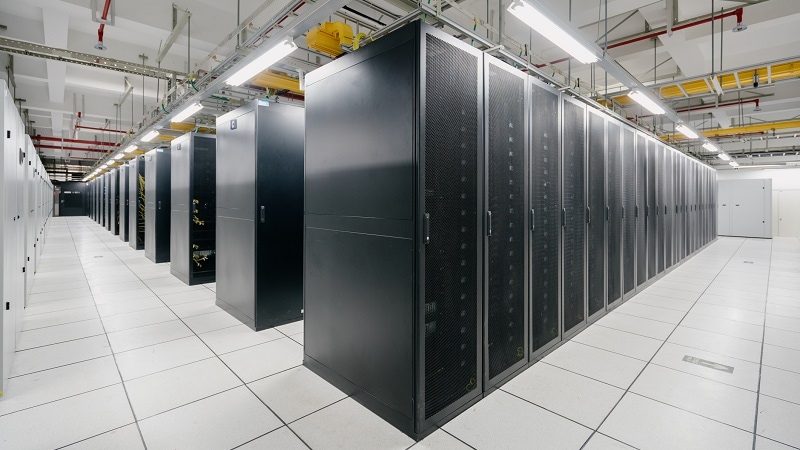
Ever since China’s DeepSeek artificial intelligence (AI) chatbot made headlines in January, the country’s cloud computing and internet industries have been racing to develop AI for consumers and businesses, according to Goldman Sachs Research. Our analysts expect power demand from China’s data centers to increase 25% this year.
Now Chinese AI hyperscalers are mostly serving domestic customers and beginning to rely on home-grown AI chips and hardware, says Ronald Keung, a managing director who heads the Asia internet research team in Hong Kong, and Timothy Zhao, an executive director in Goldman Sachs Research. Meanwhile, Keung says Chinese AI players have also started to generate subscription revenue from AI applications and see further opportunities for growth among foreign customers.
Our analysts expect the top internet firms to invest more than $70 billion next year. We spoke with Keung and Zhao about power demand from Chinese data centers, growth in the country’s supply chain for AI, and how companies are generating revenue from the technology.
How fast is AI growing in China?
A key metric is how much power new data centers will consume to support AI. Electricity capacity for data centers in China is on course to jump 30% this year, to 30 gigawatts. One top cloud computing company and a major AI player plans to increase its data center capacity 10 times by 2032.
We are forecasting that China cloud service providers will increase their capital expenditures by around 65% in 2025.
Next year, we expect the top internet firms to invest more than $70 billion as part of their effort to support AI. This is only 15 to 20% of what the US hyperscalers are expected to spend. Yet the Chinese sector is in a “build it and they will come” phase. And these initiatives range from data centers to new types of chips to AI functions.
So the growth curve is broad and steep?
Yes. China’s infrastructure buildout is not unlike what happened in the US in 2022 when OpenAI launched ChatGPT. Everyone started to download the app, and it became a must-have in phones and the subscription base has been growing ever since. China missed out on this. ChatGPT is not accessible in the Chinese market.
How do Chinese AI hyperscalers produce revenues?
Chinese enterprises and consumers rarely pay for software. Through the years, a lot of consumer-facing apps have tried generating some revenue through ads. With chatbots, those rates are very, very low. All the top chatbots are free. And the number of paid users is immaterial.
Even though business models are still evolving, China cloud hyperscalers have begun generating AI revenues at a high growth rate. Besides AI model training revenues, they also generate revenues by charging enterprises for what we call “post-training” and “inference.”
In AI, post-training is when companies want AI models to behave in a specific way with their own proprietary data to help serve their own customers and grow their businesses. For inference, this means the application of AI models after they are trained, in day-to-day tasks, taking in users’ new inputs to generate responses.
China hyperscalers generate 90 to 95% of revenues from domestic business, yet international growth is another key driver. In anticipation of the growth to come—especially from overseas markets— Chinese AI hyperscalers plan to construct data centers across Asia, the Middle East, and Latin America.
What are the top sources of monetization for China’s AI applications and models?
At the moment, AI video generation, picture editing, and object identification are the top monetizable use-cases for China AI applications, powered by rising capabilities of China multi-modal AI models. Overseas markets are already a bigger revenue contributor than domestic in AI video and picture editing applications.
These services typically monetize through monthly subscription fees. Monitoring the rate of “annual recuring revenue,” or ARR, is therefore a key way to track the business growth of such AI model and application providers.
Clearly, it is early days in the revenue story given the scale of capital expenditures in the sector.
This article is being provided for educational purposes only. The information contained in this article does not constitute a recommendation from any Goldman Sachs entity to the recipient, and Goldman Sachs is not providing any financial, economic, legal, investment, accounting, or tax advice through this article or to its recipient. Neither Goldman Sachs nor any of its affiliates makes any representation or warranty, express or implied, as to the accuracy or completeness of the statements or any information contained in this article and any liability therefore (including in respect of direct, indirect, or consequential loss or damage) is expressly disclaimed.
Subscribe to Briefings
Our weekly newsletter delivers the latest insights on economic forces shaping markets—from Goldman Sachs leaders, economists, and investors around the world.
You can unsubscribe at any time. For information about how your personal data will be used, visit Privacy Information and Resources.