
How Will the Iran Conflict Impact Oil Prices?
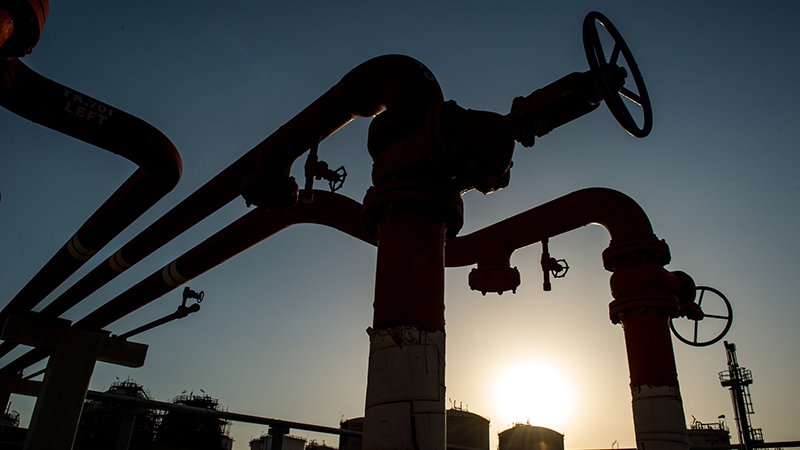
Oil jumped following US and Israeli strikes in Iran. For energy prices, much will depend on the extent and duration of transit disruptions via the Strait of Hormuz, through which around one-fifth of global supply for oil and liquified natural gas (LNG) normally flows, according to Goldman Sachs Research.
Our strategists estimate that traders demand about $14 more for a barrel of oil than they did before the conflict to compensate for the increase in risks (as of March 3). That risk premium roughly corresponds to Goldman Sachs Research’s estimate of the effect of a full four-week halt in flows through the Strait of Hormuz (with spare pipeline capacity used as a partial offset), Daan Struyven, co-head of Global Commodities Research and head of Oil Research, writes in a report. The impact is estimated to decline to an increase of $4 per barrel if half of the flows are halted for one month.
“However, oil prices can rise substantially more if the market demands a premium for the risk of more persistent supply disruptions,” Struyven writes. Brent oil, the international benchmark, closed at $77 on Monday, up from $72 on Friday and $61 at the end of last year.
How much will oil prices rise if the Strait of Hormuz is closed?
Depending on the extent and duration of restrictions to transit through the Strait of Hormuz, Goldman Sachs Research estimates for the increase in oil prices range from $1-$15 per barrel:
- $15 for a full one-month closure if there are no offsets (e.g., utilization of spare pipeline capacity, releases of strategic petroleum reserves)
- $12 in the event of a full one-month closure if all estimated spare pipeline capacity, 4 million barrels per day (mb/d), is used
- $10 for a full one-month closure if all estimated spare pipeline capacity is used and global strategic petroleum reserves are released for one month at a 2 mb/d pace
- $4 for a partial, one-month closure of 50% if all estimated spare pipeline capacity is used
- $1 for a partial, one-month closure of 25% if all estimated spare pipeline capacity is used
What is the estimated short- to medium-term impact on oil prices?
History suggests that oil price spikes from geopolitical shocks and temporary supply disruptions can be short-lived.
Goldman Sachs Research finds that oil prices can rise significantly, and well above fair-value estimates, when geopolitical uncertainty is high and when market participants are concerned that supply disruptions could persist. In mid-2022, oil prices exceeded Goldman Sachs Research’s stocks-implied fair value estimate by nearly $20. Brent rose from around $65 in early June 2025 to the low $80s when Israel and the US struck Iran’s nuclear facilities. Prices quickly retraced when the market gained confidence that actual oil supply was unlikely to be disrupted.
How much oil and gas does Iran produce?
Iran produced around 3.5 mb/d of crude oil and about 0.8 mb/d of condensate (a hydrocarbon mixture produced along with gas) in 2025, together amounting to about 4% of global oil supply. Iran's 2025 exports averaged 1.7 mb/d for crude and condensates, 0.6mb/d for refined products, and 0.4 mb/d for natural gas liquids (NGLs).
The Strait of Hormuz is crucial for nearly 20 mb/d of global oil production. Saudi Arabia, Iraq, and the United Arab Emirates together exported 13.1 mb/d of oil via the Strait of Hormuz last year, with China as the main destination. The International Energy Agency has estimated that 4.2 mb/d of the oil flows through the Strait of Hormuz can be redirected using existing spare pipeline capacities, implying around 16 mb/d of oil flows are at risk from a full closure.
What does the conflict in Iran mean for natural gas prices?
There is significant risk that European gas and global LNG prices could climb higher, according to Goldman Sachs Research. The most critical impact to global gas markets would come from a disruption of the approximately 80 million tons per annum of LNG (19% of global LNG supply) that typically flow through the Strait of Hormuz.
In a scenario where LNG flows through the Strait of Hormuz are fully halted for one month, Goldman Sachs Research estimates that Dutch natural gas, or TTF, could approach 74 EUR/MWh. A hypothetical longer disruption of natural gas supply transit through the Strait of Hormuz lasting more than two months would likely lift European natural gas prices to more than 100 EUR/MWh. TTF natural gas traded at about 31.6 EUR MWh on Friday.
This article is being provided for educational purposes only. The information contained in this article does not constitute a recommendation from any Goldman Sachs entity to the recipient, and Goldman Sachs is not providing any financial, economic, legal, investment, accounting, or tax advice through this article or to its recipient. Neither Goldman Sachs nor any of its affiliates makes any representation or warranty, express or implied, as to the accuracy or completeness of the statements or any information contained in this article and any liability therefore (including in respect of direct, indirect, or consequential loss or damage) is expressly disclaimed.
Subscribe to Briefings
Our weekly newsletter delivers the latest insights on economic forces shaping markets—from Goldman Sachs leaders, economists, and investors around the world.
By submitting this information, you agree that the information you are providing is subject to Goldman Sachs’ Privacy Policy and Terms of Use. You consent to receive our newsletter via email.