

Macroeconomics
The Jobs AI Is Likely to Boost—and Those It May Disrupt

- The loss of jobs from AI replacing workers is being partially offset by rising employment where AI augments human labor, according to Goldman Sachs Research.
- Our economists’ analysis shows a modest net drag on labor markets, with AI reducing monthly payroll growth by roughly 16,000 jobs in the past year and raising the unemployment rate by 0.1 percentage point.
- Where AI augments human workers, it can lower the cost per unit of output and therefore increase demand, creating a net increase in employment.
Artificial intelligence (AI) isn’t just a risk to jobs—Goldman Sachs Research estimates that it also increases the number of jobs in some sectors. Our economists find that, in occupations where workers face a high risk of being substituted by AI, jobs are being lost. But in roles where AI is more likely to augment human labor, employment levels are rising.
Overall, this has created a modest net drag on US labor markets, Goldman Sachs Research economist Elsie Peng writes in a report. By distinguishing between substitution and augmentation, the team develops a more detailed analysis than earlier research on this topic. They combine an AI displacement score used previously with an index developed by International Monetary Fund economists to measure AI complementarity—the extent to which AI can augment human workers, automating some tasks while still requiring human judgment, creativity, and interpersonal skills.
Is AI causing job losses?
The new analysis, weighing both substitution and augmentation, allows the economists to “dig deeper into AI’s impact on the labor market so far,” Peng writes. The team estimates that AI has reduced monthly payroll growth by roughly 16,000 jobs in the US in the past year and raised the unemployment rate by 0.1 percentage point.
The aggregate impact of AI on jobs in the past year has likely been smaller than those numbers indicate, however. That’s because the estimates don’t fully capture the offsetting effect of hiring for data center construction or incremental labor demand generated by AI-related productivity and income gains, Peng writes.
When our economists looked specifically at jobs with the potential for AI augmentation, they found an increase of monthly payroll growth by about 9,000 jobs in the past year, and a small lowering of the unemployment rate. Their research also shows that the negative overall effects of AI on job creation appear to be falling largely on younger, less-experienced workers.
Which jobs are benefiting from AI?
Where AI can substitute for human labor, and companies can deploy AI to automate tasks, the impact on employment is likely to be negative. In occupations where AI augments human labor, though, the effect is more ambiguous, Peng writes.
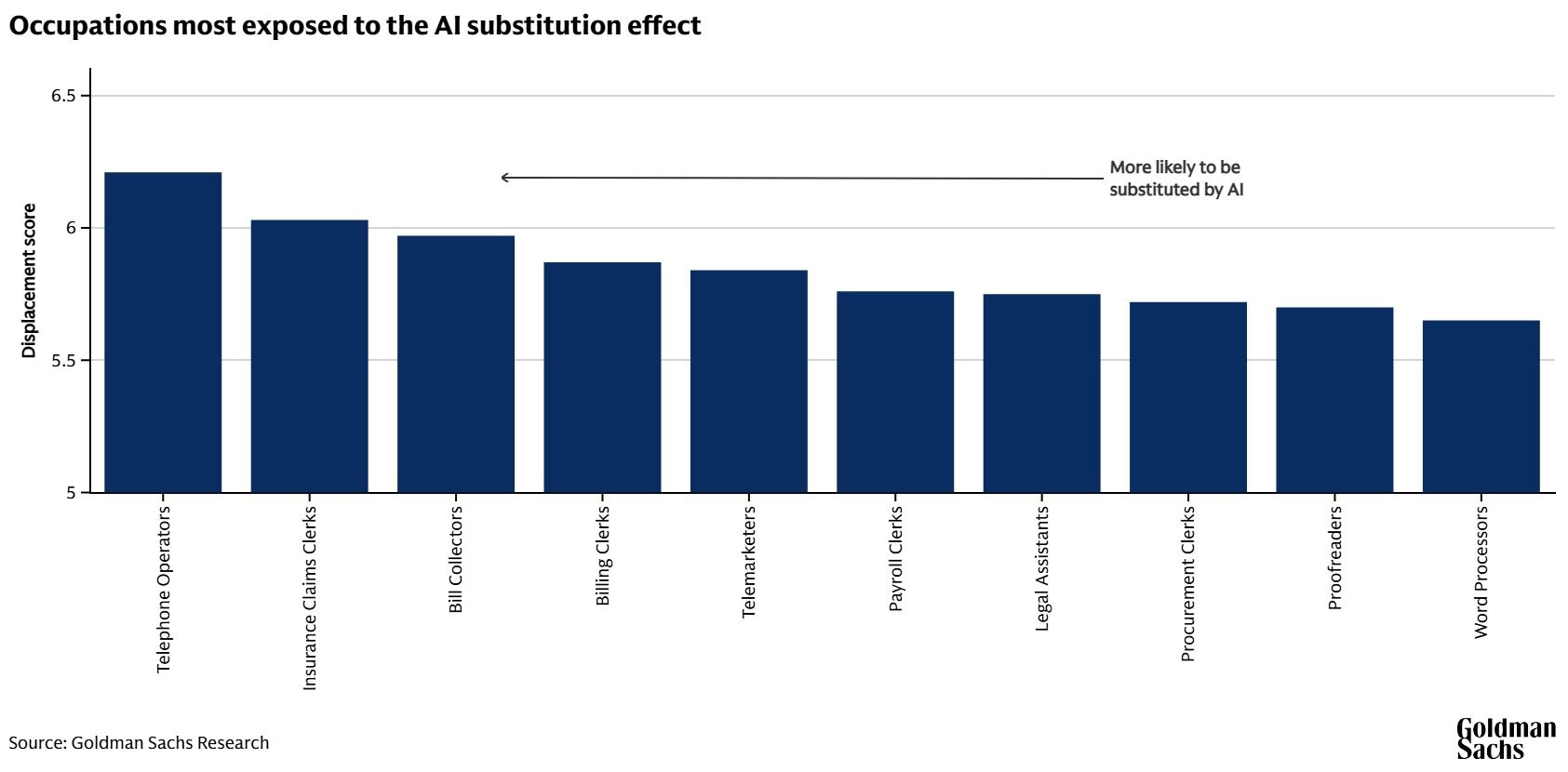
“AI augmentation that makes workers more productive can reduce the number of workers needed to produce a fixed amount of output,” Peng explains. “But by lowering the cost per unit of output, it might also increase demand for what they produce enough to generate a net increase in their employment.”
This is an example of Jevons paradox, an economic phenomenon first identified in the 1800s, when increased efficiency in the use of coal actually raised total coal consumption. The boost in efficiency lowered the effective price, prompting more industries to choose coal as their fuel source.
Until recently, it has been difficult to distinguish between occupational roles where AI will substitute for workers and where it will augment them. Indexes that economists have been using to see where AI capabilities and human abilities overlap have been agnostic on the question of substitution versus augmentation. Several recent studies, though, have begun to tease out the difference, Peng writes.
How AI complements humans in certain roles
Occupations with similar AI exposure can differ in their degree of AI complementarity—that is, the degree to which AI can complement a human rather than substitute them. Customer service representatives and interior designers both face AI exposure, for example. But the work of interior designers requires more unstructured tasks and more frequent physical presence at worksites—things that cannot be fully automated. In other words, the AI complements the human in interior design, giving the profession a higher augmentation score.
Which jobs are most at risk of being replaced by AI?
When jobs are sorted in this way, it shows that professionals such as telephone operators, insurance claims clerks, and bill collectors face the highest substitution risk. By contrast, roles such as education workers, judges, and construction managers offer the highest AI augmentation potential.
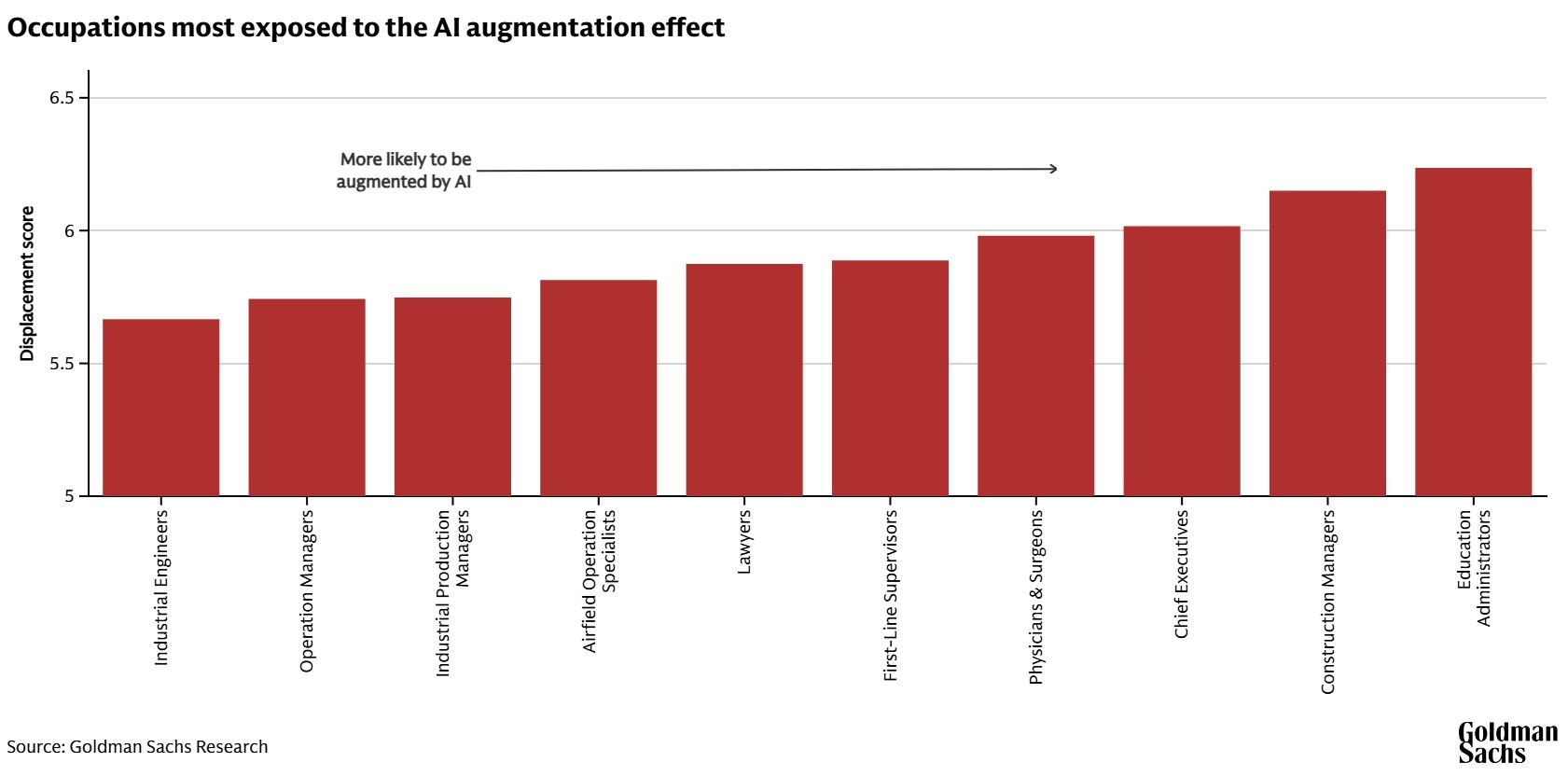
Recent research that has examined the differences between these two categories more closely has found that occupations and firms exposed to AI substitution have seen declines in operating costs and job postings. Occupations and companies with more AI augmentation potential have seen increased productivity and more job postings, Peng writes.
This article is being provided for educational purposes only. The information contained in this article does not constitute a recommendation from any Goldman Sachs entity to the recipient, and Goldman Sachs is not providing any financial, economic, legal, investment, accounting, or tax advice through this article or to its recipient. Neither Goldman Sachs nor any of its affiliates makes any representation or warranty, express or implied, as to the accuracy or completeness of the statements or any information contained in this article and any liability therefore (including in respect of direct, indirect, or consequential loss or damage) is expressly disclaimed.
Subscribe to Briefings
Our weekly newsletter delivers the latest insights on economic forces shaping markets—from Goldman Sachs leaders, economists, and investors around the world.
You can unsubscribe at any time. For information about how your personal data will be used, visit Privacy Information and Resources.