

Markets
Three New Stock Themes Are in Focus as the AI Trade Gyrates

A jump in volatility in stocks related to artificial intelligence (AI) infrastructure has triggered renewed interest in investment themes outside of the emerging technology. Goldman Sachs Research highlights three investment ideas that are unrelated to AI and have minimal correlation to those stocks: consumer-experience companies, “compounders,” and candidates for mergers and acquisitions.
Semiconductor and other AI stocks have gyrated recently. During the past three months, Goldman Sachs Research’s momentum factor (a strategy meant to capture the tendency for recent asset performance to continue), which largely reflects the AI trade, had the highest realized annualized volatility in its 45-year history outside of recessions.
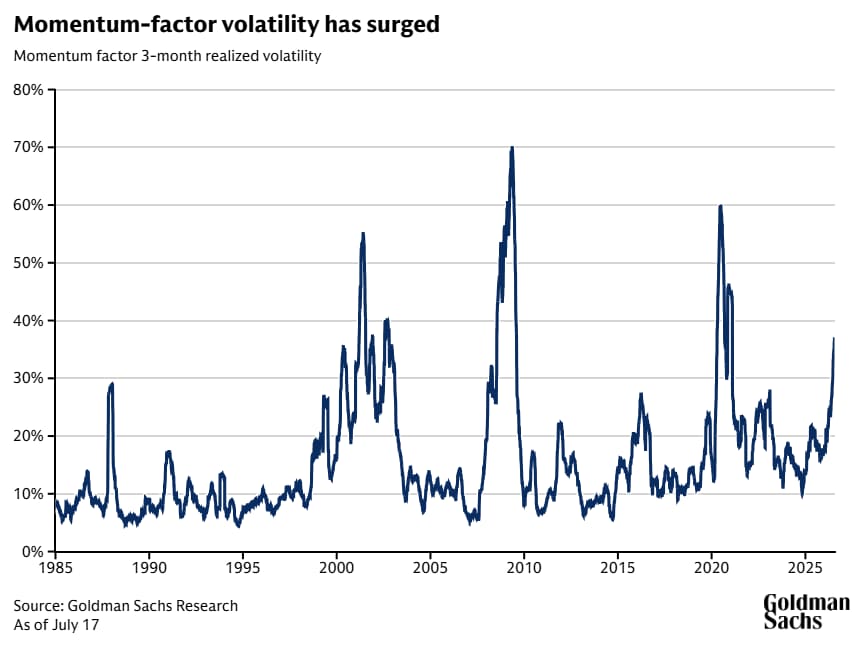
While the fundamentals may be solid, there could be more near-term challenges for the momentum trade for AI infrastructure stocks, Chief US Equity Strategist Ben Snider writes in a report. Extreme volatility encourages further reductions in portfolio positions, creating a vicious cycle.
A fundamental catalyst would be the strongest reason for the trade to regain its footing. However, our strategists expect relatively modest revisions to estimates for hyperscalers’ capital expenditures on AI infrastructure, noting that it is probably too early for companies to give guidance on their 2027 spending plans. That said, strong revenue results for hyperscalers that signal an “attractive” return on AI investment could suggest that capex spending will be higher for longer, Snider notes.
“While many fund managers have maintained a bullish fundamental view on the AI infrastructure complex, recent volatility has made it challenging to maintain that view in portfolios,” Snider writes. “Our conversations with investors have also focused on the challenge of finding investment opportunities not tied to AI, with many sectors trading with a strong positive or negative correlation to AI and momentum in recent months.”
What are some investment strategies unrelated to AI stocks?
Goldman Sachs Research identifies three investment ideas that are unrelated to AI and have minimal correlation to those stocks:
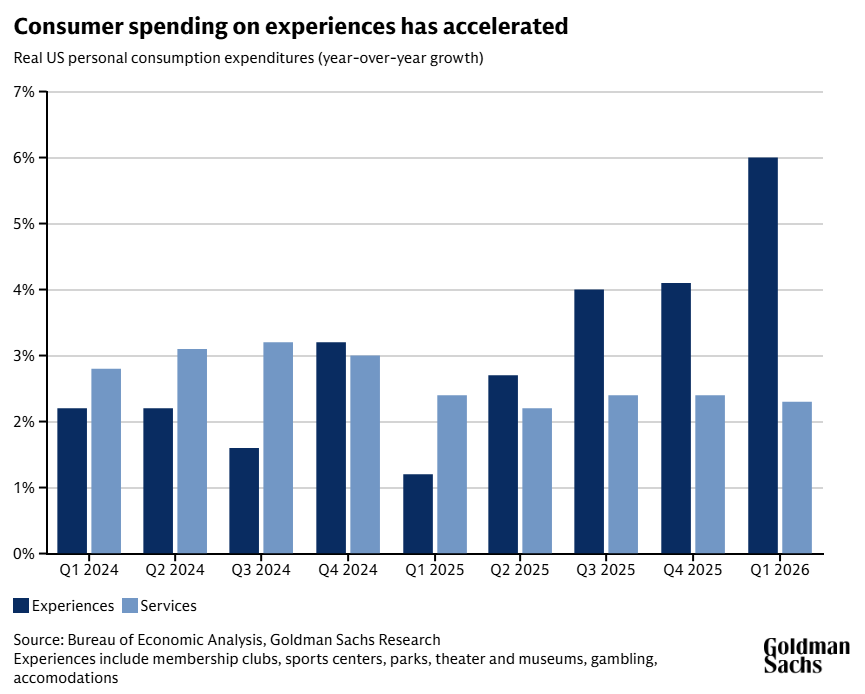
Consumer-experience stocks offer exposure to strong, sustained secular growth in consumer spending on experiences. These equities trade at undemanding valuations and have limited risk from AI disruption. “A key risk to the trade is a weakening in the health of the consumer, including via higher oil prices or a weakening labor market,” Snider notes.
Stocks that Goldman Sachs Research describes as “compounders” have strong earnings growth, returns on capital, balance sheets, and free cash flow conversion but have recently lagged behind. They now trade at a historically large valuation discount. The median compounder stock has grown earnings per share more than twice as fast as the median S&P 500 stock during the past three years, and the consensus of analyst estimates is for the group to maintain its superiority in earnings growth in coming years.
M&A candidates, identified by equity analysts in Goldman Sachs Research, are stocks that do not appear to have priced in the ongoing surge in M&A activity. The volume of announced US M&A has risen 32% to $1.2 trillion in 2026 (year over year, as of July 17). A group of potential M&A candidates identified by Goldman Sachs Research equity analysts has outperformed sharply in recent weeks. “We expect deal activity will remain strong in coming months,” Snider adds.
This article is being provided for educational purposes only. The information contained in this article does not constitute a recommendation from any Goldman Sachs entity to the recipient, and Goldman Sachs is not providing any financial, economic, legal, investment, accounting, or tax advice through this article or to its recipient. Neither Goldman Sachs nor any of its affiliates makes any representation or warranty, express or implied, as to the accuracy or completeness of the statements or any information contained in this article and any liability therefore (including in respect of direct, indirect, or consequential loss or damage) is expressly disclaimed.
Subscribe to Briefings
Our weekly newsletter delivers the latest insights on economic forces shaping markets—from Goldman Sachs leaders, economists, and investors around the world.
You can unsubscribe at any time. For information about how your personal data will be used, visit Privacy Information and Resources.