

Markets
Will Space Stocks Outperform the S&P 500?

- A custom Goldman Sachs basket of US space and satellites stocks has risen about 13% this year, compared with a gain of 9.8% for the S&P 500 (as of July 14).
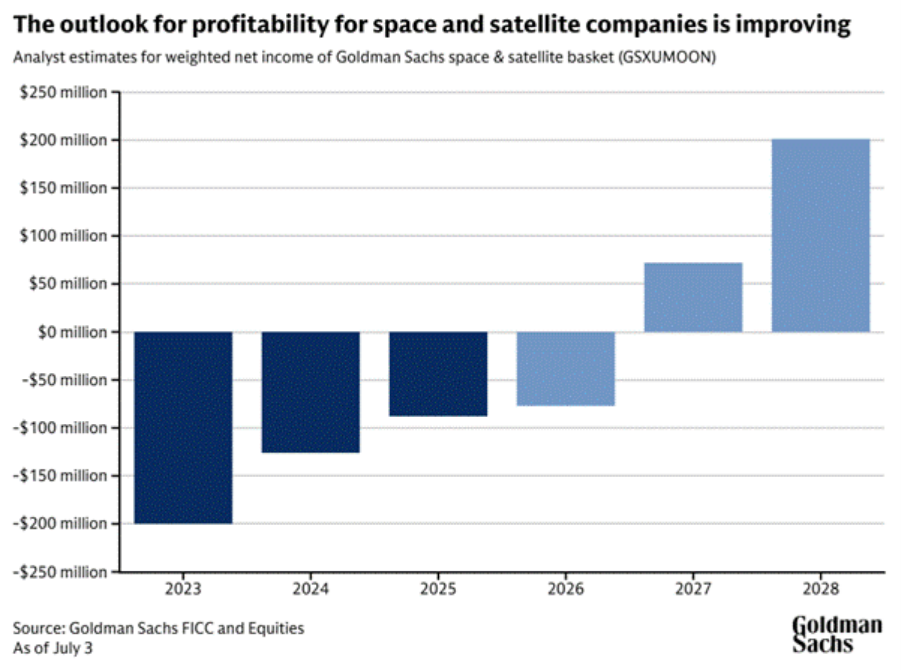
- Companies in this basket are projected to become more profitable, according to analyst estimates.
- There could be opportunities beyond space launch providers in the “picks and shovels” companies across the industry ecosystem and supply chain.
Companies involved in everything from satellites to orbiting broadband carriers and space exploration have rallied this year, although gains have cooled in recent weeks, according to Goldman Sachs FICC and Equities. The stocks surged amid enthusiasm for SpaceX’s IPO last month.
“Prior to 2025, this theme was considered more speculative and traded more in line with nascent disruptive-tech-related stocks,” says Louis Miller, global head of the Equity Custom Basket business in FICC and Equities. “In the last year, this group outperformed as a result of growing focus across verticals of the space industry such as rocket launches, satellites, global communications, and the potential for future markets that are then enabled by them.”
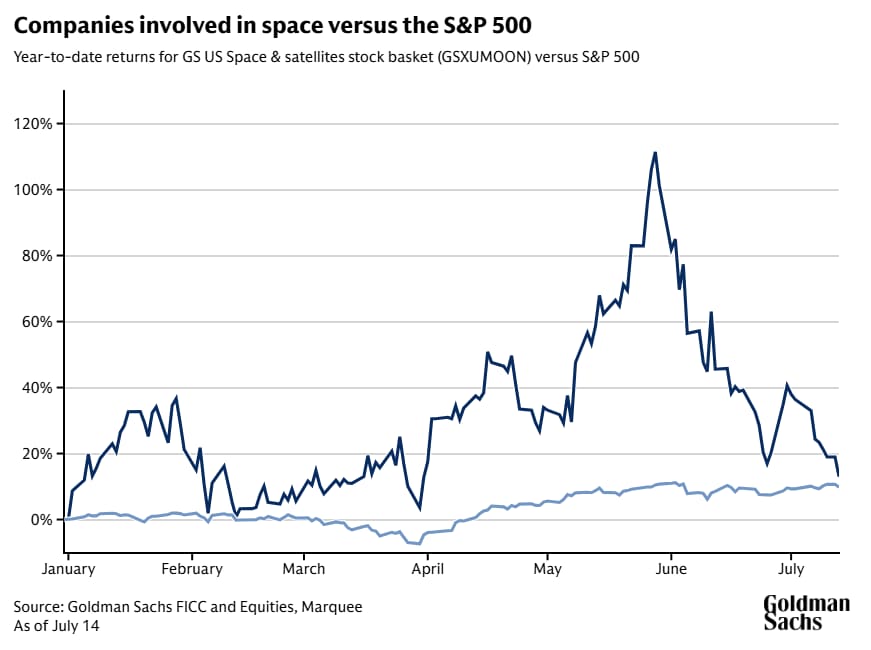
A custom Goldman Sachs basket of US space and satellites stocks has risen about 13% this year, compared with a gain of about 9.8% for the S&P 500 (as of July 14). The rally in the basket of space stocks, which has gained more than 360% over the past two years, has cooled from its high in late May. SpaceX was added to the basket on July 14.
The stock basket is very volatile—it’s roughly twice as volatile as a similar basket for AI companies and about five times as volatile as the S&P 500, according to Goldman Sachs FICC and Equities.
While the space and satellite basket is mainly made of fast growing, nascent disruptive tech related stocks, some of them could become profitable next year, Miller says. The cost of rocket launches and satellites has fallen, and the opportunity for global communications services is evolving.
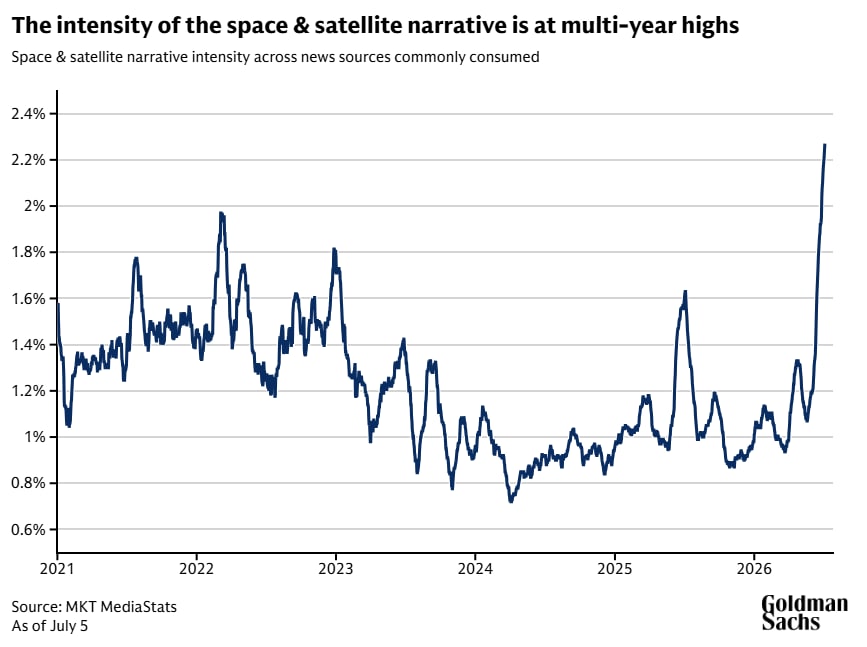
Attention to the space and satellite narrative is at multi-year highs across a vast panel of media sources, as measured by MKT MediaStats, a firm that specializes in quantifying financial economic narratives. “Essentially, news coverage intensity has more than doubled since the beginning of the year,” Miller says.
What is the outlook for the space sector in the equity market?
The space sector has opportunities for revenue growth linked to global communications and space-enabled solutions, Miller says.
Some of the companies in the basket already have increasing sales linked to defense contracts with the US government, he points out. “This is well appreciated by equity investors and is tied to the ‘new defense’ theme,” Miller says. “This theme includes satellite imagery/connectivity as a main category, in addition to new technologies like drones and sensors.”
Investors interested in this theme are also focused on companies, like SpaceX’s Starlink, that are involved in orbital broadband services, Miller says. And while SpaceX is distinct from most other companies for its ambition to develop orbiting data centers, investors are attuned to the potential for revenue growth from these services, Miller says.
What kinds of investors are buying space stocks?
“The demand we have observed has come from all types of investors across retail, private wealth management, as well as from institutional investors, all of which are looking for differentiated secular growth themes rather than traditional sector allocations,” Miller says.
“Most conversations have shown long-term investment horizons for this theme,” he adds. “There are a lot of future-oriented themes that have caught investors’ attention. We’ve seen thematic investing really increase this year.”
There could be opportunities in the ‘picks and shovels’ for the space industry
Miller points out that there could be opportunities across the ecosystem and supply chain for space companies. “Investors focused solely on launch providers may be missing a significant portion of the opportunity set,” he says. Those companies include operators in communications infrastructure, semiconductors, electronics, software, advanced materials, and manufacturing companies that are part of the broader value chain.
This shift in opportunities in the global space sector could somewhat resemble the evolution of the AI trade. “The strongest long-term opportunity could come from identifying the picks-and-shovels providers that enable commercialization,” Miller says. “Just as AI investors increasingly migrated from model developers toward semiconductors, power, and data-center infrastructure, space investors may increasingly focus on suppliers and infrastructure providers.”
Even so, Miller expects ongoing volatility among space stocks.
“The long-term opportunity appears compelling, but investor enthusiasm will likely move ahead of fundamentals at times, making the path uneven even if the structural direction remains positive,” he says.
This article is being provided for educational purposes only. The information contained in this article does not constitute a recommendation from any Goldman Sachs entity to the recipient, and Goldman Sachs is not providing any financial, economic, legal, investment, accounting, or tax advice through this article or to its recipient. Neither Goldman Sachs nor any of its affiliates makes any representation or warranty, express or implied, as to the accuracy or completeness of the statements or any information contained in this article and any liability therefore (including in respect of direct, indirect, or consequential loss or damage) is expressly disclaimed.
Subscribe to Briefings
Our weekly newsletter delivers the latest insights on economic forces shaping markets—from Goldman Sachs leaders, economists, and investors around the world.
You can unsubscribe at any time. For information about how your personal data will be used, visit Privacy Information and Resources.