

Exchanges
Citadel's Ken Griffin on AI, US-China Tensions, and US Data Centers
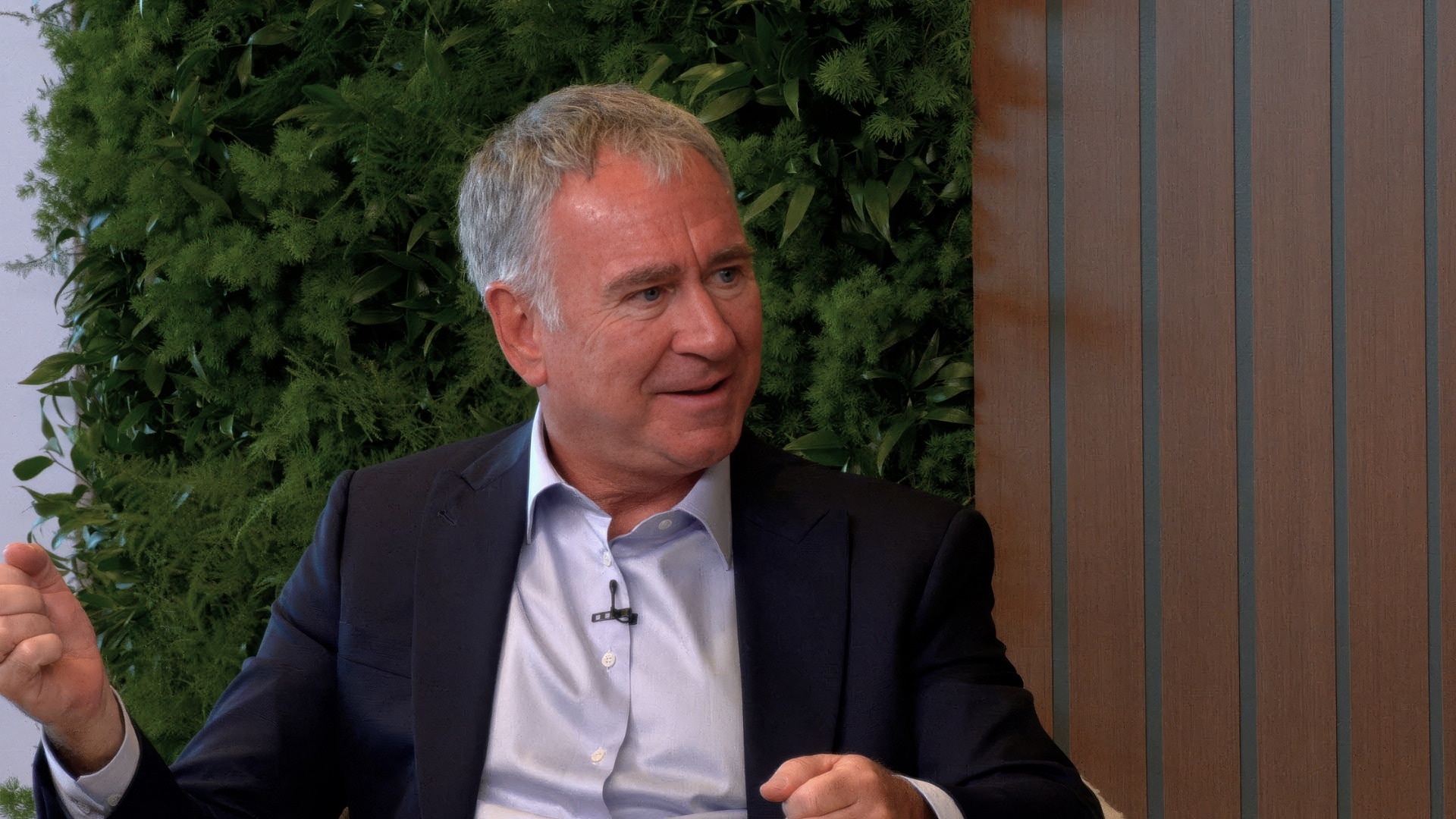
Ken Griffin, the founder and CEO of Citadel, expects agentic artificial intelligence (AI) to enable a “golden age” of entrepreneurship and eliminate some corporate moats, even as the cost of using AI creates a deep moat around other companies. And while some jobs may be replaced by technology, Griffin says he has found that productivity increases from AI have, instead of reducing headcount, allowed his company to pursue new opportunities.
Griffin shares his views on geopolitical tensions between the US and China, the need for domestic data center construction in the US, and a range of other factors rippling through global markets in this episode of Goldman Sachs Exchanges: Great Investors, recorded at Goldman Sachs's Apex Symposium.
Transcript:
Ken Griffin: You'll never manage a portfolio for every possible tail event. But you should stay very focused on, like, what is the worst-case scenario? Can I tolerate that loss? And monitor and maintain your exposures such that that loss is a tolerable loss. It may be an extreme loss. But it's still tolerable.
Raj Mahajan: Welcome to another episode of Goldman Sachs Exchanges - Great Investors. I'm Raj Mahajan. I recently got the chance to catch up with Ken Griffin, the founder and CEO of Citadel at Goldman Sachs' Apex Symposium. Ken and I discussed the implications of AI, his approach to hedging portfolios, and the competitive landscape for the hedge fund industry. We hope you enjoy this conversation.
Welcome back to Goldman Sachs, Ken.
Ken Griffin: It is great to be here today.
Raj Mahajan: This is our third public conversation in the past seven years. I know you well enough to know you think way beyond the numbers. And you're a student of leadership. So, the first question I want to ask you is beyond the numbers, for the past seven years, what are you most proud of as a leader in running Citadel?
Ken Griffin: So, two things jump out with that question. The first is we were extremely early to bring everybody back to work. And in some sense, it was almost counter cultural to demand your team to come back to an office five days a week. And yet, I think that was an incredibly important part, not only to the success that you spoke of, but more importantly, of continuing to develop our human capital.
I think as a country, the amount of human talent that has been underdeveloped because of working remotely has had a significant damaging impact on our economy. And recently, the Fed published a paper where they looked at factors that have caused reduced employment amongst those under the age of 30. And people would say, "Well, how much of this is the AI story?" Well, it turns out that remote working is a more important factor to diminished employment opportunities for young Americans than AI.
And so, I'd say one of the things that I'm really proud of has been not only did we bring our team back to work, we publicly extolled what we thought were the strengths and virtues of doing so. And I think that history will be on our side. Humans are social creatures. We learn through apprenticeship. Mentors are really critical to our personal development and growth. And bringing people back into our four walls aggressively early, both drove results for our limited partners, but more important helped maintain the strength of our human talent at Citadel. That's one.
The second is that during the start of the pandemic, actually literally as the first cases were happening in America, I was called by one of our former partners who is the COO of a major New York hospital system, Dan Widawsky. And Dan called and said, "We cannot get FDA approvals for drug trials in intensive care with those who are on ventilators who are facing imminent demise from Covid." I'm like, "Okay, Dan, why are you calling me?" And he says, "Because there's no one else who I think could actually make this happen but you."
Raj Mahajan: Warp speed.
Ken Griffin: Actually, warp speed was the second part of this chapter. We moved in about 72 hours to get the FDA to approve experimental drug trials for those with Covid here in the United States.
Raj Mahajan: Amazing.
Ken Griffin: And I'm really proud of my team that has worked hand in hand with government for decades to be able to rally resources around this existential moment in American history to help bring the full power of America's medical prowess to bear against a dreaded disease.
Another dimension of this was the idea of Operation Warp Speed which I discussed at length with Jared Kushner and that program saved ballpark half a million American lives. And understanding incentives, understanding how to minimize distances and supply chains. So, with Operation Warp Speed, the key insight was pay big pharma to produce vaccines before they have the FDA results. Okay? You get a positive result from the FDA, the vaccine works, your time to market's going to be measured in days. Not first do your studies. Wait for the FDA results. Then move to manufacturing. And lose three to six months--
Raj Mahajan: And that was an incentives problem?
Ken Griffin: That's an incentives problem, right? Because how do you get big pharma to spend potentially billions of dollars on producing vaccines who ultimately may not work and therefore will be literally flushed down a sewer system? So, this was all about the US government taking the risk to fund the manufacturing of vaccines, the efficacy of which was not known.
We spent a few billion dollars as a country. We saved a few trillion dollars in GDP. We saved roughly half a million American lives.
Raj Mahajan: It's extraordinary.
Ken Griffin: So, that's an extraordinary story that I think Citadel was a part of that I'm most proud of.
Raj Mahajan: It's amazing. The track record also was accomplished at the same time as multiple wars. You had this global pandemic. And so, let's move it to the current moment where we are. We have a conflict in the Middle East. We have potential energy and inflationary implications from that. At the same time, the S&P is at the highs. The IPO window has opened up and there's a robust pipeline, as we talked about.
As a capital allocator, how do you think about this moment in time? What's the market getting right? What's it mispricing?
Ken Griffin: So, big picture, not only is there a war in the Middle East, there's still a raging war in Europe. And the peace that you and I grew up with for most of our adult lives is clearly not on the table right now. And for anybody following the situation in Cuba, there is obviously the potential threat of what would be a reasonably small skirmish in Cuba, but yet another war. And at some point, do you encourage other countries around the world to increase their use of military power?
Raj Mahajan: We're going to get to that. Okay? We'll get to that.
Ken Griffin: So, why have we seen all time highs in the S&P while there's a war in the Middle East? Number one is the United States is somewhat shielded from the energy crisis that this war is creating. Right? The straits, key transit point for energy. We all know these details. There are a couple of things that have been, I would say, upside surprises for the world economy. Number one is for a litany of reasons, China has been able to dramatically reduce their demand for oil. Much more elasticity of demand out of China than anybody had anticipated.
Raj Mahajan: You run one of the biggest commodity traders. Did you guys see that coming?
Ken Griffin: Not the degree of the elasticity of demand destruction. So, yes, of course China will find ways to curtail their need for crude. But the magnitude of that curtailment has been stunning.
Number two is this strategically a decision by Iran or is this just happenstance? But there has been a constant, not constant, an episodic flow of oil from the region. Right? You'll get these LNG craters that will get out with LNG. You'll see the oil cargos leave. We've managed to keep oil at roughly low hundred-dollar price versus I would say most estimates would have put us at this point in this war, if the straits are closed, we'd be looking at almost $200 a barrel.
Raj Mahajan: Let's talk about in the S&P, the gains are being achieved by a narrow field of companies. And AI is a big bet, effectively, for equity markets. You've had quite a journey in your thinking around AI. The quote I think recently was on a Friday you were shocked and depressed coming home thinking about the implications of what AI will have on society. Maybe just share more about that journey and kind of where's your head today?
Ken Griffin: So, we're going to cover a war. We're going to cover shocked and depressed from AI. Is there a happy ending to this conversation today?
Raj Mahajan: I mean, I'm saving China for later.
Ken Griffin: Okay, great. So, we've been a huge user of machine learning since TensorFlow came to market about a decade ago. And machine learning has been revolutionary for the US economy in just a plethora of ways from reading radiological reports to self driving cars to use ChatGPT to rewrite the email that you drafted for the last two minutes. And it does a much better job than we seem to be able to do.
So, the big picture is the United States has been undergoing a digital revolution yet again over the last decade which has accelerated on the back of the AI revolution. And I'll share just a quick story with you. I was with a number of leaders of global multinationals about two years ago and we were having dinner. And everybody was just effusive as to how AI was transforming their business. And I couldn't help myself. I'm like, "Let's go around this table and share stories as to how AI is transforming your business."
And I got four or five incredible stories of how companies were achieving meaningful productivity gains. Not one involved AI.
Raj Mahajan: Really?
Ken Griffin: Not one. They involved machine learning. They involved optimization. They involved digitization. They involved technology. But within the C suite, I think the nuance between AI and technology writ large gets a little bit lost often. But your chief technology officers are certainly using bigger budgets, greater C suite enthusiasm to really push through meaningful projects that have a real impact on the bottom line.
And you talk about the S&P at all time highs. Corporate earnings in America are at all time highs. I mean--
Raj Mahajan: The multiple has actually come down because of that.
Ken Griffin: It's unbelievable the growth earnings over the course of just the last 12 months, right? So, there is a technological revolution happening of which AI is a component of the story. But it's just a piece. I think that's important point number one.
On the going home depressed on a Friday, I'll actually give you the use case. One of our team members built an agentic system to recreate academic papers in finance. So, academia publishes a plethora of papers in finance. We read these papers thinking about the hypothesis, the quality of the work done, do we think what they have observed will have persistence out of sample? Do stock buybacks cause stocks to outperform? Simple example.
And you know, you have a legion of young Masters and PhDs doing this work. It takes roughly six to eight weeks to reproduce a paper. It's interesting work. We find a few ideas when you're doing this. But for us, a few ideas could be worth quite a bit of money.
My colleague built an agentic AI system that would read a paper, reproduce it, verify the results that were published in the paper, produce the results out of sample, and do all of this work in about, on average, two to three hours per paper.
Raj Mahajan: Oh my God.
Ken Griffin: Right? So, here, and here's the key point, this is not just a white-collar job, this is a Master's or PhD level job. Six weeks of work turned into--
Raj Mahajan: OpenAI just solved a math problem that no one had solved for 80 years.
Ken Griffin: Yes. So, what you're seeing is you're seeing AI able to take on some really difficult tasks and crack problems that I think most of us would have viewed beyond the reach of AI just two or three years ago. Okay?
So, you think about what are the human capital implications of this for your business and for society as a whole? And there are a lot of implications. Now, of note, there's no reduction to headcount at Citadel on the back of this breakthrough, right? I have incredibly talented people. We have just a huge swath of problems that we're trying to attack and go after. I will take every single productivity gain I can get because with the talented people we have, we just have more to go after.
Raj Mahajan: That's really important for the room to absorb around this jobs point. This is going to make Citadel that much more productive. Scary thought, by the way, for the hedge fund industry.
Ken Griffin: Well, but flip it around. There's a second part of this which is that competitive moats are being filled in at lightning speed. Okay? So, you go home and have two thoughts in your mind at the same time. Wow. Think about the impact of this on very high-level work in the job market. And in some areas, it's more difficult to transition the employees. For example, if you do translation. You translate from English to German. That's a real problem. Like, you're going to need real skills retraining. And we as a country need to think about how to use higher education to help these people retrain quickly.
But number two, the competitive moats of our society, within our corporate society, are all being filled and at breathtaking rates. Now, what does this mean?
This means that we're likely to see a golden age of entrepreneurial activity. Like entrepreneurs will be able to launch new businesses at breathtaking speeds. And will be able to take on incumbents in ways that you just couldn't do five, 10, 15, 20 years ago. And without getting into the details of the business, a friend of a friend has a startup. Would generally have 30 or 40 people. Couldn't afford that many people. How's he run the business with just a few? Agentic AI systems.
We're going to see a lot of these stories come to light over the next couple of years as entrepreneurs embrace this technology to really take on some very interesting opportunities to create value by meeting the needs of customers.
Raj Mahajan: That makes a ton of sense. So, stay with Citadel for a second. I think in one of our previous sessions you called stock picking a timeless business. How do you see just the long/short equity business where a number of people allocate capital to changing? What's a PM who does that for Citadel in the future going to look like? Is it the same set of skills? Are they going to evolve? Are they going to adapt?
Ken Griffin: Look, I think it's a really similar set of skills. I think there'll be more focus and emphasis on those who have really good vision about what companies are actually creating transformative products that will change society. I think there will be much more-- the market will reward that far more intensely in the future than will a company beat this quarter's earnings or not? I think the question of will a company beat this quarter's earnings has gotten far more difficult over the last 10 years because, for example, the rise of alternative data. You know?
I have access to the credit cards of millions of Americans. What are they spending money on? What's that mean for Starbucks' revenues this quarter? What's it mean for McDonalds this quarter? This is a decade old transformation.
But the here and now is just becoming far more transparent, far more readily understood and triaged by the combination of really bright people and really good AI technology.
Where this will leave us is those who are able to see what is unfolding over years to come will be in a very valued position on a relative basis.
Raj Mahajan: That's compelling. At Citadel Securities, this other business we haven't spent much time talking about, you have double digit market share in a number of different products. In equities, in futures, treasuries. You keep reading about compute being this critical input into the production of market-making liquidity. You're reading about billion-dollar transactions. Just tell us about how do you think about source and compute within the market maker? How important is that for the future? And if you want to take it into distinctions between inference costs versus training costs. How do you sort of see that play out as running one of the most successful, frankly, technology companies in the industry?
Ken Griffin: Look, I mentioned earlier that machine learning has been a critical part of the story of Citadel for a decade. And that's equally true at Citadel Securities. So, we've been using TensorFlow and the subsequent generations of ML models for 10 years. The rise of transformer models and other models of that ilk over the last several years has continued to progress our ability to both price and manage risk. And that's true not just for us, but for a number of other leading market making firms in the world.
We compete for compute access with everybody. I mean, today I don't know if your iPhone does this, but your text messages get summarized. I don't know if Goldman has your emails summarized. We do summarize Goldman Sachs' research, I'm sorry to say. I couldn't help myself. It was kind of funny. It is amongst the best research to begin.
Raj Mahajan: There's a lot of alpha there.
Ken Griffin: It's great. I mean, let's make sure. But you know, there's just a tremendous amount of AI tooling being used in society every day. Which has consumed, and this is sort of breathtaking, for all intents and purposes, all the available compute today is more or less utilized all the time. So, the question is who's willing to pay the most for it? It's just that simple.
And the price of compute has certainly gone up per unit of compute beyond where people would have reasonably projected it two or three years ago.
And so, your large market making firms that make extensive use of these types of tools are spending today hundreds of millions of dollars on compute. And that is simply the going market price for this capability. Just like the price of jet fuel is higher today, price of eggs a few months ago was a lot higher than we like to see, like, there's inflation in compute costs. It's just a reality.
And people who have lower margin businesses won't be able to bear that cost impact. And those who have higher margin businesses will. It's the nature of where we are today given the just enormous demand for compute across a litany of different use cases.
Raj Mahajan: So, all compute manufacturing leads back to this China/Taiwan issue and TSMC. Can you tell us how do you think about where we are with the China relationship and chip security and investing in the region from your seat?
Ken Griffin: That is a lot of questions packed into one.
Raj Mahajan: Multiple choice. You can start anywhere.
Ken Griffin: Okay, let's start first of all with just the bottom-line reality. China is one of the most innovative and fast-growing economies in the world. Period. In fact, it's a bit, as an American I get frustrated by this, out of roughly the 75 most important technologies in the world today, leading with their solar, EV batteries, variety of different quantum areas, the Chinese lead in about 67 to 68 out of 74 technologies.
Raj Mahajan: I saw a stat about academic published papers. And they've pulled ahead of the field as well.
Ken Griffin: I'm not surprised. I mean, fundamentally, 1.4 billion people. Large population. Extraordinarily strong emphasis on education in their society. Extraordinary. And then a substantially higher number of graduates with STEM degrees. They are creating the human talent that you need to win in a higher value added, higher intellectual property world.
Raj Mahajan: For sure.
Ken Griffin: And the United States needs to wake up to this reality. Like, we need to move our feet and stay focused on the Chinese as a threat in the regime, in the area of the global economy where we have reigned for the last 50 years. The United States has owned the creativity and innovation area of new product development. And the Chinese, historically, have been relegated to producing low margin, low value-added products designed in America. That is changing. And that is a threat to our very way of life.
So, that is a cold, economic reality. And the most important thing we could do as a country is not tariffs. It's we need to educate our youth to be able to stand their ground and out compete, out innovate, and out problem solve their contemporaries across the ocean. So, that's one.
Number two is Taiwan's a particularly painful point of potential geopolitical tension.
Raj Mahajan: How did we end up here?
Ken Griffin: Right? And it's a situation where there is no winner. This is a really bad equilibrium because if China takes Taiwan-- you know, the rough estimate is if US loses access to Taiwanese semiconductor chips, our GDP falls by 8% in six months. Simply put, we go into a great depression in the blink of an eye. Unlike any we've seen before.
Raj Mahajan: That's staggering.
Ken Griffin: Staggering. And you go, well, how could that be? Boeing stops making planes in six months. Most new cars stop being manufactured in six months. Consumer electronics stop being made in six months. Everything freezes. TSMC chips are in every high-end product made. They're everywhere.
And for China, obviously putting the United States economy in such a tailspin would also have draconian knock down effects to their economy given how big the United States is as an export market for the world. Right? So, there are no winners in a world in which there is military escalation in Taiwan.
Raj Mahajan: How do you navigate this prisoner's dilemma as an investor?
Ken Griffin: So, as an investor you need to think about, and I think it varies depending on where in the world you're situated, right? The nature of the economic consequences will be a function of where you sit. And we see that for example even in the war with the Middle East. Right? The Iranians are very loathe to-- like, they really want to get oil to China. But that's their access. That's their ally.
So, what you would see in a situation where if a blockade was created around Taiwan, for example, you would see that the nature of sanctions and actions by countries around the world would not be unified in opposition to China anymore, in my opinion. And so, is the country that's your home going to be part of the American sphere influence? Where Europe is in this is actually, I think, a bit of a question mark. We'd like to believe that they would be part of team USA. But that's less clear today than it was two years ago.
Raj Mahajan: That's less clear.
Ken Griffin: And then if for example the Middle East is clearly going to look to play the role of Switzerland. Right? China's a huge consumer of their primary export product - oil. They're going to look to be able to play the role of Switzerland.
So, I think where you sit in the world has very important implications about how you think about your China exposure vis-à-vis this one important issue.
Raj Mahajan: That's really insightful.
We also took questions from the audience. One conference attendee asked about the outlook for energy production amid the rise of AI.
Ken Griffin: So, the United States, from my perspective, has to absolutely embrace how do we become once again a world leader in nuclear? And small module reactors being a big part of that story. But we need to reembrace nuclear. No carbon footprint to speak of. And nuclear actually has one of the lowest mortality rates of any source of energy we've ever used. Hydro has killed magnitudes more people than nuclear has. So, that's one.
Number two is solar and wind create sort of the sense of superficial, like, hey, we're environmentally friendly. But solar cells are often made in western China. They burn coal to produce the solar cells. It's about a seven-year recovery. You need to capture energy for seven years with solar cells to break even vis-à-vis the coal used to produce them.
And with wind, we still don't know what we're going to do with the turbine blades. They last about 20 years. They're carbon fiber. They don't break down. Like, they're no longer structurally strong enough to use in the turbine. But on the flip side, they don't readily break down. So, they're going to fill landfills around the world. They already are to this day.
We don't have a clean energy solution yet that's truly clean. And the holy grail, of course, is nuclear fusion. Until we get to nuclear fusion or broader use of nuclear, the United States does have one huge asset. We do have natural gas. And contrary to what you might think and read in the press, the United States is one of the few countries to really have brought down its carbon emissions by using natural gas. And we have decades and decades of supply of it at a very low and attractive price.
So, we better damn well build the data centers in America because they're going to get built somewhere in the world. And can you imagine how absolutely inane it would be if we end up having to be dependent on foreign countries for data centers? I mean, like, there's this whole "not in my backyard" ethos in America today. Okay? Tell your data center provider, "You want to build a data center? Build the corresponding required power generation."
Don't put the cost on the American consumer. Build the corresponding power generation. Tie the generator to the grid so that you've got reliability by tying yourself to the grid. But build the corresponding generation. And build that damn data center in America. It would kill me if we end up having to pay a bunch of foreign countries tens or hundreds of billions of dollars of money a year--
Raj Mahajan: Well, it's a hot political issue--
Ken Griffin: It's a hot political issue. And no one's just taking a step back. They're going to get built. Do you want them built here in America? Or do you want them build abroad? Answer that question.
Raj Mahajan: Maybe space.
Ken Griffin: Maybe space.
Raj Mahajan: Another conference attendee asked how Ken thinks about hedging portfolios for complicated risks.
Ken Griffin: Stress test. So, if this happens, how much money are we going to lose and where? That's what you're trying to get your head around. And is that loss tolerable? You'll never manage a portfolio for every possible tail event. But you should stay very focused on, like, what is the worst-case scenario? Can I tolerate that loss? And monitor and maintain your exposures such that that loss is a tolerable loss. It may be an extreme loss. But it's still tolerable, if that makes any sense.
Raj Mahajan: Definable. Tolerable.
Ken Griffin: Definable. Tolerable. Still in business. Still in a position to fight back from that point.
Raj Mahajan: Ken also got a question about the outlook for hedge fund returns.
Ken Griffin: We believe the industry's cost to capital is somewhere around the risk-free rate plus 4%. So, long run, we think that's the equilibrium point. If the industry underperforms, that capital will flow out. If the industry outperforms, that capital will flow in.
And in recent years, firms have, on general, outperformed their cost to capital, and there's still a flow of capital into the industry. That bigger capital under management, all else equal, dilutes the alpha. Right? So, in some sense, one of the reasons that we return $25 or 30 billion to our LPs is to try to maintain a high return on equity.
We have a certain amount of alpha we can produce every year. My job is to try to increase the amount of alpha we can produce every year. How much capital do we need to support that investment portfolio? To the extent that we're over capitalized, put that money back into your hands to allocate into other areas where you can put the money to better use.
Raj Mahajan: You've been so disciplined about that.
Ken Griffin: I try to be. I try to be. And part of this is alignment. The biggest investor in our funds is my partners and myself. So, we think that you should always look for, in the hedge fund community, like, what is the alignment that you have with the GP? Are they in the asset management business? Or are they in the performance business?
Raj Mahajan: This episode was recorded at Goldman Sachs' Apex Symposium on June 2nd, 2026. Thanks for listening. I'm Raj Mahajan.
Date of recording: June 2, 2026.
The opinions and views expressed herein are as of the date of publication, subject to change without notice, and may not necessarily reflect the institutional views of Goldman Sachs or its affiliates. The material provided is intended for informational purposes only, and does not constitute investment advice, a recommendation from any Goldman Sachs entity to take any particular action, or an offer or solicitation to purchase or sell any securities or financial products. This material may contain forward-looking statements. Past performance is not indicative of future results. Neither Goldman Sachs nor any of its affiliates make any representations or warranties, express or implied, as to the accuracy or completeness of the statements or information contained herein and disclaim any liability whatsoever for reliance on such information for any purpose. Each name of a third-party organization mentioned is the property of the company to which it relates, is used here strictly for informational and identification purposes only and is not used to imply any ownership or license rights between any such company and Goldman Sachs.
A transcript is provided for convenience and may differ from the original video or audio content. Goldman Sachs is not responsible for any errors in the transcript. This material should not be copied, distributed, published, or reproduced in whole or in part or disclosed by any recipient to any other person without the express written consent of Goldman Sachs.
Disclosures applicable to research with respect to issuers, if any, mentioned herein are available through your Goldman Sachs representative or at http://www.gs.com/research/hedge.html
Goldman Sachs does not endorse any candidate or any political party.
Views of the interviewee do not necessarily reflect the views of Goldman Sachs.
Subscribe to Briefings
Our weekly newsletter delivers the latest insights on economic forces shaping markets—from Goldman Sachs leaders, economists, and investors around the world.
You can unsubscribe at any time. For information about how your personal data will be used, visit Privacy Information and Resources.