

Exchanges
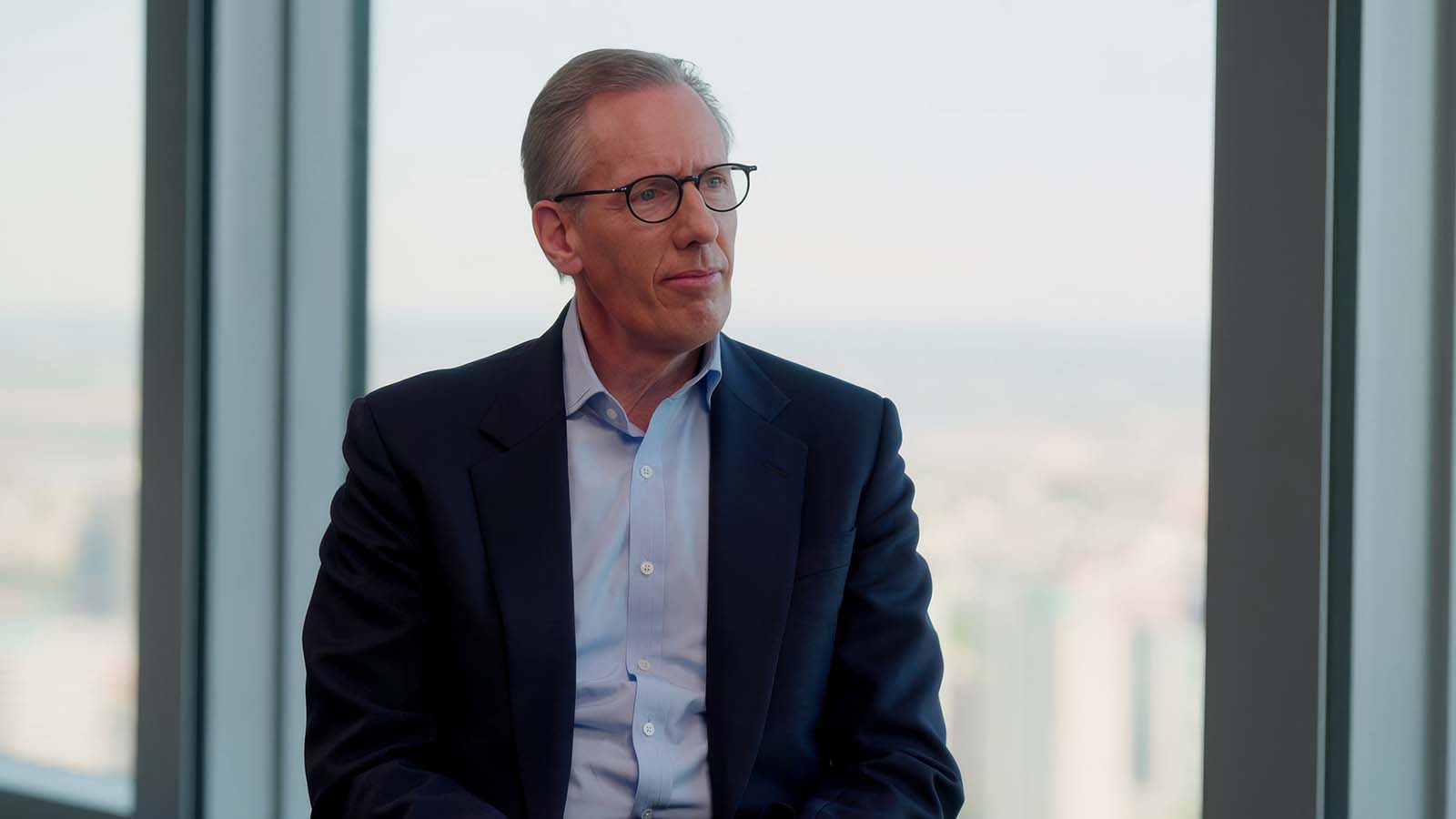
‘Complexity Is Our Friend’: James Brocklebank on Advent's Private Equity Strategy
Transcript:
James Brocklebank: This is just one more challenging time in a line of challenging times. But complexity is our friend. And we lean in, in times like this. And the best deals tend to be made in non-benign conditions, if you like.
[MUSIC INTRO]
Alison Mass: Where at the biggest opportunities for private equity investors now? I'm Alison Mass, chairman of investment banking in Goldman Sachs's Global Banking & Markets group and your host for this episode of Goldman Sachs Exchanges - Great Investors.
Today, I'm sitting down with James Brocklebank, who is the co-chair of Advent, a global private equity investor, where he also co-heads the European business.
Well, welcome to Great Investors, James. Really thrilled to have you here.
James Brocklebank: Thank you so much for having me. It's a real privilege. Thank you.
Alison Mass: So, you've been at Advent now for 30 years?
James Brocklebank: Just under 30 years, yeah.
Alison Mass: Which is spectacular.
James Brocklebank: Thank you.
Alison Mass: And thanks to a paper job listing in the FT, The Financial Times, I heard.
James Brocklebank: Yes.
Alison Mass: And I heard that you still have that listing in your office.
James Brocklebank: I do. I have it on my wall. It was given to me for my 25th anniversary at Advent. They found it. An actual piece of paper.
Alison Mass: That's fantastic.
James Brocklebank: It's framed on the wall. And it does mean a lot to me because it's a reminder of how random life can be and how non-linear one's career can be. And it was interesting because when I was at Barings, in the first year or so I did like an internship sort of stage, if you like. Like an apprenticeship in their private equity business, which was called Barings Capital Investors. It was on Park Lane in London. I really enjoyed it.
So, I had an inkling that the private equity was interesting and would appeal. And then I saw this ad and I didn't know anything at all about Advent. But I liked what it said. And it said that this was an international firm. Very sector focused. Operational value creation. And they were looking for people to help them with deal sourcing. And I thought, this looks interesting. And so, I rang them. Or I applied. And I ended up getting the job. And that is how it all started.
Alison Mass: I'm not sure I've ever met a senior leader in the private equity industry who found his or her job from a paper listing in the FT or any newspaper. So, that's absolutely fascinating.
James Brocklebank: Amazing. Yeah.
Alison Mass: So, you joined Advent in 1997 at a time when private equity was still relatively small. What did private equity look like in Europe at that time? And how different was the industry from what we see today?
James Brocklebank: Well, for starters, it was a lot smaller. Right? So, I remember in late 1997 going to a dinner, an industry dinner. And you had really the whole UK industry in the room. And it could fit in a single room. It was a ballroom in London. So, it was a very small industry.
It was at a time of transition at the industry but moving a little bit from venture capital to private equity. So, very early days. The acceptance of private equity as a form of ownership was just getting going. It was less sophisticated. There were smaller deals. For example, it's quite funny, but to think that the deal sizes that we were dealing with there at that time really was about the same as what we might pay in fees today on a transaction, right? So, that's a completely different kind of--
Alison Mass: That's an interesting concept.
James Brocklebank: Yeah. So it’s a completely different space. But it was early days. But good fun. And just in that transition period.
Alison Mass: So, now Advent manages about $100 billion and has equal presence both in the US and in Europe, which is really unique among your peers. So, how is the firm structured to serve both regions effectively?
James Brocklebank: Yeah. So, we started in Europe in 1989. Advent was founded by Peter Brooke in '84 here in North America. But interestingly, we were on the ground, in Europe for '89, which is a lot earlier than most other firms. So, we developed offices in London, later in Luxembourg, but in Milan, in Madrid, Paris, and Frankfurt.
And we've always had this strong focus on boots on the ground. Local presence. People who understand the nuances of what's happening in their regions. And that's always been a key part of how we've addressed the European opportunity. Because if you're a founder in Spain or you're looking at a carve out in Germany, it's partly about trust. And it's about who you deal with. And having people who've got those really long, established networks in the local countries is really important.
And Peter Brooke saw that was how Advent came together in a sense. And we've maintained that spirit ever since. And we were early movers in the European presence. Yeah.
Alison Mass: Yeah. So, Europe is a special place to do business. Can you talk a little bit about the structural differences that make European buyouts fundamentally different from the US market?
James Brocklebank: Yes. So, I think, look, when we compare the two, we see a little bit more transformational deal flow in Europe. So, Advent invested along two main archetypes: transformational buyouts and acceleration buyouts. And we see more of the transformational archetype in Europe.
There are a lot of very high-quality companies in Europe. But there is a complexity about Europe which means that often big companies are trimming their portfolios. And that throws up opportunities for us and other private equity firms to take on these kinds of carve out type deals.
So, if you think about us, recently with Thyssenkrupp Elevator coming out of Thyssenkrupp, or Zentiva, coming out of Sanofi, or we recently bought a portfolio of consumer brands from Reckitt Benckiser, which is now called Vestacy, we bought INNIO, which is the gas engines business of GE. There's a consistent flow of these transformational deals. And that's a little bit more the case in Europe than in North America where you see more of the growth and acceleration buyout archetype. So, that is one key difference, I think.
And then also on the financing side, you have such a deep capital market here in the United States. You can sort of price any deal in a way. It's just a matter of the price. In Europe, the market is more relationship driven. It's more binary. So, the credits get done or they don't get done. But it's also, perhaps, a little cheaper because it's somewhat over banked.
Alison Mass: Yeah, that's consistent with what we hear. But also, why you are as successful as you are, because you have those relationships locally.
James Brocklebank: Yeah.
Alison Mass: So, I'm sure you're getting a lot of questions about the macro environment now. So, has the current Middle East conflict changed the economics in your view of private equity deals, particularly in Europe where growth is already weaker?
James Brocklebank: Yeah. So, the direct portfolio impact of the conflict in the Middle East, I wouldn't say has been significant on our portfolio or other private equity portfolios in Europe. However, energy price volatility definitely feeds into higher prices, higher input costs. And that could feed through into consumer impacts.
And so, it's really the second and third order impacts that we are anticipating here. At the moment, the impact is manageable. But yeah, it depends. It really depends on kind of what happens next.
Alison Mass: So, as we talked about earlier, Europe often looks structurally different than the United States in terms of fragmentation and regulation. Does that complexity make investing harder? Or does it create more opportunities for private equity investors, in particular Advent?
James Brocklebank: Yes and yes. Look, Europe is a patchwork of 44 nations, of which 27 are obviously part of the EU. A very complex, fragmented landscape. Each country, you know, different political regulatory set ups. You've got all the different languages. We love that complexity. Complexity is your friend when it comes to operation value creation and trying to drive alpha.
And so, we really like that Europe has that kind of inefficiency in the way it's set up. There are a lot of really high-quality businesses, like the ones I mentioned, and quite often you have a situation where companies have to trim their perimeter. You have also a lot of very strong public companies, which operate across Europe and often internationally which become available.
And so, we think that the European landscape is highly attractive. But what it means is that you need this local kind of presence. I think it's really important. Because there is an information asymmetry for those who might take a more remote approach to investing in Europe.
And I think if you've got people on the ground, teams on the ground who really understand the local labor unions and the ways of doing business, it really is a huge advantage. And if you combine that with global sector expertise, then I think it's a very powerful combination. And that, in a sense, is what Advent is set up to do. And I think that is a huge benefit of how we can deal with that complexity in the European market.
Alison Mass: Yeah, I think I'll go off-piste and say that if you talk to our merger team in Europe and they're in boardrooms in all of these countries, that is your reputation.
So, one of the defining challenges in the private equity industry today is a slowdown in exits given the macro, whether through IPOs or strategic sales. So, how is Advent thinking about monetizing your portfolio investments in this environment?
James Brocklebank: Yeah. Well, you're absolutely right. In the good old days, investors could expect 20 percent of starting NAV back every year. Today, they're getting between 8 and 12 percent of starting NAV each year. And really for the model to work properly, it needs to be at least 15 percent. So, there has been a really significant change in the pace of realizations in our industry. And that is really the key question, I think, that LPs face at the moment.
So, for us, this is a key topic. And in a sense, the exit question is really a question of what you do in the beginning when you buy a company. And so, what we try and do is to be very clear and specific about who is going to buy the company at exit. And what you need to do to the company to make it attractive to those specific buyers. So, it's not an abstract discussion about who's going to buy it. It's a very specific discussion about who might buy it and what you need to do to the company to make it attractive to them.
And what we're trying to do is create very strategic businesses. Businesses that we believe will be attractive to consolidators. And we try and avoid situations which might have a single threaded exit. So, just pure IPO. We'd much rather have the optionality of being able to sell to multiple different parties. So, that is how we are trying to address this challenge. But it is very clearly something that the industry is wrestling with at the moment. And something that we all need to get better at.
Alison Mass: So, you mentioned that in the current environment you think harder about monetizations on the way in.
James Brocklebank: Yeah.
Alison Mass: And who's going to ultimately buy them. I'm curious, in your investment committees, has any of the analysis changed? Is there a new case that goes into investment committee memos now, given the macro environment with software and everything going on?
James Brocklebank: Yeah. There is even more focus, I think, on the exitability question. The other key topic we focus on is AI. Which I'm sure we'll come to in a second.
Alison Mass: Yeah, we're going right into that.
James Brocklebank: But I mean, that's the other key focus that we have. But no, without question, we're thinking about also the timing of exit because the other thing that investors are very focused on is obviously IRR and how quickly you can get money back.
Because some of these transformations take a long time. And that's the trade-off a little bit. And you need a lot of people and a lot of resource to undertake them. And that's something that we have 300 people on the deal team and for that reason.
Alison Mass: Right. So, of course we cannot have a conversation about investing today without talking about artificial intelligence which is transforming industries at a very rapid pace. How are you thinking about AI, both as an investment theme and as a tool to improve your portfolio companies?
James Brocklebank: Well, look, starting with AI within Advent, because I think, you know, you have to walk the walk internally. And I think we were very early on in hiring a chief data science officer and a chief digital officer before AI was a thing. And so, we've been thinking about this for some time. We were very early having our own large language model trained on Advent data. It was called--
Alison Mass: That's spectacular.
James Brocklebank: Advent GPT. But that was the first-generation tool. Now we have a sort of intelligence engine which is agnostic to the LLMs and uses all of them. The implication of AI in all businesses is going to be truly profound. And we see that. And so, we want to make sure that we have the tools internally to really be able to take advantage of it.
So, it's a data question, fundamentally, as well. You have to organize your data properly in order to be able to have the benefit of AI. It's also a cultural question because you need to break down silos in old ways of doing things and get the people on board with doing things in a different way. And in a sense, we're almost moving to a landscape where we're working for the AI rather than the AI working for us. In a sense. So, that's on the Advent side.
On the portfolio side, we have dedicated people who help our portfolio companies with AI transformation. And genuinely, it is about AI transformation. Because too often you have little AI projects bolted on. And really, what you need is the data to be organized properly. The cultural and human factors dealt with. And then AI then more transformative on top. And so, that's a big focus for us.
Alison Mass: You talked about how Advent is using AI. How has it impacted your investment committee's processes?
James Brocklebank: Well, the other thing that we've done which is fascinating, we've created something called the IC robot. And this is an AI that has been trained on all of our investment committee papers over the last 13 years. So, it's ingested everything, all the deals that we've shown the committee. And interestingly, it has the perspective on what happened to the deals that we did, but also the deals that we didn't do.
And then what it's doing now is that when we bring any new deal to the committee, it looks at it. And it can look at the assumptions that are in that particular case. And it can basically say, "Oh, I see a margin assumption here that has not been achieved before in this particular type of company before." And so, it's just a prompt. It's not a voting member or anything like that. But it's extremely powerful in terms of prompting discussion on particular topics.
Alison Mass: I'm curious, with your junior professionals as you on board junior professionals, how important is their knowledge of, use of AI in hiring them? And how do you teach people the business if they're using your large language model to do their analysis?
James Brocklebank: Yeah, great question. So, two things I'd say. First of all, a lot of the innovation comes from the junior people. They are coming with very sophisticated knowledge of this already. It is an apprenticeship business. You're quite right. And therefore, they need to understand the basics. They can't just outsource all of the model creation. You need to understand how the models work before you just outsource them because clearly now you can just have them made through skills and through agents in the AI.
But so far, we've not had a problem with that. We are definitely looking for people who are more native with AI when we hire them. So, rather than have a deal team and then a team of data scientists, we want the deal team to be already experienced in data analytics so that they're natural with it, rather than a separate group. And that, I think, is the vision that we've held for some time. And that's been a factor in our recruitment over the last few years.
Alison Mass: So, let's talk about Advent's own evolution. Private equity firms are under increasing pressure to branch out beyond LBOs to better compete with so-called "one-stop shops." But Advent remains focused on pure private equity. So, tell us about the strategy. And where do you look for unique opportunities?
James Brocklebank: Yeah. So, we have made the definitive choice to stay absolutely focused on private equity. And that way, all of our time, attention, and effort can go into what makes the bicycle go faster. And we love that purity and clarity of purpose. And we also think it's actually becoming increasingly attractive to the LP community because so many firms have grown so much and have diversified so much, that private equity is actually quite a small part of what they do. And there's nothing wrong with that business model, it's just a different thing. They are solving for something else.
And so, we want to be the best place for people who love deals. So, rather than financiers, we want people who love doing deals, who really love the kind of deal environment. And we want Advent to be the best possible home for those people.
Alison Mass: So, you're known also for specializing in payments and financial services. And in fact, led the acquisition of the payment processing company Worldpay from the Royal Bank of Scotland in the early 2010s. Which I think we worked with you on.
James Brocklebank: Yeah, you did.
Alison Mass: What did you learn about sector verticals from that deal? And how did it change the way you think about operational complexity?
James Brocklebank: Yeah. So, look, the payments sub-sector is just one of many sub-sectors that we focus on. You know, within Advent we have our five main sectors, but we really focus on these very deep sub verticals, of which payments is one, chemicals is another, pharmaceuticals, aerospace and defense being others. And in payment specifically, we've invested about $11.6 billion since 2008 in 19 different payment companies. Much more if you include the M&A that those payment companies have done. So, really deep experience.
And what we learn is that by being so deep in the sub vertical, you become almost quasi strategic. You really understand what good looks like. So, for example, in a payment company, by the time you've done your third churn management project or your third pricing project, you're pretty good at it, right?
Alison Mass: Right.
James Brocklebank: And so, you keep repeating that knowledge. And you also can recycle people. So, you can recycle some of your best talent. And so, this all speaks to how you can drive operational value creation and transformation. And this is really core, core to the Advent model, which is continuous improvement and this deep sector knowledge, then across the globe. So, taking your learnings, initially the early payment company's done in the United States, moving into Europe and then more broadly across the world. This incredibly powerful model. And it's something that we keep repeating over time.
Alison Mass: So, you've reaffirmed your involvement in the defense sector in recent years. Tell us about how you're thinking about that sector.
James Brocklebank: Yeah. So, we were an early mover in the defense space. I think we saw it before it became sort of a fashionable thing. And we were attracted by long-term contracted cash flows. Very defensive business. Great technology. But equally, many of these defense assets were part of struggling or underinvested conglomerates.
So, one of the early deals that we did was Cobham in the UK. And it was a public company that had multiple profit warnings. But within it, really strong individual businesses. There was no strategic buyer for the whole thing. But we identified that there'd be really strong strategic interest in the individual parts.
So, we acquired that company through a P to P, which is a public to private. Provided the investment it needed. Put specific boards in place for each of the different companies with the relevant people. And liberated that company in a sense and all the different underlying entities.
Since then, we've pivoted a little bit more to next generation defense businesses. We've recently invested in a business called Shield AI and a business called Saronic, where we are supporting innovation into next generation defense technology, which is we're very excited about as well.
Alison Mass: So, in early 2024, Advent announced its plans to invest $5 to 10 billion in India over five years. The firm also recently opened offices in Tokyo and in Sydney. So, what is driving the focus on the Asia Pacific region? And what opportunities are present that didn't exist a decade ago that have made you focus today?
James Brocklebank: Yeah. So, Asia Pacific broadly is going to account for 50 percent of global GDP growth over the next period, right? So, it's super important. Equally, its share of global trade has gone up from about 7 percent to 35 percent in the last 25 years. So, you want to be there. That's our view. You want to be part of that growth, taking the Advent model to Asia.
So, we started in India. Then we opened an office in China. And as you say, we recently opened an office in Australia and also in Japan. And what you're seeing is a growing acceptance of private equity as an ownership model. You're seeing growing maturity in the capital markets. You're seeing greater acceptance of control buyouts, which is what we do. It's also why we're less focused on Southeast Asia because there are less control buyouts in that region. So, we focus more on the sort of buyout markets.
So, Asia has developed and is now becoming a really quite exciting opportunity. India is a story around financial penetration, emerging middle class, strong growth. China you have, in our focus is on domestic champions. So, very strong strategic businesses which we think have strong, strategic bids in due course, even if exit is more challenging at the moment.
Japan is a fascinating opportunity because of regulatory and governance changes, which are requiring these complicated and complex public companies to simplify. So, we see a huge opportunity for carve outs and P to Ps in Japan. And we think our brand of steep sector level knowledge and this operational value creation will really work well. That said, we recognize it's a very competitive market and it's very popular at the moment.
And then Australia is a mature market with very strong institutional support where we see great opportunity for patient capital to drive value creation.
So, in all four markets, we think there are very exciting opportunities. But overall, Asia Pacific is clearly a key focus for us going forward.
Alison Mass: So, I've heard that the culture at Advent is similar to Goldman Sachs's culture. And what values do you think that our two firms share?
James Brocklebank: Yeah. Great question. I think excellence. Integrity. Collaboration. And I would say continuous improvement. Culture of continuous improvement. Those four things really stand out for me.
I think culture is so important. One of the fascinating things that I've learned over the last few years is that culture is really driven by leadership. And performance is a lagging indicator of culture. And the great high performing firms of whatever kind tend to have really strong and good cultures.
Alison Mass: And as you scale the business and as you've added investment professionals over the years, how do you maintain that culture?
James Brocklebank: Well, we get together a lot. So, we spend a lot of time and money bringing people together, talking about things that went well, but things that also didn't go well. So, we have leaders stand up and talk about the deals that haven't worked. And by the way, deals don't always work. And so, we try and share the good things and the bad things. We try and encourage the younger team members to really mentor the people coming up.
Alison Mass: So, you've invested through the dotcom bubble, the global financial crisis, the Eurozone crisis, and now a world shaped by geopolitical fragmentation. So, when you compare today's environment, higher rates, energy shocks, geopolitical risks, how challenging does this moment feel to you relative to past cycles?
James Brocklebank: Well, I've first got to say this is, as you say, this is just one more challenging time in a line of challenging times. But complexity is our friend. And we lean in, in times like this. And the best deals tend to be made in non-benign conditions, if you like. And so, it's at times like this that you see some of the interesting carve-outs happening as the bigger companies have to reassess their portfolios.
So, we are hopeful that we will continue to see interesting deal flow. And we will continue through our sector focus to try and find these interesting opportunities.
Alison Mass: I do remember in COVID you being, was it TK Elevator done?
James Brocklebank: TKE. Yes.
Alison Mass: Yeah. TK Elevator done during that--
James Brocklebank: Exactly.
Alison Mass: I do remember that you were--
James Brocklebank: So right.
Alison Mass: -- Like the first out of the box doing something large.
James Brocklebank: That's a great case study because we, indeed, underwrote that deal in March 2020. Right at the beginning of COVID. So, COVID was locking down the world. Everyone was terrified and retrenching. But what we saw, partly through our China team, was that Wuhan, which was the first city in the world to go into full lockdown, the elevators were still being serviced. So, we saw that--
Alison Mass: Interesting.
James Brocklebank: -- Even in a full lockdown scenario, which would then spread across the world, even if that happened-- we didn't know what was going to happen at the time, we felt really good about that model and that business because of what we had seen in China.
Alison Mass: No, I remember all the dialogue around it because we were committing capital and you were making the decision to go/no go. And it's very consistent with what you have said about managing and investing through other crises.
So, we've covered a lot of ground on the industry and the current environment. But I'd love to take a step back and talk a little bit about your own journey and what's shaped your perspective. On a more personal note, we talked earlier. You have three sons. And I understand two are considering careers in finance.
James Brocklebank: Uh-huh.
Alison Mass: So, what advice do you give them as they think about entering the industry today, especially given how much it's changed?
James Brocklebank: Yeah. I encourage them to be open-minded. Finance is a broad church. And so, there are a lot of opportunities. There are many different things that they could do. So, I try not to be too prescriptive with them about it. Be human. In a world of AI, I think humanity is very important.
Alison Mass: Yeah, I get a lot of questions from clients, friends who are raising children now in the sort of 15- to 25-year-old age range about what would you tell your children to focus on because the EQ part of our jobs is going to become so much more important over time. And you can learn it, but it is harder to teach. Whereas the IQ is going to come from your, you know, LLM.
James Brocklebank: This was sort of my point about humanity. It's very important to have the relationship building skills in whatever you do and to keep the human factors at the forefront, very true. Because the AI is like a superpower, cloak of superpower. And that will give them a lot of opportunity. Everyone the opportunity to do amazing things. But at the end of the day, the difference is still being human.
Alison Mass: The relationships.
James Brocklebank: Right. And relationships, yeah.
Alison Mass: You also spend a lot of time on your philanthropic initiatives. You and your wife recently established a foundation which focuses on education, especially for students from disadvantaged backgrounds. So, what inspired that initiative? And what impact has it had so far?
James Brocklebank: So, my wife and I were very fortunate to have an amazing education. We both were at Cambridge University. That's where we met. And so, we both feel very strongly that we should give back and that education is the best route to help people advance.
And so, we are supporting an initiative in part of the UK in a place called Dudley. It's an area which is characterized by high levels of deprivation. And the idea is to build a school there which will help talented kids get access to elite education.
And there's one great case study. It's called The London Academy of Excellence. It's in the borough of Newham in London. There is about 75 percent of the people in that borough are from disadvantaged backgrounds. And in that case when it was set up in 2012, only three students in the whole borough went to Oxford and Cambridge. Last year, 62 kids went to Oxford and Cambridge from that one school alone.
Alison Mass: That's spectacular.
James Brocklebank: That's the difference.
Alison Mass: Over what period of time? What was--
James Brocklebank: Since 2012. So, in 14 years that's what's happened. Amazing, amazing results. And that's what we want to replicate. So, we're supporting the building of this school, which hopefully will be open by the end of the decade.
Alison Mass: That's great. That's a huge impact in a positive way. So, outside of investing and your philanthropic initiatives, I know you enjoy running. Cycling.
James Brocklebank: Uh-huh. I was out in the park this morning.
Alison Mass: Yeah, what a perfect day for it.
James Brocklebank: Lovely day.
Alison Mass: Music. And even eFoiling.
James Brocklebank: eFoiling.
Alison Mass: Which is like electric surfboard that glides above the water.
James Brocklebank: That's right.
Alison Mass: First of all, how did you get into that? But also, how do those activities help you maintain balance? And do they shape how you think in your professional life?
James Brocklebank: So, well, just on the eFoiling. I got into that during lockdown because we had a lake near us and we had access to it. The body of water. It was really fun to do that.
So, look, getting out I think is really important. Doing sport is really important. I was a rower back in the day. And I saw the importance of hard work, training. And how much it gives your mental clarity if you can get out. You know? Being out and about just gives you a different perspective.
And so, I always try to run when I'm traveling. Central Park. I learnt once-- a funny story. I was wearing my Boston Red Sox hat in Central Park.
Alison Mass: Oh boy. Not a good idea in New York City.
James Brocklebank: On a run a few years ago. And I couldn't understand why I was getting this really borderline threatening vibes from people. And then I realized when I looked in the mirror and I go, "What an idiot." Yeah. Anyways.
Alison Mass: All right, so I like to end these things with a little bit of a lightning round if that's okay. So, short answers. So, what do you think your greatest strength as an investor is?
James Brocklebank: I think humility. Humility is so important in the investment game because it means that you have that healthy paranoia, and you never assume you're the smartest person in the room.
Alison Mass: What's the best piece of advice you've ever received?
James Brocklebank: If you train harder than everybody else, you tend to win. That was a rowing advice.
Alison Mass: Yeah. My dad used to say, like, "If you work hard, good things happen."
James Brocklebank: Yep. Exactly right.
Alison Mass: Very simple. Which investor do you admire most?
James Brocklebank: Easy. Peter Brooke, our founder. Amazing man who effectively gave us the firm we have today.
Alison Mass: How long did you--
James Brocklebank: Overlap?
Alison Mass: Yes.
James Brocklebank: Peter died during COVID. So, we actually had quite a lot of overlaps. And it was incredible. He was constantly in the office. He actually set Advent up in his fifties. So, he was quite old when he did it. But he was an absolute legend. Kind of hall of fame investor and an amazing man.
Alison Mass: You're very lucky to have overlapped with him for a long, formative period of your career.
James Brocklebank: Absolutely. Exactly. Exactly.
Alison Mass: And finally, what are you most excited about in the world right now?
James Brocklebank: AI. Excited and terrified in equal measure.
Alison Mass: Which is smart. James, thank you so much for joining me on the podcast.
James Brocklebank: It's been an absolute pleasure. Thank you for having me.
Alison Mass: Thank you all for listening to this episode of Goldman Sachs Exchanges - Great Investors which was recorded on April 21st, 2026. I'm Alison Mass.
If you enjoyed this show, we hope you'll follow us on Apple Podcasts, Spotify, YouTube, or wherever you listen to your podcasts and leave us a rating and a comment.
The opinions and views expressed herein are as of the date of publication, subject to change without notice, and may not necessarily reflect the institutional views of Goldman Sachs or its affiliates. The material provided is intended for informational purposes only, and does not constitute investment advice, a recommendation from any Goldman Sachs entity to take any particular action, or an offer or solicitation to purchase or sell any securities or financial products. This material may contain forward-looking statements. Past performance is not indicative of future results. Neither Goldman Sachs nor any of its affiliates make any representations or warranties, express or implied, as to the accuracy or completeness of the statements or information contained herein and disclaim any liability whatsoever for reliance on such information for any purpose. Each name of a third-party organization mentioned is the property of the company to which it relates, is used here strictly for informational and identification purposes only and is not used to imply any ownership or license rights between any such company and Goldman Sachs.
A transcript is provided for convenience and may differ from the original video or audio content. Goldman Sachs is not responsible for any errors in the transcript. This material should not be copied, distributed, published, or reproduced in whole or in part or disclosed by any recipient to any other person without the express written consent of Goldman Sachs.
Disclosures applicable to research with respect to issuers, if any, mentioned herein are available through your Goldman Sachs representative or at http://www.gs.com/research/hedge.html
Goldman Sachs does not endorse any candidate or any political party.
Subscribe to Briefings
Our weekly newsletter delivers the latest insights on economic forces shaping markets—from Goldman Sachs leaders, economists, and investors around the world.
You can unsubscribe at any time. For information about how your personal data will be used, visit Privacy Information and Resources.