

Exchanges
How Falling Launch Costs and AI Are Driving the Space Economy
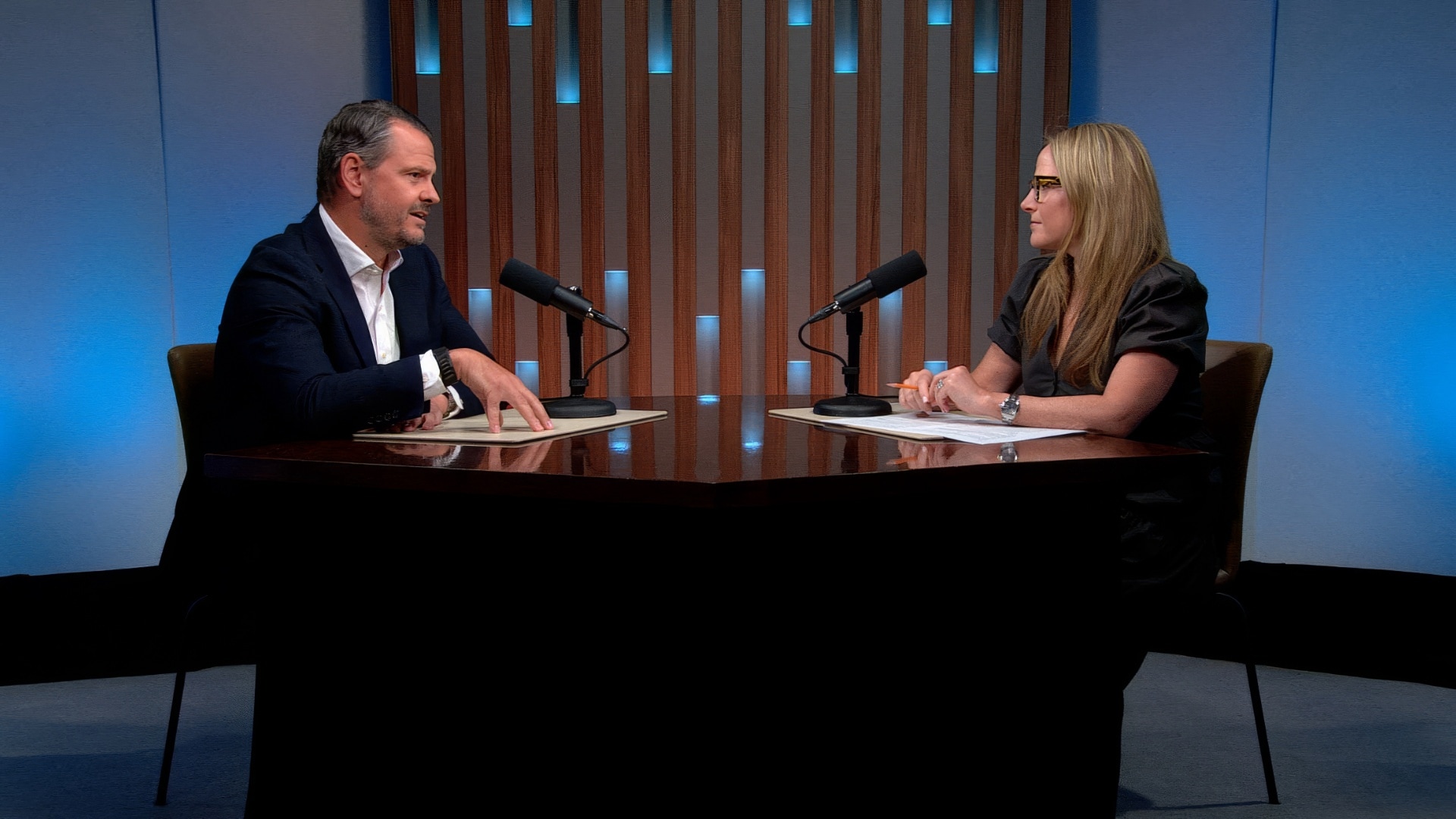
Falling launch costs, innovations, and AI are fuelling a space economy that could reach $1 trillion by the 2040s, according to Michael Tarulli and Erik Sparks in Goldman Sachs Investment Banking. The key driver: launch costs have plunged sharply, opening up access to space and enabling new frontiers of commercial activity. The shift is creating new potential opportunities as well as risks for investors. To learn more about the impact of AI on space, satellites, and other industrial sectors, read Harnessing AI for the Real Economy.
Transcript:
Allison Nathan: The space industry sits at the center of technological innovation, economic growth, and national security. But as activity in orbit continues to expand, so do the opportunities and the challenges facing the sector. So, are we still in the early innings of a new space age? Or are expectations running ahead of reality?
I'm Allison Nathan and this is Goldman Sachs Exchanges. Joining me today to help unpack all of this are Erik Sparks and Michael Tarulli from Goldman Sachs' Global Banking & Markets group. Erik is our head of global resilience leading our coverage of space technology, satellite communications, and national security infrastructure. And Michael is our global head of aerospace and defense, bringing deep, corporate expertise and relationships with the world's largest companies in the sector.
Michael, Erik, welcome to the program.
Erik Sparks: Thank you for having us.
Michael Tarulli: Thank you.
Allison Nathan: Michael, let's just start first with the big picture here. We're obviously seeing tremendous growth in the global space economy right now. So, talk to us about what's really driving that interest and that momentum.
Michael Tarulli: The single most important factor is the cost to launch a kilogram into space. That cost during the height of the space shuttle era was about $55,000 per kilogram. That's down to $3,000 per kilogram today. So, it's really democratized space. It's given access to space to almost anyone that has a desire to be in space today. So, it's no longer the domain of the richest countries and the largest companies. It's really opened up access. And what that's done is promote a significant amount of development, of investment, and innovation that's just driving a lot of activity and further interest in space.
Allison Nathan: And it's been that innovation that has driven that sharp reduction in cost. Talk to us about what are some of the major innovations we've seen.
Michael Tarulli: The key innovation has really been rocket reusability. And that's what's really brought down the cost of launch. That innovation, in and of itself, has brought down cost by 95%. And we're not done where we are right now. There is visibility to getting launch costs down to $1,000 per kilogram. And eventually $100 per kilogram. At that level, almost anyone will have access to space.
Allison Nathan: And when we think about the access, we're also thinking about what people are involved in this space. So, it's traditionally been very government dominated. But now we are seeing, obviously, the private sector, a huge component here. Talk to us about that evolution and what you've observed from your seat.
Michael Tarulli: Yeah. It started with governments because it was expensive. It was risky. What's happened really is today most of spending in the space economy is really driven by commercial companies. About 80% today is driven by commercial companies. A generation ago, it was 80% government. And again, that's been driven by the steep reduction in launch costs, which has invited in a lot of new investment and a lot of new innovation that has just created a flywheel effect of attracting more investment and development.
Allison Nathan: Erik, let me bring you into the conversation. When we talk about this emerging space economy, what does it actually consist of? We think of these rocket launches that we see on our screens. But talk us through the different aspects of this economy.
Erik Sparks: It's been absolutely remarkable what the transformation has been. And it starts really with telecommunications. For example, on your iPhone you have now backup comms. You have this SOS function which will allow you to receive alerts in remote locations.
But it goes beyond that to Starlink, which is providing you WiFi during your flight at, basically, real time speeds that you would get over broadband internet.
It goes to earth observation. So, being able to see what's going on in your Google Maps and getting more up to date maps at more regular intervals. And then look, ultimately, it's going to get beyond orbit and beyond just supporting the terrestrial economy into space stations, into a lunar base, and then ultimately making humanity multi-planetary.
Allison Nathan: It's fascinating when we think about the potential scope of this. It's also fascinating to think about the size in terms of the dollar amount. A lot of people talk about this as a trillion-dollar space economy. We've heard about that number for years. What are the latest forecasts and what do we actually need to see happen to bring those forecasts to life?
Michael Tarulli: Sure. I think right now it's about $625 billion. I think the market view, the consensus view is that we'll probably hit a trillion in the mid-2030s or 2040s or so. And again. I think it comes down to just reducing the cost of launch to achieve that. But I think it's a matter of when, not if.
Erik Sparks: Absolutely. And so, Mike really hit it earlier. What will open up this economy is increased access to space. So, there are a number of companies that are working on providing increased capacity. There are service providers that then move satellites from where the launcher gets them into orbit, like into LEO. Into other parts of LEO. And then, ultimately, potentially into GEO and beyond.
LEO is the acronym for low earth orbit. This has been a sea change and is one of the most important evolutions for what's gone on in space. Decades ago, you had these high GEO, large bespoke satellites. You can remember sort of satellite communication where you'd have to put a dish on your roof and point it at a satellite in GEO.
So, what LEO does, and again this has happened over kind of the last decade, is like literally moved satellites closer to your terminal. And so, the latency is much lower. And so, this enables much faster communication. And opened up all these other possibilities for technology. But it all comes back really to launch and increased access to space.
Michael Tarulli: One thing I would just add to that is I also think at the other end of the spectrum it's continued successful exits for investors. Which is going to drive more capital formation and support more of that development.
Allison Nathan: I do want to get into the investment side of all of this because, ultimately, when we think about investors trying to understand how to value these companies, it feels like a very difficult task. There are so many unknowns in the sector. How do you advise investors to think about that?
Michael Tarulli: Yeah, it's really difficult because many of these companies are early stage. They're very high growth. Some have unproven technologies and very limited customer bases. And it's very hard, I think, for investors to separate winners from losers or winners from those that are maybe a little bit more speculative.
What we typically look at, and I think investors have been looking at, is the quality of the backlog they have. The quality of the customer. The quality of the manifest. Because I think ultimately that's probably the key determining factor for success. It's really difficult for companies that are this early stage to really figure out what technology is going to be successful or not. And I think investors are looking to the customers to validate that for them.
And in many cases where you have customers that are national security agencies or governments, I think that even further reinforces the potential success of a company.
But what people are looking at the specific metrics are revenue and revenue growth more than anything else because most of these companies are not profitable yet.
Allison Nathan: And Erik, do you have anything to add to that? Because these are very long timeline, capital intensive projects.
Erik Sparks: Sure. It is risk adjusted certainty on revenue. And so, we'll take like launch, for example, which has been quite challenging, actually. We've seen a lot of rockets blow up on the pad. And so, investors, quite rightfully, heavily discount launch companies. Even though there is this great economic opportunity, launch is really, really hard. Whereas when you have more developed business models, you have bus companies that are making satellites that have already been on orbit and you're just kind of strapping on better payloads, providing better technology, better equipment, better observation capabilities, that's just less of a discount that you have to provide.
And then you go back to those fundamental metrics. And what investors do is they take that backlog. They overlay it on their revenue expectations for however many years out you can see. And then you apply a multiple to it. And that's generally the approach we see investors taking.
Allison Nathan: And the other unknown or uncertainty around this space is, of course, on the regulatory side. You mentioned all these different initiatives, Erik. We often hear about a lot of junk in space. It's getting pretty crowded up there. What type of regulation do you think we need to see for the space economy to really reach its full potential? Michael?
Michael Tarulli: I think you hit the nail on the head. I think it really is regulated traffic. You've got, at this point, tens of thousands of objects operating in low earth orbit right now. And I think the challenge is keeping them from colliding with each other because I think one collision creates a real risk of a domino effect in creating vast areas of space that just are not even accessible. So, I think the real challenge now is regulating how objects are being controlled and avoiding collisions in space.
Allison Nathan: And how do we actually see that being executed in practice, given so many countries around the world operating in this low orbit space at this point?
Michael Tarulli: That is, I think, the fundamental challenge. I think on the one hand the lack of regulation is what has really promoted innovation and access to space and all this investment that we're seeing. On the other hand, it's been really difficult to align all these various countries and agencies to agree on sets of protocols and standards for regulating space right now.
So, I don't have a good answer. But I think everyone is aware of the problem and recognizes that it needs to be addressed.
Allison Nathan: And there is another component to all of this, of course, which is the geopolitical competition that exists across all of these different countries and in many ways is playing out in space. So, how does that complicate the sector?
Michael Tarulli: Space is a critical war fighting domain today. Full stop. Having assured access in space right now is as fundamental as having a standing army, a navy, or an air force. And I think every country now that is playing on the global stage is investing around having access to space.
I think it's going to become increasingly important. You're seeing how much the US is spending around initiatives like Golden Dome. China's spending $20 billion a year on space right now. They're actively arming themselves in space and preparing themselves to basically defuse or attack enemy satellites in space. It is a war fighting domain. There's an active war happening in the skies above us right now.
Allison Nathan: That actually was a little scary, Michael, but thank you for clarifying that for us.
Erik, I wanted to spend a little bit more time on this human element because there are so many commercial opportunities. There are military opportunities, as Michael just said. But of course, when you talk about launch, and that is what many people think of as the future of space, what is the strongest economic case for a human presence in space? Some of these initiatives that some of these companies are exploring and investing heavily in at this point?
Erik Sparks: Yeah, look, there are some absolutely wild opportunities. And it's tremendous to be a part of it. So, there are companies that are working on the evolution of the ISS. And so, we know that the ISS will demise in the coming years. And there are a number of companies that are putting up their own space stations. And for the first time, those space stations are going to be able to have commercial activities. And so, maybe that's pharmaceuticals. It's testing new GPUs. It's making new products that we never even thought about because you can actually manufacture and test in zero G, which is pretty exciting.
And then, look, ultimately it gets to a lunar base. A Martian base. So, that we can start to do these ideas that people have been talking about in terms of mining asteroids. Bringing back precious metals. And just other elements that are not really present on earth. And you just don't even have any sense of where that's going to go. But it's going to be pretty exciting.
Allison Nathan: Right. I mean, it's a wide array of opportunity you just discussed. Give us a sense of the timeline on some of these. How close are we to some of these opportunities?
Erik Sparks: Look, I think in the next couple of years you're going to start to see modules for new space stations. And whether they're one, two, maybe three space stations that come in. We've already got companies that are starting to manufacture in space autonomously and then reentering earth, which is really exciting.
I think a lunar base is probably a decade plus off. It's a very complicated exercise. We have yet to land a person on Mars. But that's maybe the 2050 sort of scenario. So, in space things do take a long time.
Allison Nathan: I cannot have a conversation it seems on this podcast without talking about AI. So, I do want to ask, has AI changed the landscape and the opportunity set in this space as well?
Michael Tarulli: It definitely has. In fact, I think space was one of the earliest adopters of autonomous flight if you think about just the requirements of operating in space with latency of communications, limitations on bandwidth. Some of the earliest things that were operating in space were doing so semi-autonomously.
I mean, think about how many things are in space as we mentioned before. Navigating and avoiding collisions in space requires autonomous flight. You now have autonomous take-offs and landings. You have autonomous navigation through space. So, it's sort of fundamental to space right now.
So, the next step is I think you've got autonomous edge computing where satellites are less so just focused on collecting information and transmitting that back down to earth. What they're doing actually now is actually digesting that, analyzing that, and making decision making on earth a lot faster. That's all being driven by AI.
Allison Nathan: Interesting. So, just to close things out, let's look a bit further down the road. If we were having this conversation in 2050, Michael, what development in aerospace would you most hope had occurred? And what development would most surprise people listening today?
Michael Tarulli: I hope we land people on Mars. I think that would be incredible for humanity to see that during our lifetimes. What do I think will most surprise people? I think by 2050 the biggest companies operating in space won't be space companies. I think space is going to be fundamental to almost every business. And I think it's very similar to what happened with the internet. In the early 2000s, you had internet companies. And now the internet is fundamental to every company. I think that's what we'll see by 2050.
Allison Nathan: Interesting. And that does surprise me. But perhaps it won't be surprising in 20 years. Erik?
Erik Sparks: I think it's a next-generation propulsion system that allows us to move faster really through the galaxy. And, you know, people are working on this. I'm not sure what is even in development now is what ultimately we will find. But I am confident that someone will find a solution to move us faster through the universe.
Allison Nathan: Right, and who knows what that will bring? Thanks so much. It's rare that I get to have a conversation talking so much about the future. I appreciate it, Michael and Erik. Fascinating.
Michael Tarulli: Thank you.
Erik Sparks: Thanks.
Allison Nathan: This episode of Goldman Sachs Exchanges was recorded on Tuesday, July 7th, 2026. If you enjoyed the show, we hope you'll subscribe on Apple Podcast, Spotify, or wherever you listen to your podcasts and leave us a rating and comment. I'm Allison Nathan. Thanks for listening.
Recorded on July 7, 2026.
The opinions and views expressed herein are as of the date of publication, subject to change without notice, and may not necessarily reflect the institutional views of Goldman Sachs or its affiliates. The material provided is intended for informational purposes only, and does not constitute investment advice, a recommendation from any Goldman Sachs entity to take any particular action, or an offer or solicitation to purchase or sell any securities or financial products. This material may contain forward-looking statements. Past performance is not indicative of future results. Neither Goldman Sachs nor any of its affiliates make any representations or warranties, express or implied, as to the accuracy or completeness of the statements or information contained herein and disclaim any liability whatsoever for reliance on such information for any purpose. Each name of a third-party organization mentioned is the property of the company to which it relates, is used here strictly for informational and identification purposes only and is not used to imply any ownership or license rights between any such company and Goldman Sachs.
A transcript is provided for convenience and may differ from the original video or audio content. Goldman Sachs is not responsible for any errors in the transcript. This material should not be copied, distributed, published, or reproduced in whole or in part or disclosed by any recipient to any other person without the express written consent of Goldman Sachs.
Disclosures applicable to research with respect to issuers, if any, mentioned herein are available through your Goldman Sachs representative or at http://www.gs.com/research/hedge.html
Goldman Sachs does not endorse any candidate or any political party.
Subscribe to Briefings
Our weekly newsletter delivers the latest insights on economic forces shaping markets—from Goldman Sachs leaders, economists, and investors around the world.
You can unsubscribe at any time. For information about how your personal data will be used, visit Privacy Information and Resources.