

Exchanges
Maverick Capital Co-CIOs on Finding the AI Winners
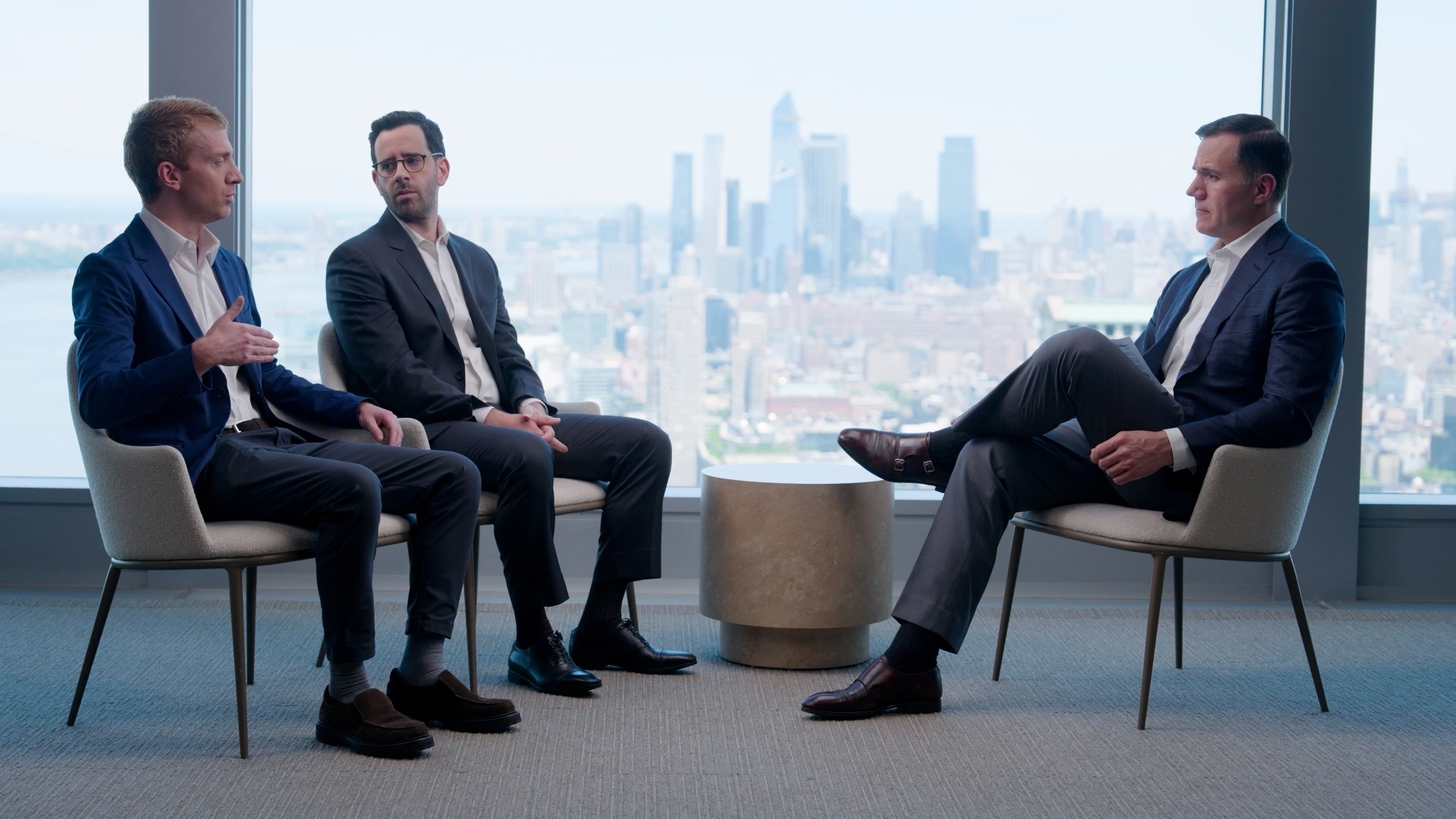
Ben Silver and David Tykocinski, co-CIOs of Maverick Capital, say their investment strategy has, in some respects, been the same for three decades: Rather than trying to time the market, the firm aims to drive performance by taking a long-term view, partnering with management teams, and doing deep diligence on its investments. In an interview with Goldman Sachs’ Tony Pasquariello on the Great Investors podcast, they discuss the investment opportunities in AI and healthcare as well as their complementary skills in a shared role.
Transcript:
Tony Pasquariello: Where are the most exciting opportunities in the stock market today? I'm Tony Pasquariello and I'm about to sit down to Ben Silver and David Tykocinski of Maverick Capital. Ben and David are co-CIOs of Maverick’s public funds business. They've had tremendous success at identifying the key drivers of markets and pouncing on the opportunities that crop up as a result. And today, they're going to talk about how they do it.
David, Ben, thank you for coming down to see us. Thanks for being here.
Ben Silver: Thank you for having us.
David Tykocinski: Yeah, really appreciate it.
Tony Pasquariello: Tell us a little bit about how the co-CIO model came together. I presume the transition came from Lee Ainslie?
David Tykocinski: Yeah, right. So Lee had obviously had a little bit of a sense, right, of our thought process from an investment perspective in terms of our performance when we were sector heads. I think beyond that, though, there was a couple year period where we were beginning to kind of just incubate general ideas and thoughts about, kind of, organization writ large, investment process and philosophy writ large.
And so I think even before he executed the transition, he obviously had some degree of conviction in terms of how we think about some of these bigger picture items that would be relevant in the event of a transition. And so I think by and large he had this view that, one, he already had a sense of our natural chemistry of kind of approaching certain critical decisions together. But I think also just some of the natural similarities and differences between us would provide a degree of interesting counterpoint that I think he thought would be beneficial for the culture and the organization.
Tony Pasquariello: Let's jump off that point. In terms of style or areas of expertise, what would you say are the characteristics you two share? And then what makes you different?
David Tykocinski: I mean, I think at its core we share a certain commitment to, kind of, commerciality and first principles that does have us fundamentally aligned when it comes to capital allocation. You know, and I think that from a stylistic perspective we're both pretty candid, straightforward, have kind of a high degree of just basic trust and camaraderie, which ends up being kind of critical with decisions kind of throughout the day, investment or otherwise.
I do think stylistically we do have differences. I think it's hard to parse those differences as being a function of different sectors, Ben growing up in the healthcare and cyclicals universe, myself growing up more in the TMT universe. Where in the world of TMT, things like secular trend, operating momentum, thematic dominance are obviously extremely critical, right, because the reality is, when a sector trend is in your favor, you typically see the multiples of stocks re-rate in the same directions as the revisions in underlying fundamentals. And so you get a degree of natural operating momentum underneath the trend.
Where if you're working in industries that maybe have less end market secular growth then you have things that can be more idiosyncratic in nature where managerial decisions have a greater impact on underlying earnings power or you're oscillating around a macro operating cycle that's been going around for seven decades.
And so I think in general Ben's focus on highly specialized, more idiosyncratic, novel ideas versus a little bit more in the mold of sort of classical thematic investing is on the surface at least one of the differences in how we approach things.
Tony Pasquariello: And in the risk, in the risk taking, the risk management, how much of that is divide and conquer? And then how much of that is kind of joint decision making?
Ben Silver: It's really done together with Lee as well and two other members, longstanding members of Maverick. And we really look at that both holistically and at the sector level. And there's a whole host of statistics. And that's really evolved over time. I know we're going to talk about some of the things that have changed over time at Maverick, but the risk management approach is one of those things.
And it's kind of sliced and diced every which way you can look at it, but what we're really solving for at the end of the day is the whole portfolio and we're managing towards the optimal portfolio, not the optimal sector allocation.
Tony Pasquariello: So Maverick is one of very few funds that's enjoyed more than three decades of success. I'd be curious how you would characterize the evolution of the fund, particularly with a nod towards the more recent years.
Ben Silver: I think much more has stayed the same in terms of the important parts of what we do than what has changed. So obviously a lot has changed over 30-plus years in terms of investment process. And so when I think about the constants, it's the culture of Maverick, putting investors first, team very much working together and collaborative in the context of a very high-performance culture.
From a strategy perspective, the first slide of our marketing materials is the same as it's been since inception. Performance that's driven by alpha, not market timing, not sector exposures, or big sector exposures I should say. Long-term view. Deep diligence. Partnering with good management teams. Taking a long-term view.
So a lot more, again, I would say is similar rather than different, but there definitely have been some changes over the last 30-plus years as well. The risk systems are night and day. When Lee started, he was looking at net exposures by sector and beta-adjusted net exposures by sector. And now we're looking at a 20-plus-page risk report, looking at idiosyncratic contribution to volatility sliced all sorts of ways, every factor, making our own factors. So that's really evolved.
Obviously, the research process and the tools used in the research process have really evolved. And I would say in the last five-plus years or so since we took over, I'd say there was a period at Maverick where a real focus on near-term valuation metrics became pervasive. And I think that was somewhat of a deviation from Maverick's first call it 15 years or so. And so I think we've brought it back to that first principles approach.
Tony Pasquariello: Let's talk about the markets a little bit. It's been a terrific four years or so in US equities. A lot of that rally of course has been powered by the AI build out. How do you guys think about the sustainability of that trend and that theme?
David Tykocinski: I mean, that's obviously the critical question. Because we're in a world where the AI trade is no longer just GPUs. It's the entirety of that broader hardware infrastructure, energy ecosystem, and then in a similar vein, all of the services and software and broader complex perceived to be on the other end of disruption.
And so I think the question people have is: How sustainable are these current levels of CapEx that seem really high? And I think the cop-out answer is we see clear areas of difference versus prior build outs and periods of excess if people think about the dotcom bubble. But it's also evolving, and some of those things that look very different are having more similarities by the day.
So the thing that would be most often thought about is just the source of funding. So at this point, in dotcom bubble, your cumulative CapEx was essentially running 200% of your operating cash flow, and so it was almost definitionally externally funded. Now, that number for the last couple years was well under 100%. So there's clearly a difference when the build out is being funded by the largest, most well-capitalized companies in the world.
The offset of that is we've just recently seen a multi-trillion-dollar market cap company suddenly tapping equity markets for that next tranche of the build out. So it's the kind of thing where a difference can exist, but it might be a little bit tighter than it was before.
And I think the heart of the question is ultimately going to be the ROI on that spend and how it translates. I think that the way there's a risk in markets is, when we have that handoff, the buildout of infrastructure for the training, that handoff towards the underlying applications for AI that are actually transformational from a productivity standpoint, the question we all have to wrestle with is: Is there an air pocket in that interim which is what creates the opening for volatility in the markets, even for a trend like AI in which you can be a full-throated believer and will likely have a great amount of salience going forward?
And so we do see that the market is going to gradually transition from that second derivative slowing in the training build out. And to date, we have seen a commensurate pickup in certain agentic inference applications like something like coding as an example. But we are going to need to see that use case can break out into the broader knowledge workspace to maintain that velocity of demand to support some of those outyear projections. So in many ways, we are very receptive to just the speed at which facts are changing day by day and adapting accordingly.
Tony Pasquariello: And in that context, there's a beat within the market on where the real terminal value of AI will most accrue over the long run. Do you have a sense, do you have a guess or strong view on where that will take place?
David Tykocinski: Yeah, no, look, I think the hallmark of the trade to date has been an inversion of kind of the 2000s and 2010s paradigm where the value accrued at the software application layer to an inversion of that where suddenly it's accruing at the hardware and infrastructure layer. I think in general, to monetize the trade, it's been about following that migration of that bottleneck further upstream.
So in the early days, when your demand is still within the existing industry production capacity, your downstream physical outputs of things like GPUs are where you see the most explosive growth. Once you cross that threshold, which we have in terms of demand being in excess of industry production capacity, the bottlenecks move upstream to the fabrication level, to the tools that go into making them, even to the obscure materials listed on a Japanese stock exchange. And so that's kind of where the market is moving, is towards those areas that have the sharpest revision torque frequently against companies that had very low margin basis to begin with.
I think what's interesting now and what we're starting to see is we actually think that migration, though, is going to begin to swing back the other direction where the trade becomes a bit more back downstream towards the infrastructure and application layer where it's about servicing AI and actually transforming businesses with the productivity gains. And that has different implications obviously.
Suddenly things like CPUs or the databases that they're talking to become the critical chokepoints because I think what we've seen is I think there was a thesis maybe a year or two ago that LLMs would exist in an island where the answer to all the organizations' questions would essentially be answered within that framework. What we're seeing in practice instead in the world of AI agents is that it's more about integration of that LLM within many ways the preexisting enterprise, workflow, and stacks.
And so that change in interface suddenly brings a lot more value closer to the edge and closer to the end user. And so that's what we're heavily focused on now.
Tony Pasquariello: Shifting gears to another sector but one where comparatively it's been a little leaner of late, Ben, what's going on in healthcare that gets your attention these days?
Ben Silver: Mostly it's just a large sucking sound with all the capital coming out of healthcare and going into AI.
Tony Pasquariello: Going from your boat to his.
Ben Silver: Yeah. But we actually think there are pockets of healthcare that are very much on the right side of the biggest trends in the world. So think AI, reshoring manufacturing that will come to healthcare as well, but we're not yet seeing that in the numbers. And that's specifically in the life science tools space. So the companies that are involved in providing the products to discover drugs and manufacture complicated drugs, there's a big shift towards reshoring manufacturing from outside the US to the US. So there should be a big CapEx boom in the equipment needed to manufacture drugs, which we should really start to say, I would say, three to six months from now. It should drive a very nice revision cycle as well as driving the discovery of many more drugs, which obviously leads to many more drugs ultimately being manufactured.
Now, they have to work through the clinical trial process, and that takes time. But we're seeing signs now in early stages of drug discovery of pickup in consumable usage there as well. And so I think that's a space that's very much poised to become an AI winner and kind of modern mercantilist winner as well.
And then the other thing that's also really interesting about that space is it's been a space that's been consolidating for 20 years. And right now kind of all of the companies are left for dead, but there are real money buyers in that space in the likes of the big consolidators in the space. And there's three to five, depending on how you want to define it. And there are a number of companies in the more $5-10 billion range that I think are ripe for M&A interest if those fundamentals don't turn fast enough.
Kind of a similar dynamic that we see when the biotech market sells off. You see the pharma companies come in and right that usually within six months to a year or so. I'm very optimistic prospectively but there's definitely been a large sucking sound this year so far.
Tony Pasquariello: In general -- again, it's been a very good four years in the markets -- at the same time, it's your jobs to worry about what could go wrong and the risk factors. Is there any one particular story right now that you find yourselves worrying about more than the next?
Ben Silver: Yeah, it's something we talk about a lot. I think it really ranges from the division that we see within the US and just the ability for this country to make very rational decisions on a long-term basis through the nature of our system is one where it's hard to make rational long-term decisions given short-term political incentives. So that's a concern, I think.
Geopolitical dynamics certainly with China and what happens in kind of the Cold War we have going on there is obviously another big risk that we're focused on.
David Tykocinski: Yeah, I think that the risk of China as an industrial counterweight to some of this infrastructure trade is something that concerns me. Like, going back to what I was telling you before. Like, there's a reason why a lot of the value historically accrued at the application layer because that's kind of where a lot of IP existed. Whereas root hardware and materials is more subject to commodification over time. And so to the extent a lot of the companies are big beneficiaries here are playing in spaces that are historically more ripe for Chinese competition, if you think about lasers and the optics space or analog semiconductors, there's this kind of universal maniacal focus on, like, what's the next bottleneck-memory? And so I do worry about people underrating the structural industry differences of some of the businesses that are driving a huge part of the equity appreciation now versus the prior decades.
Tony Pasquariello: One last longer form question. Co-head roles, co-CIO roles. Within our industry, they can be interesting dynamics at times. How have you two managed to kind of share your responsibilities?
Ben Silver: I mean, he's been long semiconductors and memory for a really long time.
Tony Pasquariello: So you're happy with his performance?
Ben Silver: Yeah, it's really nothing to complain about from my side. No. I think we have known each other for a long time. We're friends as well as colleagues. Our families are close as well. We realize we're in it together. We know how difficult the business can be and that there's ups and downs and you're never as good as you think you are and you're never as bad as you think you are at the bottom. And we, from day one, agreed that we would, to the extent there were disagreements, we'd disagree and commit. And I think we also have Lee as a sounding board, so there's kind of a third party that is very helpful just providing general advice but also helping us think through things. And yeah, I think it's just at the end of the day, a respect and appreciation for the other person. And I think also an appreciation that we make each other better.
David Tykocinski: Yeah, I mean, I would just add, like, to the prior question in terms of stylistic differences, there's a lot of different, kind of, flavors of investment style and approach, and almost by definition everyone believes that theirs is the right one. But I think that deep down there's also this recognition of I'm kind of happy to have a counterweight who might see things differently to, in theory, protect me from my own excesses maybe in one direction. And then that works vice versa.
And so, yeah, I do it think that, at the end of the day, there is an appreciation that no singular investment philosophy is kind of perfect in a vacuum. But sort of having a degree of counterbalance ends up working out pretty well.
Tony Pasquariello: For the road, just a handful of shorter form questions. David, I'll start with you. What's your greatest strength as an investor?
David Tykocinski: I think that I'm able to balance a fundamental analysis with a commercial intuition. I think some people can get too bifurcated. You can get too academic and not face the reality of the market or kind of too much of a trader. And so I think being able to craft and ground my decisions in what is happening fundamentally and secularly but also just gut checking and requiring some sort of commercial view of how that transpires in a reasonable risk-adjusted time frame within public markets.
Tony Pasquariello: Ben?
Ben Silver: I think it's getting deep in the weeds, understanding how businesses really make money, really work, and then being able to kind of extricate myself from that to see the bigger strategic picture as well.
Tony Pasquariello: Which investor do you admire most?
Ben Silver: Look, I think we're both kind of fanboys of Stan and Uncle Steve. Kind of hard to be in this business and not be.
Tony Pasquariello: Both of whom have done this interview before.
Ben Silver: And I hope, Uncle Steve, you're watching. I believe the Mets will make it back to the World Series, and I would definitely not turn down tickets the owners' box. But I think we both feel like we've worked with one of the greatest investors in Lee Ainslie. And I think my experience also at Corvex with Keith Meister, I put both of them up there as sort of in my hall of fame. Both unbelievably smart, grasp really difficult concepts very quickly, very commercial, very entrepreneurial.
I think also it's somewhat underrated. I know this is the lightning round, but what's underrated about some of these investors is they build really good businesses. They're really entrepreneurs as well. And some of them are phenomenal business builders as well as investors.
Tony Pasquariello: What's the best piece of advice you've ever received?
David Tykocinski: The best piece of advice I've gotten is -- I have three sisters. And my oldest sister, I remember, she once said to me, she's like no one is really thinking about you all that much. Like, I think that --
Tony Pasquariello: You're the only boy in the family?
David Tykocinski: I am, yeah. Youngest, too. And, yeah, she's like, "No one's really thinking about you all that much." And in many ways, that's very freeing because I feel like, you know, a lot of times we get stuck in situations that are sort of, like, predicated on this idea that everyone's evaluating it and you can kind of overweight certain opinions. And sort of just reminding yourself that, like, most people are pretty concerned with whatever's going on in their life and you're kind of the last thing on their mind. It gives you a certain freedom to just, like, move and operate and think in a way that I've personally found pretty liberating at junctures of key decisions.
Tony Pasquariello: Ben?
Ben Silver: I would say it wasn't just one piece of advice, but my grandfather was a Holocaust survivor, and his experience had a big impact on me. And it was just an attitude of "keep going," persevere, "you can do really difficult things," "you don't know how bad things can get," "be very grateful for what you have."
Tony Pasquariello: Remarkable. How do you guys spend your time outside the office?
David Tykocinski: I mean, answer can't be too dissimilar. I have three kids under six. So, you know, the vast majority of my time is spent with my kids, positive or defusing whatever the latest crisis is. But, you know, I've always -- I've tried to kind of -- since always. I've had an interest in humanities, broader social studies, kind of things outside of a strict business context. And so I try and spend some kind of residual time kind of maintaining some of those interests that take me out of the immediate business world. But mostly kids.
Tony Pasquariello: Same answer?
Ben Silver: Yeah, not much outside of work. I love sports watching and playing but unfortunately don't get to do as much of that as I would like but hopefully one day.
Tony Pasquariello: What are you most excited about in the world right now?
Ben Silver: I think we're not shy with going with the consensus when we think that makes sense. And I think -- I'm sure there'll be hiccups in the road but just the impact of AI on the world over the next 10-20 years is I think going to be way more profound than we can possibly fathom. And just seeing how that plays out will hopefully be very exciting and not so scary, but I think it will probably be a mix of both.
David Tykocinski: Yeah, I mean, it definitely has to do with AI. Like, I feel like so much of the experience and conversation is just, like, dimensionalized in monetary terms in terms of what does it mean from an investment perspective and enterprise productivity or in the negative dystopian vision of AI because that can provide pretty effective engagement bait. But I think the reality is there's a lot of just upside optionality and positives to come down the road, and so that kind of open-ended excitement of what could come of it is kind of big to me and what I'm excited about.
Tony Pasquariello: Okay. We're going to leave it there. David, Ben, thank you for coming down to 200 West Street. Thank you for doing this.
David Tykocinski: Thanks for having us.
Ben Silver: Thank you for having us.
Tony Pasquariello: Thank you all for listening to this episode of Goldman Sachs Exchanges Great Investors, which was recorded on June 4th, 2026. I'm Tony Pasquariello.
This episode was recorded on June 4th, 2026.
The opinions and views expressed herein are as of the date of publication, subject to change without notice, and may not necessarily reflect the institutional views of Goldman Sachs or its affiliates. The material provided is intended for informational purposes only, and does not constitute investment advice, a recommendation from any Goldman Sachs entity to take any particular action, or an offer or solicitation to purchase or sell any securities or financial products. This material may contain forward-looking statements. Past performance is not indicative of future results. Neither Goldman Sachs nor any of its affiliates make any representations or warranties, express or implied, as to the accuracy or completeness of the statements or information contained herein and disclaim any liability whatsoever for reliance on such information for any purpose. Each name of a third-party organization mentioned is the property of the company to which it relates, is used here strictly for informational and identification purposes only and is not used to imply any ownership or license rights between any such company and Goldman Sachs.
A transcript is provided for convenience and may differ from the original video or audio content. Goldman Sachs is not responsible for any errors in the transcript. This material should not be copied, distributed, published, or reproduced in whole or in part or disclosed by any recipient to any other person without the express written consent of Goldman Sachs.
Disclosures applicable to research with respect to issuers, if any, mentioned herein are available through your Goldman Sachs representative or at http://www.gs.com/research/hedge.html
Goldman Sachs does not endorse any candidate or any political party.
Subscribe to Briefings
Our weekly newsletter delivers the latest insights on economic forces shaping markets—from Goldman Sachs leaders, economists, and investors around the world.
You can unsubscribe at any time. For information about how your personal data will be used, visit Privacy Information and Resources.