

Talks at GS
Leading Through Complexity: EY’s Janet Truncale on Leadership, AI, and the Modern Boardroom
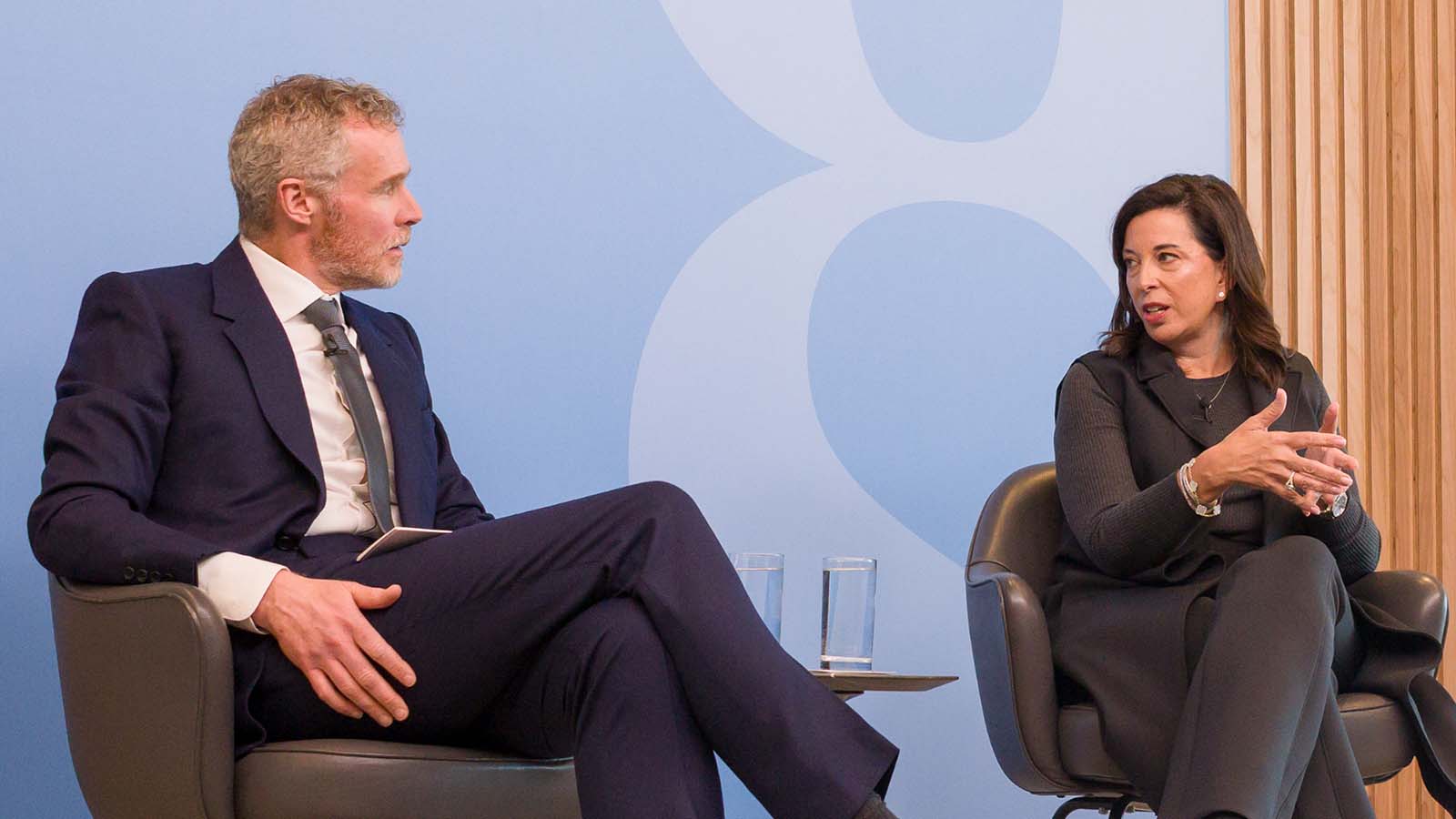
EY operates as one of the world’s largest and most globally connected professional services firms, employing 400,000 people across more than 150 countries. EY Global Chair and CEO Janet Truncale joins Matt McClure, global co-head of Investment Banking at Goldman Sachs, to discuss her 33-year journey from intern to CEO, the firm’s commitment to upskilling its workforce, and why the narrative around artificial intelligence is shifting from job displacement to a focus on productivity, growth, and the essential role of human objectivity.
Transcript:
Janet Truncale: The shape of our workforce has changed over the last 20 years, and it will continue to change. But those that are embracing the newest technology are the ones that are going to be with us for the long term.
[Music Introduction]
Matt McClure: Well, good afternoon, everyone. Welcome to another session of Talks at GS. Delighted to be joined by my friend Janet Truncale, EY Global Chair and CEO. I don't think EY needs much of an introduction. But as global chair and CEO, she leads one of the world's largest and most globally connected professional services firms.
In her role, she oversees a staggering 400,000 people. That's a lot of catch-ups across more than 150 countries and territories around the world. She's a trusted advisor to the Fortune 500 CEOs and boards. Is known for her perspective on transformation and growth in what is a rapidly shifting global landscape. Prior to becoming Global Chair and CEO in 2024, you had various leadership positions across EY's audit, financial services, and global client service businesses. Thanks a ton for being with us today.
Janet Truncale: Happy to be here.
Matt McClure: I thought we would just jump straight in with the start of your career. You actually interned at EY. Is that correct?
Janet Truncale: Yes.
Matt McClure: Was that a predetermined choice? Were you interested in professional services, or you got the gig, and then you became interested in it? How did that work out?
Janet Truncale: First of all, I know I'm among a small group, probably getting smaller, that have the privilege, I would say, of starting my career. I know that I'll retire from EY in a full-time capacity, and I'm definitely humbled by that. My children remind me that that's not how things are going to happen in the future, because everyone's very interested in doing different things and having multiple careers.
First, I'll just say, I feel like I've had many different careers within a 33-year span. But no, I graduated college in ‘92. I was an intern in 1991. The job market was a little soft during that time. What was important to me was to go to a large organization. I wanted to be with a larger group of peers, kind of navigating. For me, it was New York City for the first time, even though I lived in a suburb, I hadn't spent a lot of time in New York City, but also working for an organization that had an iconic and trusted brand. And just as importantly, was focused on development and investing in their people. That's always been important to continues to be important for us.
And then, as we evolved, it was also an organization that had a big purpose behind it as well. I think that's something that's always been important. The learning and development, the different opportunities, the brand, which I feel like is now entrusted to me in this role, those are all things that attracted me to that.
Again, I was a little bit practical at that time. It was important to get a job. It's really panned out really well.
I do get the question from time to time, like, did you ever think about becoming CEO? As a matter of fact, I didn't. Not until the last couple of years did I think that right leader, right time, depending on what you're going through, could my skill set match up? But there's many people, 400,000 people, 14,000 partners around the world. There's many qualified people. But for me, I was always very satisfied in the job I was in. I'm big on living in the moment. Make an impact where you are. Make an impact, whether you have a title or not. Make an impact with people every single day, and good things happen.
Matt McClure: But just take a step back. I think most people in the audience are super familiar with EY. Would you just describe EY's kind of mission statement? What issues are you trying to solve?
Janet Truncale: First of all, I have to say not everybody understands what EY is because one of the surprising things for me when I was out meeting with clients, no one really recognized the scale of our business. So I do always, and it was important to our people to make sure that I emphasize that. Why is it important? Because at 400,000 people in every single country and territory you can imagine, we should have a point of view. We should be able to be a resource to our clients globally on almost every topic, or at least be able to direct you to where you should go. It's important to note that not everybody understands that. It's been important to me to emphasize that. I'm glad you mentioned it, but I think it's also important for our people to understand the powerhouse of the firm that they're working with.
What we like to look at is when I came into role, we launched a new strategy, and we had our purpose very ingrained in our business, and it was building a better working world. But in this moment, we wanted to add to that. And so, we came up with shaping the future with confidence, shaping your future. Meaning our people's future, with confidence. Because in a world where confidence sometimes right now is low, who do you want to turn to? We were very bold in that. We want to be the organization that is going to help you with your most complex challenge, your biggest transformation, be on the journey, and be a true journey partner. That's what we're all about.
But at the heart of it, we're a tech-enabled professional services firm who has morphed over the years. In terms of really being tech-led. That's more important than ever before. How we offer our services has always been a journey and will continue to change, even in the world with AI. But at the core of it, that's what we want to be known for.
Matt McClure: You've achieved a lot with the all-in strategy since you implemented it. Where does that go from here?
Janet Truncale: So look, we always have to be an organization that's evolving. We have to be nimble. That was part of the operating model change. We were very clear in what was going to be important going forward in terms of growth and innovation. We put people in charge of those. When you have a new role with a new executive in charge of it, that signals to the organization that you're going to do some things differently. That was important. We brought the largest member firms of our organization closer together to make sure that we were going to do everything that was important to this organization. With the largest member firms to increase the momentum, increase the investment capacity that we could put towards things like AI, managed services, technology in general. That was really important. I think we had lost some of that, the member firm relationship and connectivity as we go.
I think also from a culture perspective, recognizing that we need to be an organization that's going to take calculated risks and that you have to find people that are going to disrupt challenge. We didn't always have that as a strong fundamental view that we should be having a little bit more of that risk-taking. That's harder to change in a culture. Keep in mind, because part of our business is to protect the capital markets and audit and mitigate. But also, there's a room to innovate even in those regulated trust-based businesses on behalf of our clients and for ourselves. That's been really important to develop a challenger model within our organization.
Also recognizing that we don't have to do everything alone. Another piece that's really important to us is we have alliance partners with all of the tech firms. What's important there is what are we going to build ourselves. What are we going to do in partnership with an alliance partner? How is that going to pivot and do differently?
Also, then, having those relationships that, for a Goldman or any other client, that we can be the orchestrator of that technology ecosystem for you as an independent person with an independent view. That's been really important as well. But this concept of you don't have to go to loan is also something that we've embraced in the last couple of years in a significant way, and recognizing that that's going to be the way for many organizations, not just ours, but for yours too. You've got to be in it and have different relationships and be very clear about what you're going to do for yourselves and what you're going to do in partnership.
Matt McClure: Let's talk about EY's relationship with large organizations such as ourselves. Our history goes back a long way, whether it's M&A or digital transformation or whatever it might be. But how do you see the relationship evolving with large organizations such as ourselves?
Janet Truncale: Yeah. Well, first let me say thank you for the relationship. We are a client of yours. You're a client of ours. What I also get excited about is when we get to do things together with our mutual clients, and that will continue. Those relationships that have those dynamics are the most important to our organization. We learn from you, you learn from us, and we learn together. I think those are the best that we have. But it is going to change. The way that we deliver services is going to change.
As we grow as an organization and we add to our skill sets, we're going to be doing different things. It's important when you have a trusted relationship. And Goldman's one that is open to hearing us out on different topics. Sometimes you'll engage us, and sometimes you don't. That's fine. Sometimes you'll want us to come and do something for you, and we'll say we're not the best firm for that. I think that trusted relationship is very important. But the way that we engage with you will be different over time. This is really front and center for a lot of organizations right now.
With technology coming so fast and with the change happening, where do you want to spend your time, and having a real, honest conversation about what's important to you? It's always going to be the interaction with your customer. That's the most important where you want to deploy capital. Then what are the things that we can help you with and transform and disrupt that might be not as client-facing? But it's still really important to work together. That's important. There's things that we do.
I come from financial services. I think about insurance. We hire a lot of actuaries within EY. How do we offer that now as a service as opposed to just being an advisor? Things like that is where we're moving and pivoting to have more of an outsourced co-source or even managed service relationship with many of our clients. That's a discussion that's going to happen more and more with organizations, is what's best within my organization and what's best owned or operated by someone else. That's a journey that we've been on for 15, 20 years. We'll continue to see that.
Also, how the workforce transforms. You look at 400,000 of our people. A big part of that is sitting in our global delivery centers, where we've been building the engine to fuel some of those businesses. Whether that's tax compliance at scale. Whether that's vendor risk management. Whether that's AML businesses. But we're seeing more and more of that. And a lot of organizations coming to us and thinking about transformation of the workforce, what needs to be onshore, what needs to be offshore, what's going to be AI-enabled?
When you have 400,000 people, and you put yourself as client zero, and you talk about a story about how we've done it to ourselves, that's really powerful. That's where you have that trust to help an organization go on that same transformation.
Matt McClure: Let's talk about AI in a bit more detail because it's really, I'm sure you're finding the same, but it's kind of topic number one, two, and three in every boardroom around the country at the moment, around the globe. Can you talk about, since the launch of EY AI in 2023, how that started and what that journey has been like? Then, where you see AI being deployed going forward.
Janet Truncale: Yeah. When we first launched it, we were very clear that we wanted to be client zero, and we wanted to transform ourselves. We wanted to be the partner for our clients to do that as well. We also had a very significant responsibility because of our brand around trust and assurance that we were very focused on AI for good. That means like, how do you make sure it's protected, safe? Then also there's another piece to that we want to work in the world. How do we use AI in our Ripples programs and other things that are trying to help the community, to upskill the world? We have big ambitions on that as well. That's kind of how we've looked at it as we go.
We were very focused in the beginning, as if we were going to have the right to serve our client base, we had to demonstrate that we were doing that to ourselves. Every single one of our businesses has been AI-enabled, and everyone's at a different pace. But really excited that I'll just think about our core businesses, audit and tax, where we have platforms that are consistent across our entire platform. 160,000 people that deliver audits around the world are on one platform. When we are deploying AI in that, it's real-time. The learning and development is there, and it's consistent across.
That's the greatest transformation that I can think of when we're talking to our clients, because that's 160,000 people on the same platform, deploying AI at scale where it's safe, protected and tested. That's important. Same thing with our tax platform. We're agentifying all of our tax knowledge so that people can upskill and work at the top of their license, and they're not. When I came into work at EY, you're looking up tax code, or you're looking up accounting rules, but how do you get that agentified so that everybody can operate more quickly and readily at the top of their license and do more interesting things?
We are very clear that everything that we're doing is going to be humans at the center. That we still need judgement, oversight, objectivity, that only people can deliver and really help our people on that journey. And so, that's kind of how we've been transforming ourselves. It is, you talk about it's the topic in the boardroom, it's the topic in our boardroom all the time. Are we going fast enough? What does this do to our workforce? What are the bets we have to take? The reason it's a topic is because no one knows the answer.
The same program that I was at a couple of weeks ago, there were 12 CEOs. They did a survey about who's talking about impact on the workforce openly. Only four out of 12 said they were. Eight were quiet. We had a really great discussion about that. People weren't talking about it because the answer is they don't know.
Matt McClure: It's a lack of certainty.
Janet Truncale: It's a lack of certainty. I think for us, what's been really important for us to talk about is we're going to bring people along. Every one of our professionals has received baseline training in AI. 90% have received a higher level of AI training. That's our commitment. Again, I can start with our people organization, we're going to help and bring people along. It's a new tool that's being rolled out to make you more productive, to change your job, to allow you to operate and work on different things. But we're going to bring you along. And I think that's important. The shape of our workforce has changed over the last 20 years, and it will continue to change. But those that are embracing the newest technology are the ones that are going to be with us for the long term.
Matt McClure: I'd love to get your view on the economy. We institutionally come into this year feeling like the setup was incredibly constructive for US growth. Obviously, the world has evolved a bit over the last month or so. What's your view, and what do you think the tail risks are? And what are you hearing from your clients?
Janet Truncale: It's a lot of uncertainty. We do a CEO confidence survey every quarter and had been building momentum as we were going into early 2026. You saw the M&A market really frothy. We're excited about that. Some of the IPO market coming back, the war has definitely dampened that. I was feeling better about Europe, and after a couple of years of feeling frustrated, that they were getting organized on a path towards maybe less regulation. A little more growth-focused, innovation focused. This throws a little bit of a wrench into that. I do worry about that. I saw some great momentum.
I'm always looking at our relative businesses. We're continuing to grow. When I look at our forecasting, I think people are really bullish. But this short term, I think, is definitely going to be a bit of a challenge. The longer this war goes on, the harder it's going to be. I don't need to tell you that. I worry about things like mobility and being able to get people in the right places at the right time in order to help. We're always thinking about the safety and the well-being of our people. But some of the areas that are in the middle of this crisis were some of the fastest-growing economies. This is going to have a significant impact for a long period of time.
What I will say, though, is there is a bit of resilience in the boardroom of our clients that we will get through this, and that organizations are continuing down the path of investing in the future. Freeing up capital, making sure that the transformation is continuing at scale. In some ways, this speeds that up. We're still seeing deployment of capital. We're seeing a lot of opportunity on transformation, maybe more pressure to accelerate some of those things.
Matt McClure: Yeah, we're seeing the for what it’s worth. We're not seeing a slowdown in investment activity. I agree with you. I think most boardrooms and management teams will come out the other end of this, and we've got to keep investing. Let's talk about leadership and career development. Looking back across your career, is there one moment that you would describe for the audience as being pivotal?
Janet Truncale: Pivotal is one, and I never like to talk about it from a gender lens, but I will because we're sitting here and we're talking about leadership, and it's personal. But I was a client-server for years. I still think of myself as a client-server. For those of the EY folks in the audience, I think they know that I'm always trying to be out with clients whenever I can. But I remember once, I was serving clients. I grew up on the audit side of the business, and I was helping on a project where we were nationalizing one of our practices, our audit businesses.
A leader that I had worked with for a while sat me down for breakfast and said, "I want you to throw your hat in the ring to lead our audit practice for financial services. " It was a so coming out part-time from client service, but leading a PNL for the first time. I remember sitting there, I can remember like it was yesterday. And I said, "Well, I've never run a PNL before. I have this big client engagement that I'm working on, and I just see him smiling. He said to me, he said, "Janet, instead of telling me the nine reasons why you're not ready for this job, I'm going to tell you the one reason why you are. I've seen the way you operate. I see the way you take care of our people. I love the way that you approach the business. I'm going to ask you, like, you need to throw your hat in the ring. " I think that was really pivotal to me because –
Matt McClure: That kind of vote of confidence.
Janet Truncale: Well, a vote of confidence for him to see something in me that I didn't see myself. But I just think that for me personally, so I don't want to say it's a woman thing, but like you're always kind of risk managing, like, well, I haven't done this. I was a little risk-averse. I think just to have someone to say one reason to say yes, not nine reasons to say no. That kind of opened up my eyes.
I loved what I was doing. I loved serving clients. I love being in the middle of a deal. I love being in the middle of a transaction. I love to be in the middle of some messy things. What I learned is that in leadership, you get to be involved in lots of messy things and lots of really challenging things, too. Because usually, when it gets to you, they're really messy, and they haven't been able to be solved prior to that. But I think it was just find a reason to say yes to something and take a risk.
Matt McClure: How do you make sure when you're managing an organization of your size, that you're surrounding yourself with people that can give it to you straight and you don't get a bunch of happy talk?
Janet Truncale: That quote has gotten a lot of play over the last two years, but I think it's important. You always run the risk of hearing only the good and not the bad. And for me, it was bringing people with me to this role that I knew were going to do that for me. But that's not enough. When I came to this role, we had 50% of our global executive that was new, and 50% that were continuing on. In a new leadership team, we made a commitment to each other to invest in our ways of working.
We brought in an external firm that came and helped us for high-performance teaming, but also to set the ground rules.
It was really important for us to say what is our purpose as this global executive for this organization and very clearly define our purpose, what we were going to do, and what we weren't going to do. But we also defined our ways of working. We said, "Everybody has to have a voice. We want to have a constructive debate. " We were very clear that when we had constructive debate, that we were going to end up with alignment and not consensus because consensus is basically impossible in an organization of our size. We were even so bold as to say that the way we talk about each other and this group was really important when we went outside these four walls. Every single meeting that we have as a global executive, we start with those principles.
I think it's just really important because every voice matters, especially in a time where there's so much complexity and not one of us has every answer, and that we need the collective group and wisdom to go, and to really challenge each other. I'm not going to lie, some of those meetings get uncomfortable when you have this constructive debate. Can feelings get hurt? But when you have it as your kind of guiding principle, no one takes it personally. We've had a little fun along the way.
Matt McClure: That's awesome. I think we should all thank Janet for her time.
Janet Truncale: Thank you for coming. Thank you.
The opinions and views expressed herein are as of the date of publication, subject to change without notice, and may not necessarily reflect the institutional views of Goldman Sachs or its affiliates. The material provided is intended for informational purposes only, and does not constitute investment advice, a recommendation from any Goldman Sachs entity to take any particular action, or an offer or solicitation to purchase or sell any securities or financial products. This material may contain forward-looking statements. Past performance is not indicative of future results. Neither Goldman Sachs nor any of its affiliates make any representations or warranties, express or implied, as to the accuracy or completeness of the statements or information contained herein and disclaim any liability whatsoever for reliance on such information for any purpose. Each name of a third-party organization mentioned is the property of the company to which it relates, is used here strictly for informational and identification purposes only and is not used to imply any ownership or license rights between any such company and Goldman Sachs.
A transcript is provided for convenience and may differ from the original video or audio content. Goldman Sachs is not responsible for any errors in the transcript. This material should not be copied, distributed, published, or reproduced in whole or in part or disclosed by any recipient to any other person without the express written consent of Goldman Sachs. Disclosures applicable to research with respect to issuers, if any, mentioned herein are available through your Goldman Sachs representative or at http://www.gs.com/research/hedge.html
Goldman Sachs does not endorse any candidate or any political party.
© 2026 Goldman Sachs. All rights reserved.
This session was recorded on March 26, 2026.
The opinions and views expressed herein are as of the date of publication, subject to change without notice, and may not necessarily reflect the institutional views of Goldman Sachs or its affiliates. The material provided is intended for informational purposes only, and does not constitute investment advice, a recommendation from any Goldman Sachs entity to take any particular action, or an offer or solicitation to purchase or sell any securities or financial products. This material may contain forward-looking statements. Past performance is not indicative of future results. Neither Goldman Sachs nor any of its affiliates make any representations or warranties, express or implied, as to the accuracy or completeness of the statements or information contained herein and disclaim any liability whatsoever for reliance on such information for any purpose. Each name of a third-party organization mentioned is the property of the company to which it relates, is used here strictly for informational and identification purposes only and is not used to imply any ownership or license rights between any such company and Goldman Sachs.
A transcript is provided for convenience and may differ from the original video or audio content. Goldman Sachs is not responsible for any errors in the transcript. This material should not be copied, distributed, published, or reproduced in whole or in part or disclosed by any recipient to any other person without the express written consent of Goldman Sachs. Disclosures applicable to research with respect to issuers, if any, mentioned herein are available through your Goldman Sachs representative or at http://www.gs.com/research/hedge.html
Goldman Sachs does not endorse any candidate or any political party.
Subscribe to Briefings
Our weekly newsletter delivers the latest insights on economic forces shaping markets—from Goldman Sachs leaders, economists, and investors around the world.
You can unsubscribe at any time. For information about how your personal data will be used, visit Privacy Information and Resources.