

Talks at GS
McLaren Racing's Lando Norris and Zak Brown: Building a High-Performance Team
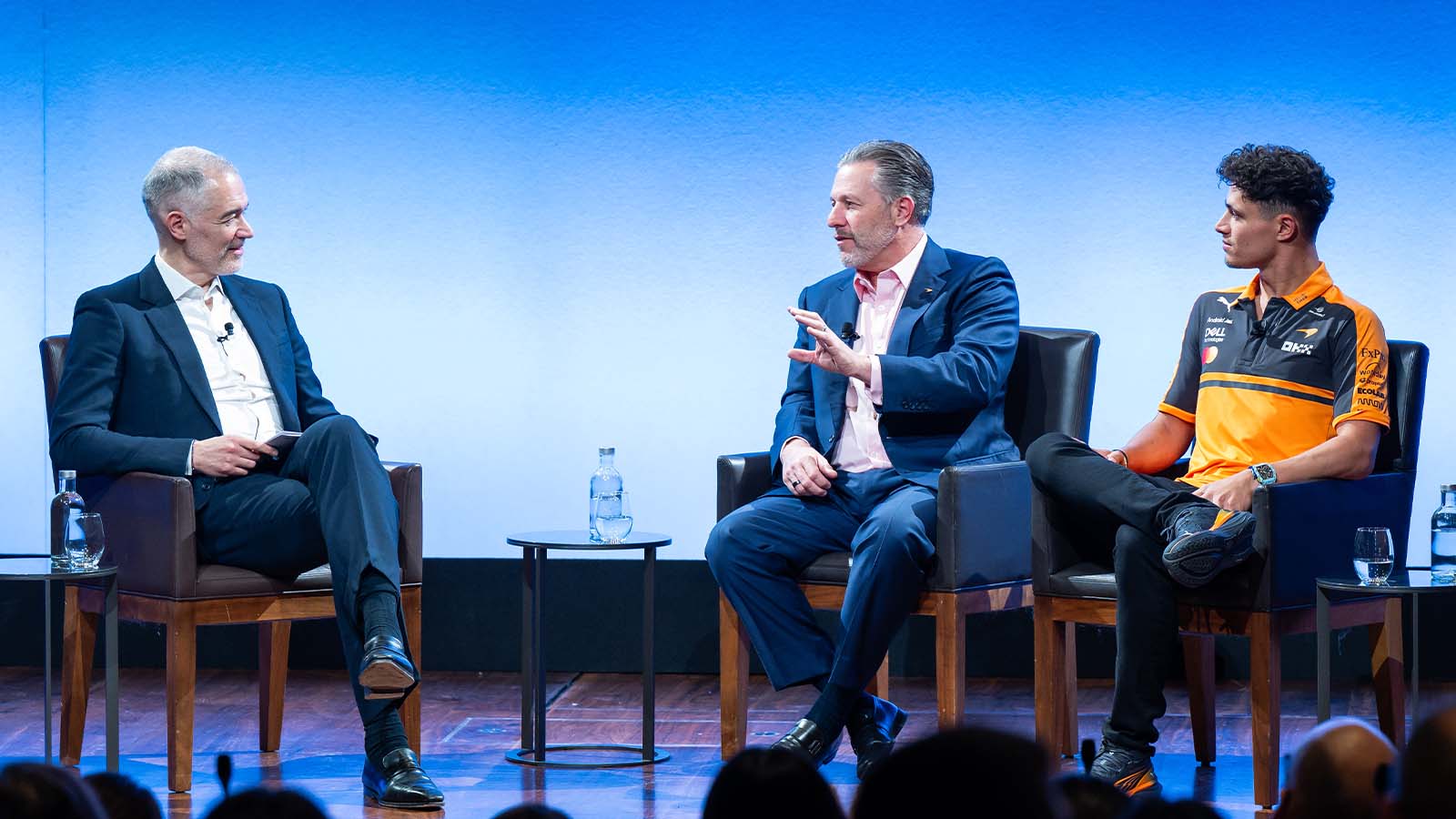
McLaren Racing returned to the forefront of Formula 1 through a culture of collaboration. Lando Norris, the 2025 Formula 1 World Drivers’ Champion, and Zak Brown, CEO of McLaren Racing, joined Anthony Gutman, Co-CEO of Goldman Sachs International, to discuss McLaren’s team-first approach to performance, the evolving technical landscape of Formula 1, and what has fueled the team’s resurgence. This episode was recorded on March 18, 2026.
Transcript:
Anthony Gutman: Welcome to another Talks at GS session. I'm thrilled to have two leaders of Formula One here. Zak Brown, who is the CEO of McLaren Racing, and Lando Norris, the winner of the 2025 Formula One World Drivers Championship.
Zak was a former professional racer. He took the helm of McLaren in 2018, and within just an incredible focus on cultural transformation and a restructuring, strategic restructuring. And Lando's beginning his eighth Formula One season with McLaren and has become a pillar of the team's resurgence. From his consistent podium finishes to, obviously, his recent world championship win, he's proven himself to be one of the most talented and resilient drivers. So it's great to have you here.
I know it's probably not the best way to start, but just tell us what happened this weekend.
Zak Brown: So, I was actually in Texas with our IndyCar team, so I'll start with it wasn't my fault. No, we ended up having two different battery issues on our power unit, so something that was out of our control. But these new technologies can be unreliable until you get on top of them.
Anthony Gutman: Lando, obvious question, but you spent your whole time building up to the race, then you get to that stage. What's the dynamic in your mind and how have you developed a degree of resilience around this stuff?
Lando Norris: Well, I mean, it was my first non-starter in Formula One. So, it's tough, especially because it was a race where there were safety cars, opportunities, one where we want to go out and score points. We want to keep ourselves in the race for the championship later in the year. It's disappointing. But it's life sometimes.
Anthony Gutman: Well, let's go from that to obviously, what was just an incredible year last year, in 2025. Tell us about your reflections, having had that incredible season and what you take from that into this year.
Lando Norris: I mean, you learn from every situation. Good situations, bad situations. We made our life very difficult, throughout the latter part of the season, especially. But since I was seven or eight years old, my dream was then Formula One. And I wondered what it was like to win a world championship. And then I spent seven years in Formula One with Zak, with McLaren trying to achieve it.
There's a lot that goes into it. The middle part of the season, I think I was 36 points down on Oscar. So the effort that then had to go in, the kind of level up that I needed to take in order to then try and outscore him through the rest of the year was - yeah, just takes a lot out of you. It's a lot of work behind the scenes that goes into these kinds of things, a lot of sacrifices.
So then when I started to see the progress, and you get to the end of the year, it gets pretty emotional. Especially the last race of the year, it's that first moment where I thought, this is it. Like this is what my whole life has led to this single moment of going out, trying to race for the team, race for my engineers, my mechanics, and allow my dream to come true. Like this was that moment. Which is odd to think of, that I got to envision my dream as a kid almost 20 years ago. And it took me 20 years to get to that point.
Anthony Gutman: How nervous were you that - before that last race?
Lando Norris: I mean, I was shaking. I was surprisingly calm for my own knowledge.
Anthony Gutman: Was he, Zak?
Zak Brown: He was. That's one of the things, when we first put Lando in a Formula One car, that struck me, is when we did free practice one and up against Fernando Alonso, a two-time world champion, just kind of how relaxed he was in the garage. It was kind of no different than when I'd seen him in Formula Three or Formula Two. And obviously, the nerves, I think, in any sport are extremely high, but not projecting them. I was probably more nervous than Lando was. I get very nervous before the start of races. But I think that nerves turns into adrenaline. From all the sports guys I've spoken with in all the various sports, the greatest players in their sports, they've all said, if you're not nervous, you're lying or you shouldn't be in sport. But I think those nerves kind of propel us forward. We like that adrenaline rush.
Anthony Gutman: So how do you decompress, Lando? Firstly, after a race, and then how did you decompress through the down season?
Lando Norris: Golf. Golf is my thing. Half of it is just is peaceful. You can go out, be with my mates. Play against Zak, whatever it may be, travel the world and get to do these things. So I get to go to lovely places. Therefore it's relaxing. At the same time, it feeds my competitiveness side, which is, if I'm against Zak or my mates, you always have that feeling of I want to beat them. I want to do well. So I kind of feed my hunger of being a competitive person, but I also get to just completely take my mind away from racing, from Formula One. And I see over the years, that's one of the things I found the most important, is like when I started, 2019, 2020, all I could ever think about was why did I not do this well enough? How can I do better there? This was good, but could I do better here?
Anthony Gutman: Sounds like Goldman Sachs, by the way.
Lando Norris: Yeah. Well, I think a certain part of you needs to have that kind of constant drive of what can I do better? But I learned that you've got to have those kind of breaks of going away, doing other things. Also, live my life outside of Formula One. But then also, just give myself time to kind of consolidate things, get away, come back, and then be able to refocus. Because I think if you're kind of thinking of the same thing for too often, it's easy just to dilute, to lose efficiency. And my efficiency has certainly gone up and actually making progress on myself, has suddenly been higher over the last year than it's ever been before.
So I think you've got to find what works for each individual. But having time away, going to play some golf, going to be with my friends, deejaying, partying every now and then, whatever it may be. It's got to be part of it and you've got to enjoy life at the same time.
Anthony Gutman: Let's talk a little bit about the season now, if we can. So big change this year in terms of regulatory and technical changes coming into effect. Can you, maybe, Zak, can you just talk to us about what you think that's going to do in terms of the competitive direction of the sport and how it affects you guys?
Zak Brown: Yeah. And I think you're seeing it now, which happens every time there's a major regulation change, the big teams tend to figure it out quicker than the smaller teams. Which then means the grid is more divided. And then over time that consolidates. We're currently the third quickest team. The big four are kind of in a league of their own. And so - in Monza last year, 9/10s covered the whole field. Now it was 4.5 seconds, because Cadillac's new to the game, so it's going to take them some time to catch up. So the field will spread out. The big teams will have a bigger gap than we had last year. It's going to be a huge development race, which is exciting because that's what Formula One is all about.
The rules are extremely sophisticated, almost too sophisticated. But these engineers at these race teams figure this stuff out very quickly. So you see things like a double did not start, we haven't had that happen in 22 years. But there was two other cars that didn't start the race and three that I think started from pit lane. That will all kind of go away over the course of the season. But from a fan point of view, that can be exciting. It's not a very exciting for us. But these cars are so bullet-proof that I remember when I grew up watching Formula One, watching cars break on the last lap while leading. Now, when someone gets in the lead halfway through the race, you just take it for granted.
So that lack of predictability can be exciting for the fans, not necessarily exciting for us. But it could be exciting for us, because for the times that we'll lose out, there'll be times over the course of the year that we benefit from that. The drivers need to recalibrate how to drive a race car, because these do some quirky things. They're still unbelievably quick Formula One cars, but in my 30 years of being in racing, you hit your top speed at the end of the straight. And this is the first time ever I've seen in motor racing, where you hit your top speed halfway down the straight and then, depending on your energy deployment, managing the second half of the straight and in fact slow down. But they come off like rocket ships off the corner. So the overall lap times aren't radically different.
I'm sure it's frustrating for the drivers kind of having to drive differently, but the cars will develop so fast, and we'll work with the FIA to modify the rules. And then ultimately we'll catch up to the technology. So we're two races in. I can't remember the last time there were four lead changes between two drivers at the start of a Grand Prix, like you had in Australia. Or the battle with Lewis and Charles was pretty awesome to watch. So once you kind of get into racing, regardless of what you're in, you're racing.
So new territory. Everyone has an opinion. A lot of people don't like change, understandably so. But that's making Formula One exciting. Back when we had perfect cars, 2004, Michael Schumacher won every race and everyone was talking about how boring the racing was. No one's talking about how boring the racing is because the racing is quite fascinating because a lot's going on. So it'll smooth out over time, things will consolidate, kind of get back to normal. And our goal is to win races this year. And it's early days. We got some work to do. Half of it on our chassis, and then the other half is on the power unit and understanding exactly how it works. And we're getting smarter every weekend. We would have got smarter in China had we done the race, but we'll come out fighting in Japan and it won't be long before we'll win in races.
Anthony Gutman: Lando, how different does the car feel, and what are the new elements of the design that are exciting to you? Or less exciting.
Zak Brown: It's lighter.
Lando Norris: It's lighter. I mean, there are certain things - the actual driving of the car itself is different and it's still enjoyable. It's a different car, and therefore you have to learn how to actually maximize just the car itself, its grip, the handling of the car, the characteristics. All of which are quite different. That's always the fun part. And obviously, I'm used to just going flat out in the straights half the time, bless you. And that's how you always growing up, for pretty much every single driver got used to doing the same thing. You're trying to break as late as you can, you're trying to get on throttle as early as you can.
This year, that's just absolutely not the case. You have to lift into a lot of the corners. You're decelerating into a braking zone, which is very - it can be inconsistent and very difficult to judge when to break. Because if you're decelerating from 340km an hour to, it can be almost like 280km, as you're decelerating, you're breaking point gets later and later. So it's a very odd sensation to kind of recalibrate your body with, because you're normally always used to accelerating at least. And then quite often not getting on throttle as early as you can in a corner now can help, because you delay how the battery deploys and you sometimes save batteries.
So there's quite a few very ingrained things that I've lived through since I was - I started racing, which I basically just had to throw out the window, forget about, and now have to recalibrate again. So as much as the engineers, the mechanics, everyone's learning about how to build a better car, as a driver, it also takes a little bit of time to adapt, to understand how to maximize everything.
Because we're talking about trying to extract thousandths of a second, hundredths of a second, tenths of a second are often seen as quite a bit of lap time. So as a driver, when you're trying to figure those things out, you're trying to get hundredths, it can be frustrating and it can be very difficult. But it's also what I enjoy and it's also my job at the end of the day.
So there's things I like about it, a few more things I probably don't like about it. But it's still Formula One and it's still what I love to do every day, but it's just different with how you have to use the battery and manage all of these things. It's a very separate thing from the past and some things are very much out of your control. Sometimes the system deploys the battery in a different way to how it would have done. You use the battery, then the next straight, you have no battery and the other guy has the battery and just comes straight back past you and it caused like some great racing on the weekend, and you saw some great battles. But there are a lot of situations where you're very much just at the mercy of what the system is doing and you can't really change that. And that's probably the only bit I personally don't like. Yeah.
Anthony Gutman: Feeling out of control.
Lando Norris: It's just feeling at the mercy of systems. Yeah.
Anthony Gutman: I mean, you spend your whole time sitting in the car and then you translating through what you're feeling and doing to your huge team. And it's all about the team, you've said that consistently. But just can you talk us a little bit about that collaborative process? I mean, in the good times and the bad times. I mean, how does it work when you're in the car and you're communicating with them and the changes you make?
Lando Norris: The most important thing is translating feelings into say, normal words and ways that our engineers can understand, some which maybe have never driven a car before and I've taken my engineers karting, to get to understand certain things of how I might feel things. So when I'm trying to say I'm feeling this or I'm feeling that, they're almost able to translate it and almost have that understanding themselves, rather than just going, what the hell is this guy saying? And then just doing something separate.
So, for me, that's very important, is relationships, first of all. And I've been with my engineers and my group now for, well, since I've joined in Formula One. So eight years. But I guess that's my job is to, yeah, translate my feelings through, I guess every driver does differently, but visually, what I'm feeling through my body and my movement through the steering wheel. From an audio point of view, what am I hearing now through the engine and the battery and how are those things working? To my engineers, who then can maybe put a better setup on the car and change the mechanical side of things, some aerodynamic side of things. To give me either a better feeling or a car that at times might be harder to drive, but potentially quicker.
And I have to make - we have to make those trade-offs of what do I think I can get out of a race car? Do I need a more comfortable car to drive so I can be more consistent, but maybe slower? Or can I take the risk of a more aggressive, more optimistic setup to get better lap times, but be more inconsistent? So I have to decide these things.
Then you got the final part, which is everything gets relayed back to the factory, back here in Woking, in the Technology Center. Where you have basically the rest of the team, another 900 people or so who are taking all of these comments and turning it into future parts. So they're redesigning the front wing, the rear wing, the floor based upon my comments and Oscar's comments. So you always want to make sure you're saying the right thing. Because that can develop a new part that gets made in two or three months’ time or one month time. That is my hope, let's say, and my knowledge that this will be a part that can help me win races down the line.
So, you kind of have short term, what can I do better now for the next session or in the session? And then you also have what's going to help us be a better team in one month, six months, one year's time? So there's already things now that I'm saying that I know can't change now, but I know that in March next year, even though we're still there now. There are things that we're already having to decide now to make happen on the car for next season. So it's a lot of say, pressure at the same time, not just on the driving, but to make sure that we're designing things and I'm giving good feedback for present and also future.
Anthony Gutman: Zak, you and I talked about this before, but one of the reasons why we care so much about this partnership is the culture of this firm is a culture committed to excellence and teamwork and collaboration. And it's very clear that you have a similar approach I've heard you talk about this before, obviously the papaya rules, but also you turned a team that was ninth in the championship to a winning team. I've heard you talk before about not having a culture of blame and fault. And can you give us some reflections on that?
Zak Brown: Yeah. I think it's our greatest strength. Because we've all got great technology and wind tunnels, but it's our people. The way we work together, I think we've been successful at having every person in our racing team understand that they have to be greater than their peer at the other racing team and whatever role they're in for us to win a world championship. people tend to look at the race car and think those people are the ones that have made the race car fast.
Of course, they have from a technical standpoint, but if you look at our ecosystem, there's no Formula One and McLaren and partners without a huge, awesome, engaged fan base. So you've got to have a great communications and brand team. You've got to have a great commercial team. We live in a cost cap world, so we have to spend our money very wisely, whether that is on the race car or in our work environment or our people. So finance plays a big role in performance of the racing team. HR, making sure that we're live, we're working 24/7, we're 24 races around the world. So taking care of our team and their families and friends to have everyone feel and work at their highest level.
Then you hand it over to the racing team. And I think, so when we win on Sunday, everybody feels that they contributed to when Lando or Oscar won the race. They all feel like they contributed to the success. And so that gets everybody rowing the same direction.
When we have problems we tackle problems, we don't tackle people. Because nine out of ten times when you have a problem, it wasn't a person's fault, it was a system failure, a communication failure, a kind of a team failure. So tackle problems, very straight talking with each other. So we have hard conversations, but kind of don't take it personally. If we don't think you're good enough to be on the race team, you won't be on the race team. So if you're here and we're talking about it, it's because we know you're awesome. But we can all constantly improve. And our business is about every day, just the smallest marginal gains.
Spain, we finished first and second, and there was probably eight areas that we could have risked that first and second. So we're constantly challenging ourselves to do better, knowing that we're trying to get to perfection but you're never going to get there. And so, when you get everyone buying into that, it's amazing.
And then having a lot of respect for each other and having an environment of everyone's innocent until proven guilty. Because when you get into a negative mindset of what we call a loser's mindset, people can start blaming each other. So tough start to the year for us and we're in a great place. Are we happy about it? No. But we're going to channel that frustration and anger into passion and determination. And that's what drives a great culture. So we're going to lean into our culture more than ever when things are challenging.
Lando Norris: It's a very weird sport, I guess, because it's probably one of the only sports where your team-mates. We have to work together. Deep down you also want to beat each other more than anything. But we turn that into a good environment rather than, there's been plenty of examples where they get really head-to-head against each other and that causes a bit of an implosion within the team. So Zak and Andrea manage these things very well. And I think we have a very good understanding that we know we want to beat each other, the team knows that. But we also know that we have to work together and those kinds of things.
Zak Brown: Those are our racing values and that's been McLaren's racing values before I was at McLaren. And that was one of the reasons why they were always my favorite team growing up. And we've had multiple world champions at the same time in our cars. And so to me, we want to, as a team, have the two best drivers in the world, which we have, give them equal opportunity and let them decide. we never even discussed changing that. It was never even a conversation. And the fact that we had both drivers go down to the last race with the chance to win the world championship is exactly what we wanted to accomplish as a team. We're quite proud of that.
And there were incidents on track and there will be incidents in the future on track. You can't have two great racing drivers who both really want to win, let them race, and then be naive and think they're not going to wipe each other out every once in a while. And as long as it's not intentional and malicious, which is what you have seen with other drivers, they're just racing incidents. Then as long as kind of leave the helmet on, don't let the media wind you up, let's just talk about it, then we're going to be able to kind of work through it. It's when you see the drivers driving each other off the track, which you see team-mates do all the time, that that's unacceptable.
And so that's exactly how we're going to continue to race.
The rules aren't quite as sophisticated as they've kind of taken on a life of. We just come over the radio, I think it was Tom, said to Oscar, don't forget papaya rules. And then it just became a thing. Had he just said, Oscar, remember how we race, papaya rules would have never become a thing. But actually, I think it's kind of fun. And so, we're going to stay true to that. I think that's the only way to go racing.
Anthony Gutman: Well, that's a great way to end. And, look, on behalf of everyone here, everyone at the firm, we're your biggest fans, both of you. We wish you huge luck in the rest of the season.
Lando Norris: Thanks, everyone.
Zak Brown: Thank you.
The opinions and views expressed herein are as of the date of publication, subject to change without notice, and may not necessarily reflect the institutional views of Goldman Sachs or its affiliates. The material provided is intended for informational purposes only, and does not constitute investment advice, a recommendation from any Goldman Sachs entity to take any particular action, or an offer or solicitation to purchase or sell any securities or financial products. This material may contain forward-looking statements. Past performance is not indicative of future results. Neither Goldman Sachs nor any of its affiliates make any representations or warranties, express or implied, as to the accuracy or completeness of the statements or information contained herein and disclaim any liability whatsoever for reliance on such information for any purpose. Each name of a third-party organization mentioned is the property of the company to which it relates, is used here strictly for informational and identification purposes only and is not used to imply any ownership or license rights between any such company and Goldman Sachs.
A transcript is provided for convenience and may differ from the original video or audio content. Goldman Sachs is not responsible for any errors in the transcript. This material should not be copied, distributed, published, or reproduced in whole or in part or disclosed by any recipient to any other person without the express written consent of Goldman Sachs. Disclosures applicable to research with respect to issuers, if any, mentioned herein are available through your Goldman Sachs representative or at http://www.gs.com/research/hedge.html
Goldman Sachs does not endorse any candidate or any political party.
Subscribe to Briefings
Our weekly newsletter delivers the latest insights on economic forces shaping markets—from Goldman Sachs leaders, economists, and investors around the world.
You can unsubscribe at any time. For information about how your personal data will be used, visit Privacy Information and Resources.