

Talks at GS
From Automation to Autonomy: The Future of Industrial AI with Honeywell Technologies Chairman and CEO Vimal Kapur
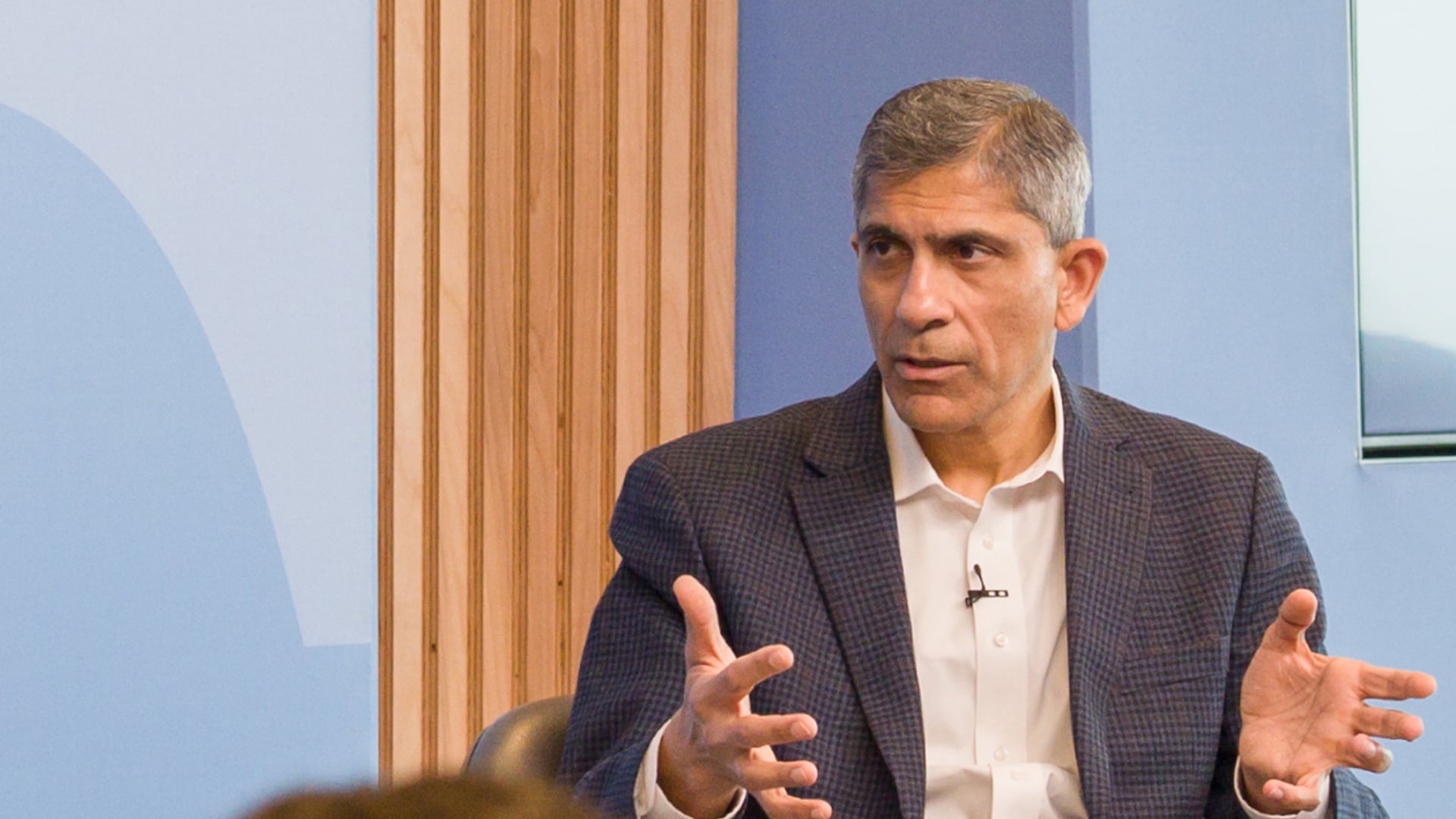
Honeywell Technologies Chairman and CEO Vimal Kapur joined John Waldron to discuss the organization's transformation into a more focused automation company and its strategy to unlock growth through innovation, disciplined M&A and portfolio simplification. The conversation also explored the company's focus on physical AI's transformative potential, the importance of human-led decision-making in industrial settings, and how Honeywell Technologies is helping address complex challenges that shape daily life.
Transcript:
Vimal Kapur: There are a lot of unsolved issues in the world which can create a lot of human value. Every day what we do improves human quality of life behind the scenes. So, we can't be pessimistic and just hunker down and stop everything. We just need to keep progressing.
[MUSIC INTRO]
John Waldron: Welcome to Talks at GS. I'm delighted to be joined today by the chairman and CEO of Honeywell, long time client of Goldman Sachs, one of the most important companies in the world, Vimal Kapur. Let's give him a round of applause.
Vimal Kapur: Thank you.
John Waldron: Vimal has been with Honeywell for over 35 years. I'm celebrating my 26th year at Goldman Sachs. So, I'm super impressed with that. That's another level of achievement. Serving in a range of leadership roles across its automation and materials businesses. In his current seat, Vimal's been focused on driving growth and transforming Honeywell's portfolio through $14 billion of strategic acquisitions. Having worked with Honeywell a long time, they've been very adept at making important acquisitions, adding to the business portfolio of the company.
He's also the architect behind its upcoming separation of three public companies. Which we're going to talk about here shortly. Honeywell Aerospace, Solstice Advanced Materials, and Honeywell. After the separation, Vimal will continue to lead Honeywell as chairman and CEO. Thank you so much for being here.
Vimal Kapur: Thanks for having me, John, here. And look forward to it.
John Waldron: All right. Let's get into the separation. We're going to kind of work maybe backwards a little bit from there. So, why did you do it? What drove the decision? And how do you think about value creation for the shareholders and the other consistency of Honeywell?
Vimal Kapur: So, you know, it was a bit of a long journey. I interviewed for my job in early 2022 and started my job in '23. And what I presented in the interview was that we are too complex a company and we need to do something simple. So, that's kind of your hypothesis to say, you know, we have come to a point that complexity is becoming a barrier to our next chapter. So, I started in '23.
And incidentally, two things happened at the same time when I started as CEO. The aerospace cycle started about that time. And ChatGPT moment happened in December '22. So, I was grappling with the two questions that ChatGPT is likely to have an impact on automation in a significant way because we create so much data, which we never use. So, what will it do? And how will it impact our business? It was clear something big is going to happen. It was unclear what.
And then, can aerospace grow within the Honeywell umbrella? Or it needs to be unleashed with the capacity and capability you have? And that really took my idea to have to do something simpler to do more, make the decision to split into two companies. But then there was the chemical business which didn't fit into any one of them. And then we said we need to do three. But we also need to do significant portfolio adjustments. If something doesn't fit in, we should divest those businesses too. So, it became a harder task.
But at the end of the day, I would say that now I feel that was the right decision. Two years or two and a half years since we talked about it. And of course, Goldman was a big part of the process. Helping us walk through different scenarios. Helping us walk through with a board. It’s a board of the combined company, convincing them to split into three is not easy because there's the emotional aspect of humans, apart from the practical aspect of it. But I think we dealt with all of that pretty well.
And I would say now I feel more convicted versus what I felt, you know, late '23 when we really started this process. So, it's been a nearly two-and-a-half-year journey for us now.
John Waldron: As long as I've been around Honeywell, automation has been, you know, a big factor. You know, a lot of first of kind innovations. Energy infrastructure and the like. How would you characterize automation today? How much automation opportunity do you see in the forward? Obviously, it'll have an impact on the value creation and the separation. Just talk about the automation opportunity, if you would.
Vimal Kapur: So, automation, first we have to really understand what really the automation business means, because one of our, I think, both challenge and opportunity is we're creating a new category of stock called pure-play automation. I think automation fundamentally drives when you, the world still is creating more infrastructure. We are still building more hospitals, data centers, pharmaceutical plants. We are still building more LNG plants, utilities, semiconductor fabs. All that requires automation. There's no way humans can run it without sophisticated automation systems. So, that became your basic business.
The segments we serve that benefit from these segments are mission critical. Therefore, it requires significant service just to keep it up and running. Because everything we do cannot fail. It has to just keep working 24/7, 365 days. So, we get a lot of our work from front-end capital spend. And then we get about-- so, 60 percent comes from capital spend. 40 percent comes from OpEx spend, after-market services and software. Which makes it naturally the segment more like a mid-single digit grower. More secular because you serve multiple end markets. And you also serve the entire globe. So, you kind of can deal with ups and downs of, like, current conflict for example. We can generally deal with that. We can deal with some suppression in one end market because we don't have exposure to one thing, we're just so deep, that we can ride or fall with it.
And the bigger opportunity is this CapEx/OpEx baseline is well established for us and our peers. The bigger opportunity is AI. The automation industry has worked so far is you use the data to solve a problem. So, you get input. You sense and you act. That's what these systems are designed for. These are very deterministic systems. And they perform the defined tasks.
But the data which we are sensing, we've never used it other than controlling what we were asked to do. And the data is available immensely into our underlying infrastructure of Honeywell automation systems, which are in tens of thousands of sites. Millions of assets.
So, the question is, why would you like to mine the data? What problem are you trying to solve? And what business opportunity will it create?
And that, to me, is moving from automation to autonomy. And that is likely to occur, in my view, over the next five to ten years. So, this basically makes it a three-bite apple. The business or growth or capital cycle. You get a tailwind to OpEx cycle because you need to maintain and service it. And then you have a compounding power through AI because this is unused data, manage your assets better, drive more operation excellence. So, that's bound to happen over the next-- and that's where we are really spending our energy. Which makes you kind of the-- the power of focus. We wouldn't have asked this question as a diversified company. And as a focused company, that's what you ask every day.
John Waldron: You're leading into my next question which was really about the competitive landscape because you're not the only company trying to drive automation business. Do you think you'll invest more and put more dedicated resource into the business because it's not competing with the other parts of what was Honeywell?
Vimal Kapur: Yeah. So, we already raised our R&D dollars significantly last year in 2025. Now our R&D spend is 4.8 percent of our total revenue. So, if we grow mid-single every year, we get to spend that much money by default, extra by without really, you know, raising the baseline. So, we took a step up by about 40 to 50 basis points.
Because for us, the growth is driven by new products. This business is pretty simple. The growth margin is pretty simple. How much you grow through new products; how much is price? That equals to organic growth. And you do a good job on managing your cost base and margin, expansion should come just by volume leverage. So, new products being the heart of it, you have to spend more money in R&D. And spend it wisely.
Spending more money, and I always tell my team, spending more money does guarantee you more growth. You know? More money in the pocket doesn't mean you spend it wisely. But you have to also spend it wisely means understanding your end markets better, understanding your customers better, meet the needs which are known and unknown.
So, a lot of that is a big part of our focus area. So, we are able to spend much more time to only do that. I spend the majority of my time to think about what segments we serve, what segment we should not serve, which offerings we don't have? When you meet with a customer, what are the words they are using? And don't link with your product, but look at the outcomes they are talking about. And build your offering towards it. That, to me, is the biggest focused company's opportunity to always think about customer need.
John Waldron: And the R&D spend is mostly AI driven at this point?
Vimal Kapur: R&D spend increase, I would say, is a combination of maintaining our core, because core will always give you the bulk of your growth. So, how do you keep your share and grow some with a competitive differentiation? And then you invest proactively into AI, our Forge platform, which allows us to collect all the data and then build AI algorithms on top of it.
So, we have invested a lot. It became break even last year. So, it's no more a loss leader. So, we make money out of it. But the compounding power of that will come over the next several years because I would say we are not even near zero because as we get more and more data and able to build more specific outcomes for our customers, it's just going to give us more outcome there.
John Waldron: You talk about physical AI, which again, I think is back to our prior conversation a little bit about data. But describe what you mean by physical AI.
Vimal Kapur: It's important to differentiate between AI we all experience in our life versus physical AI, which comes from, you know, systems we operate. First and foremost, it's that we are solving a known problem. The problem in the industrial world is how the automation system are built is it's an automated process. But exceptions are managed by human beings. That's the kind of principle of design. So, let's say you think of a plane. We all know planes are most autopilot. But why there are two pilots? They're dealing with exceptions. Bad weather. Route changes at the last minute. So, humans are required to deal with exceptions.
Over the last ten years, the skilled people running these high-value assets are less and less available, either due to retirement and people's willingness to get into this profession. And the lack of the population increase is making this problem worse. I mean, the replacement rate in the US is 1.6. Most countries I go, I Google the replacement rate, actually it's 1.5 pretty much in all the world today. When you go to China, you go to Europe, you go to Japan, you go to Korea, you go to India, everywhere it's somewhere between 1.5 and 2.
So, there are skill shortages. And it's going to get worse. So, that's kind of a problem to think about. So, you have a high-value asset - a $10 billion semiconductor fab. A $10 refinery. $5 billion data center. You need people to run. And those people are not there. So, that's the kind of problem you're solving.
So, how do you solve the problem? The physical AI is when you say physical AI, the image that comes to mindset is humanoid and robotics, which are more in the discreet manufacturing where you make widgets. We don't serve that segment. We serve the segment where things are being done continuously. It's like up and running system 24/7.
The data in our systems is not in the public domain. The data is in our system. So, you can't show up and train anything on internet unless Honeywell and JCI and Emerson and Rockwell and all these companies collaborate and are willing to share the data. So, the first friction is data.
The second friction is domain. Because problems of what to solve, fundamentally, the problems are the same. Asset up time. Operational excellence. And people skills. But nuances change by industry. So, like a pharmaceutical plant has one set of problems. They want minimum quality rejects. That's what they want. But if you go to a hospital in the same sector, they want up time. They want nothing to stop because it'll be chaos for them. So, you need to know the context of what to solve for.
So, what makes physical AI very interesting is you're solving a known problem, which is a skill shortage. And you're dealing with this data friction issue. And you're dealing with domain issues. So, once you're able to pull together an offering with that in mindset for each specific segment, that gives you the incremental value proposition to your customer.
Customers don't want dashboards. The moment you say, "I can get a lot of data analytics on a dashboard," they will switch off because they have lots of them. They want to solve a problem. And the problem "Is I don't have people, what do you want me to do?" And you say, "Well, here is a new set of tools. I'm reducing your work by 20 percent. But you need these people skills to offset that." And now you're talking because you're giving them a solution which is tangible and you're offering them an offering which is part of their new work order. And that's basically is a physical AI word for us. And it's an exciting part of the work.
I think we are more in the early innings. But as more and more it gets penetrated, that's going to be the compounding power of--
John Waldron: So, where do you come out on the question of humans in the loop? And then the broader question of employment?
Vimal Kapur: Yeah. So, employment for us is less contentious issue because problems start with having a lack of people. So, we're not fighting that because we are looking for a different skill mix versus looking-- absolute, you know, we'll mainly lose about 5 to 10 percent. Which I would argue in an industrial system is very common. Industrials look for 4 to 5 percent productivity every year. So, this becomes a new way to get there.
And the autonomy, to us, the human in the loop question is we'll likely build systems which are more augmented and less autonomous. Autonomy is possible in few end markets we do, but not many. Most of us is we give a set of tools and make humans to make the final decision. Is human most looking for data? You don't have to do that anymore. I'm going to save you four hours a day to look for data. I'm going to give you right in front. Or I'm going to give you three options. But you have to make a decision. I'm not going to make a decision for you. So, it's basically agentic systems which coexist.
I think the best analogy is most of us when we still drive, even on the known road, we put Google Maps. Why do we do that? Why do we still put Google Maps? Because we're concerned the route will change. Or traffic will show up. There could be blockages. So, I must be prepared for alternatives.
So, it is telling you the options. It's not forcing you. It's your choice. It's very similar. You still have to make a decision. What's a better choice? Is it safer? Is it productive? It's not going to be any risk? And that's where this is in coexistence with the humans.
But you need now people with different skills to use the system. So, it's a skill mix which is going to change. And that's kind of where we have to work with our customer on the change management portion. Which is a bigger challenge than just developing the core offerings.
John Waldron: Yeah. Okay. Let's shift to quantum computing. You've talked about it as a national capability. What do you mean by that? And how does it fit into your thinking?
Vimal Kapur: So, quantum computing. I mean, there are a few problems humans haven't solved. You know? Aging. Fusion. Quantum. These kind of couple-- I read Quantum Computer in my college in the mid '80s, slides and books. It always existed. So, to me, quantum doesn't compete with anything. It compliments classic compute because classic compute based upon zeroes and ones have natural limitations beyond which it cannot perform a certain task. So, quantum is supposed to perform those tasks which are, you know, discovering new drugs, solving extremely complex algorithms.
So, where it has evolved over the last, I would say, ten years is more so in the last one year is the physical engineering problem has been solved. We have a quantum computer today which will soon have more power than a classical computer in a year or so. There is zero doubt about it. This is not if/when. Because the science problem has been solved. We have to solve the engineering problem now.
The real shift is now where to use it, you know? The so-called what classical computer cannot do which this will do, one of the use cases and what’s the economics equation: where there's a value creation equation. So, it's more in that phase.
I would give two to three years time for that phase to get over. And I always remind everybody that the ChatGPT moment when it happened in December '22, there was no forecast of it. There was no news in the Wall Street Journal it's coming up in 30 days. It's just going to appear. It's just going to say, "It happened. And three companies figured it out. Two banks figured it out." And that will then create a slow inflection to this.
So, it has a meaningful impact on evolution of the problem which humans have not been able to solve so far. I think drug discovery is the biggest unsolved opportunity in my view. Cryptography is another in which banks will have a role to play. And I remain very optimistic that, you know, this is going to be complimenting the today's world of high compute from AI towards quantum computing.
John Waldron: Makes sense. I really like this question because it kind of resonates with me, which is you've spent most of your career away from headquarters. All over the world. Different jobs. Reporting into headquarters. You got more and more senior. And I've heard you say, you've said it to me, it sort of impacts how you think about bureaucracy and how you think about now being in charge and how you deal with everybody out in the field. Just talk about that.
Vimal Kapur: Yeah, you know, I think--
John Waldron: You've got a whole firm of people that are highly focused on that at Goldman.
Vimal Kapur: I know. I think the big companies can create a lot of headquarter function which can create a lot of work without any incremental value. And that's what really I want us to question. So, I have the benefit of being on the receiving side for, like, 30 plus years. So, I've been, in my mind, questioning why does it exist and, you know, what's the need for it?
So, first and foremost, I believe that the metrics can be simplified as a first step. You know? We can have three, four, five-dimensional metrics. I think two-dimensional metrics are good enough. Sometimes you made three dimensional. So, that portion can be simplified dramatically.
And businesses have to make more decisions. And corporate needs to find its own role. When that separation of duty occurs, then corporate becomes lighter because you know, "I only do these three things." You know? Corporate should focus on portfolio. It should focus on operating system. Should focus on talent and telling the story to the street. That's my job.
How much influence I can have in day to day running a business? The answer is not much. So then why should I have many decision rights? What value am I going to add? So, I think thinking in that way.
I think challenging yourself and reinventing is important. And then it really boils down to the decision right equation. And can the corporate get over that I need to control everything? I think if we define that well, it should be easier to have, you know, more value added. It’s absolutely required. As a public company, you need, definitely, multiple roles. You can't be a public company without it. But if you try to now interfere in the decision of the businesses, I think that's where the overall starts occurring.
John Waldron: Yeah, that makes sense. How do you manage your time? How do you think about your time allocation? How disciplined are you? Do you have a system around that? What's your--
Vimal Kapur: I'm more disciplined than anybody would like to have. I think as a leader, if you can't manage your time, you're sending a signal you cannot manage the organization. But that's the first signal. If every meeting starts late and half the meeting gets cancelled, you're essentially sending a signal you don't know how to manage yourself. And then you're trying to manage a large company. You know? So, I'm very particular about managing every meeting on time.
I typically show up two to three minutes before. If people are not there, I don't really make a big deal of it. But managing time is important.
I do look at my calendar every 90 days. I have a thesis on how should I spend my time. I tell my admin to track it in those buckets. Essentially, I want to spend one third of my time externally, with a customer or with our sales team. Anything external. About 30 percent. And I'm generally able to maintain that. It's not perfect every quarter. Sometimes it can be more or less. But define your goals. And manage them well.
And have boundaries. I never stay late in the office. I leave home at 6 o'clock. I pack my bag. And I'm gone. Everybody knows it. So, when you put boundaries, I think the time manages itself better. If you give time a lot of flex, you know, it's not going to get there. So, I think as a leader the biggest skill is-- the leaders biggest scarce resource they have is time. That's the only thing that's not in our control. There are only 24 hours in day. You can't add more. So, if you don't know how to manage them, you can't be an effective leader.
John Waldron: What's your most optimistic thought as you look to the future in a pretty complex world right now?
Vimal Kapur: I think there are a lot of unsolved issues in the world which can create a lot of human value, which makes me optimistic relative to the segments we serve, there are a lot of unsolved problems. And I think the political system has become more, I would say, it was a constant for the last 20 years till 2020. Then the political system in the world has become a little wobbly. But my theory is probably it will settle back again. Once this cycle is over, it again becomes stable. So, we have to remain optimistic on how to create economic value, how to make human generation, you know, better quality of life. And that's the job what we do as a company. Every day, what we do improves human quality of life behind the scenes. And we can't lose the bigger purpose. Which makes me optimistic. Because if we stop working, the next progression on what can happen is not going to happen. So, we can't be pessimistic and just hunker down and stop everything. We just need to keep progressing.
John Waldron: Good. Yeah. Vimal, thank you for being here.
Vimal Kapur: Thank you.
John Waldron: Thank you for the relationship with the firm. And good luck in the future.
Vimal Kapur: Thank you very much.
This episode was recorded on April 13, 2026.
The opinions and views expressed herein are as of the date of publication, subject to change without notice, and may not necessarily reflect the institutional views of Goldman Sachs or its affiliates. The material provided is intended for informational purposes only, and does not constitute investment advice, a recommendation from any Goldman Sachs entity to take any particular action, or an offer or solicitation to purchase or sell any securities or financial products. This material may contain forward-looking statements. Past performance is not indicative of future results. Neither Goldman Sachs nor any of its affiliates make any representations or warranties, express or implied, as to the accuracy or completeness of the statements or information contained herein and disclaim any liability whatsoever for reliance on such information for any purpose. Each name of a third-party organization mentioned is the property of the company to which it relates, is used here strictly for informational and identification purposes only and is not used to imply any ownership or license rights between any such company and Goldman Sachs.
A transcript is provided for convenience and may differ from the original video or audio content. Goldman Sachs is not responsible for any errors in the transcript. This material should not be copied, distributed, published, or reproduced in whole or in part or disclosed by any recipient to any other person without the express written consent of Goldman Sachs.
Disclosures applicable to research with respect to issuers, if any, mentioned herein are available through your Goldman Sachs representative or at http://www.gs.com/research/hedge.html
Goldman Sachs does not endorse any candidate or any political party.
Subscribe to Briefings
Our weekly newsletter delivers the latest insights on economic forces shaping markets—from Goldman Sachs leaders, economists, and investors around the world.
You can unsubscribe at any time. For information about how your personal data will be used, visit Privacy Information and Resources.