

The Markets
Shawn Tuteja on Bubble Concerns and the AI Trade
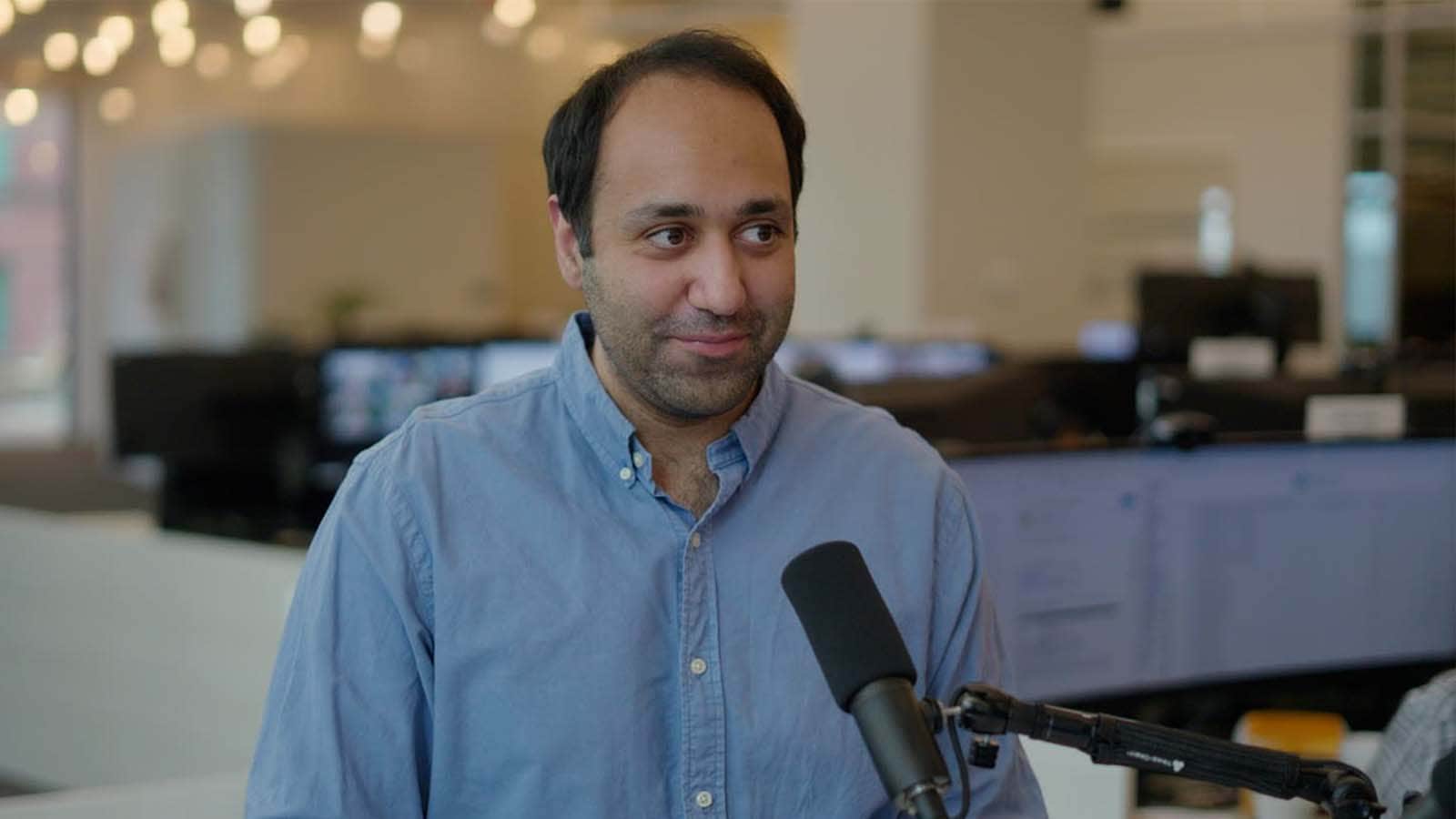
As AI stocks drive the S&P 500 and Nasdaq to record highs, are fears of a bubble warranted? And what are the newest opportunities in the AI equipment trade? Shawn Tuteja, who oversees ETF and custom baskets volatility trading within Goldman Sachs Global Banking & Markets, discusses with Chris Hussey.
Transcript:
Chris Hussey: This is The Markets. I'm Chris Hussey and today is Wednesday, May 13th. And I'm here on the Goldman Sachs trading floor with Shawn Tuteja who oversees the ETF and custom baskets vol options trading desk within Global Banking & Markets. Shawn, thanks so much for joining us.
Shawn Tuteja: It's always fun to be on.
Chris Hussey: All right, Shawn, SPX is up 16 percent. NASDAQ's up 26 percent. I think semis are up like 70 percent off those March 30th lows. What's going on? What happened?
Shawn Tuteja: Yeah, it's amazing because we're still in the middle of a large geopolitical conflict where oil prices are still very elevated. And as you mentioned, you just look at it, and S&P is up 8 percent on the year now. NASDAQ's up about 15 or 16 percent on the year. Semis, you know, they go up every single day it feels like. And it really feels to me like it's a tale of two markets. There are the AI stocks within US equities, and anything that's related to the AI trade, whether it's the hyper scalers, the semiconductors, the data centers, the equipment. And then there is the rest of the market.
And the indices that you mentioned, the S&P, the NASDAQ, so much of that concentration in those is now these AI names. And so, we've just gone through another earnings season just about here in the S&P. We're about 90 percent of the way through. And EPS growth is tracking at plus 17 percent year over year which is the sixth consecutive quarter of double-digit earnings growth.
Now, as remarkable as that is, what's even more remarkable is that the expectations for the next 12 months of EPS growth have now been ticking up to plus 13 percent. And if you look at it, in one way you would say, well, the S&P is up eight percent year to date. EPS growth over the next 12 months is up 13 percent. So, the multiple has actually compressed from 22 to 21 times. So, if anything, earnings are doing most of the heavy lifting.
Now, that's not to say that a 21 times multiple is historically cheap by any metrics based on everything that's going on in the world. But I think what it does show is that so much of these indices are concentrated to AI. And the AI story is still fundamentally intact in terms of earnings. And they're still growing at a very rapid rate.
Chris Hussey: Yeah, that's a great point. AI is driving so much earnings. It's funny though because going into the year we had this call around HALO stocks outperforming even the AI stocks. And it was working. What happened to that? You're talking about a tale of two markets. What happened to the other side of the market, that HALO side?
Shawn Tuteja: It's amazing because when we sat here three months ago and did this podcast at the beginning of the year, the whole theme around the market was a broadening out trade. It was that the conventional leaders, US tech, hyper scalers, etcetera, were getting sold in exchange for more cyclical equities to start the year. The view was that there was going to be above trend growth, below trend inflation, and a Federal Reserve who could start cutting rates as soon as the summer into a very hot economy.
And so, a lot of our clients at the beginning of the year said, "In a world that has plentiful growth, we should be looking for names in the home builder space, in the consumer space," which was supposed to get relief from the tax refunds that were part of the One Big Beautiful Bill last year, as well as from potentially the Supreme Court striking down tariffs, which ended up happening.
And there were a lot of things to get bullish on in terms of the real economy, whether it be as well the industrials, what we call the cyclical equities. And what's ended up happening is you can't really see it in the price of S&P because it's so dominated by AI, but there has been a real growth shock and inflation shock because of how high oil prices have been because of the geopolitical conflict that we're seeing right now. And so, that's affected a lot of these cyclical equities. And we're seeing this massive rotation back into the hyper scalers, back into the AI names as people view that story as more inelastic demand and able to withstand the things that the consumers aren't. Because now we're in a really murky macro world where there's very high inflation. And we thought the Fed was going to be cutting. Now we're hearing clients say that the next move might actually be a hike just given that we had an extremely high PPI this morning, really high CPI yesterday, and the growth numbers are starting to deteriorate a week. And the Fed might be a little handcuffed, which is not a good setup for the rest of the economy or the real economy, we should say.
Chris Hussey: So, square the circle there because, you know, as you pointed out, six straight quarters of double digit EBS gains. But all this ahead of us. And maybe a Fed hike. And as you say, the real economy actually showing some stress. Are we in a bubble?
Shawn Tuteja: So, no, I don't think we're in a bubble. And the way that I define a bubble would be you have a stock or group of stocks that go up for, call it, a day, a month, a year, two years, whatever it is on air. And when the bubble pops, so to speak, they go back to the levels that they were at to start all of this.
And when I look at the AI complex, there are a lot of things that fundamentally are working in that complex. If you look at the hyper scalers, they've committed to spend $755 billion this year in capex, which that number is just completely mind-blowing. That's up 38 percent year over year in terms of capex growth. And that's why the semiconductor earnings are always beating because there's just so much capex going into the trade.
So, do I think that when things start to draw down that they're going to go back to levels that we saw two years ago? No, I don't. But what I will say is that we have something called the GS Risk Appetite Indicator which is effectively a measure of how willing our clients are to take risks and how willing the market is to put on risk. That's at five-year highs. You look at our prime book; semiconductor exposure is making new record highs every single day.
And so, what I do think the market is underappreciating is that even in up trends, you can have two-way volatility. Things don't just go up all the time. They can also have violent corrections. And we haven't really seen that. And what worries me a bit more about the market right now, especially the semiconductors and AI story, is how much leverage there is in the system. There are a lot of levered ETF products that have launched that get you 2X exposure to semiconductors or 3X exposure to semiconductors. And those products inherently are what we call short gamma products. Meaning, to keep their constant leverage on days when the underlier is up, they need to buy a bunch on the rebalance. And on days when it goes down, they need to sell a lot.
And so, the reason that worries me is as leverage increases and as positioning and exposure increases, you could have a moment where something fundamental comes out that's negative and a stock should be down 3 percent. But because of all these deleveraging forces that exist in the market, 3 percent can turn into 10 percent very quickly on the downside. Just like we've seen it turn into that on the upside. And I think that that's something that's underappreciated.
Now, does that mean that we're in a bubble because we could have a 10 or 20 percent drawdown? Absolutely not. But it does mean that there could be some two-way volatility in the market.
Chris Hussey: Yeah, that's a great point. When you have a forced seller in there in a leveraged situation, it can exacerbate downturns. Talk to me a little bit more about the AI trade then. Where is it now? What's the theme that you want to play in that AI trade?
Shawn Tuteja: You know, so for the past three, three and a half years, AI has been the talk of not just the US markets now but even more so now recently the international markets. And when I look at the evolution of the AI trade, you know, at the end of 2022/beginning of 2023, it started with people looking for the picks and shovels, which were the semiconductors. Then it kind of expanded to the people funding AI, which are the hyper scalers via capex. And then it transitioned to the data centers, the people who are powering the AI trade. And then AI equipment.
So, in the last six months, what's really been in trend has been memory chips. Memory chips are things that have been around for decades. But now that there's an AI application, there is a lot of euphoria in names that have to do with AI memory. More recently, it's shifted to fiber optic cables which are effectively the cables that allow for high-speed transfer of data within these AI data centers. And those are more efficient than the previously used copper cables. And so, this optical networking theme is up over 100 percent year to date.
Chris Hussey: Yeah, it's fascinating. It's almost like walking through the AI hardware store and trying to pick out the shovels that we're short of.
Shawn Tuteja: Absolutely.
Chris Hussey: That's a great idea. All right, so what's the trade?
Shawn Tuteja: Our baskets team sees the next spin off or the next iteration of the AI equipment trade being within liquid cooling. So, traditional data centers consume a lot of electricity using traditional air-cooling systems almost as much goes into cooling as it does to actually producing the AI. But with liquid cooling technology, you can significantly reduce by as much as 10X the amount of electricity that goes towards cooling. And you can shift that more towards the power and distribution of actually fueling the AI trade. And so, we think that's where the puck is going. The theme is up about 30 percent year to date. And we're seeing that trend catch on with a lot of data centers looking for that type of equipment.
Chris Hussey: All right, we're in the middle of May. Traditionally this is "sell in May, go away." What are you looking for though over the next month or two?
Shawn Tuteja: I think the most important thing is to watch back-end bond yields. So, this morning as we're talking, 30-year yields have eclipsed the 5 percent mark, which is a huge psychological level to even equity investors who look at yields for a lot of their tech investments or a lot of their more, like, levered equity investments, etcetera. And I think that, again, it speaks to the tough position that we're in with rising inflation into a potentially weaker growth environment.
We also have about 10 to 15 percent of the earnings season left, with the largest company in the United States, largest company in the world reporting earnings next week, which will continue to show signs of how capex is being spent in the AI trade and the next steps of the AI trade.
And then lastly, you have the US and China meeting this week. And I think that that's really important because when you look at China equities, those have been the notable underperformer in terms of the rest of the world. You've had such strong performance in Japan, Korea, Brazil. And I think that a lot of investors are looking to China as are things going to open up more. And are some of the China tech companies and China AI an investable story going forward? And maybe we'll learn more after these meetings.
Chris Hussey: Yeah, three important things to look at. Rates. Semis. And China. We will keep our eyes open. Shawn, thanks so much for joining us today.
Shawn Tuteja: Thank you for having me.
Chris Hussey: That does it for this week's episode of The Markets. I'm Chris Hussey. Thanks for listening.
Date of recording: May 13, 2026.
The opinions and views expressed herein are as of the date of publication, subject to change without notice, and may not necessarily reflect the institutional views of Goldman Sachs or its affiliates. The material provided is intended for informational purposes only, and does not constitute investment advice, a recommendation from any Goldman Sachs entity to take any particular action, or an offer or solicitation to purchase or sell any securities or financial products. This material may contain forward-looking statements. Past performance is not indicative of future results. Neither Goldman Sachs nor any of its affiliates make any representations or warranties, express or implied, as to the accuracy or completeness of the statements or information contained herein and disclaim any liability whatsoever for reliance on such information for any purpose. Each name of a third-party organization mentioned is the property of the company to which it relates, is used here strictly for informational and identification purposes only and is not used to imply any ownership or license rights between any such company and Goldman Sachs.
A transcript is provided for convenience and may differ from the original video or audio content. Goldman Sachs is not responsible for any errors in the transcript. This material should not be copied, distributed, published, or reproduced in whole or in part or disclosed by any recipient to any other person without the express written consent of Goldman Sachs. Disclosures applicable to research with respect to issuers, if any, mentioned herein are available through your Goldman Sachs representative or at http://www.gs.com/research/hedge.html
Goldman Sachs does not endorse any candidate or any political party.
Subscribe to Briefings
Our weekly newsletter delivers the latest insights on economic forces shaping markets—from Goldman Sachs leaders, economists, and investors around the world.
You can unsubscribe at any time. For information about how your personal data will be used, visit Privacy Information and Resources.