
The Markets
The Outlook for AI-Related Stocks and US Interest Rates
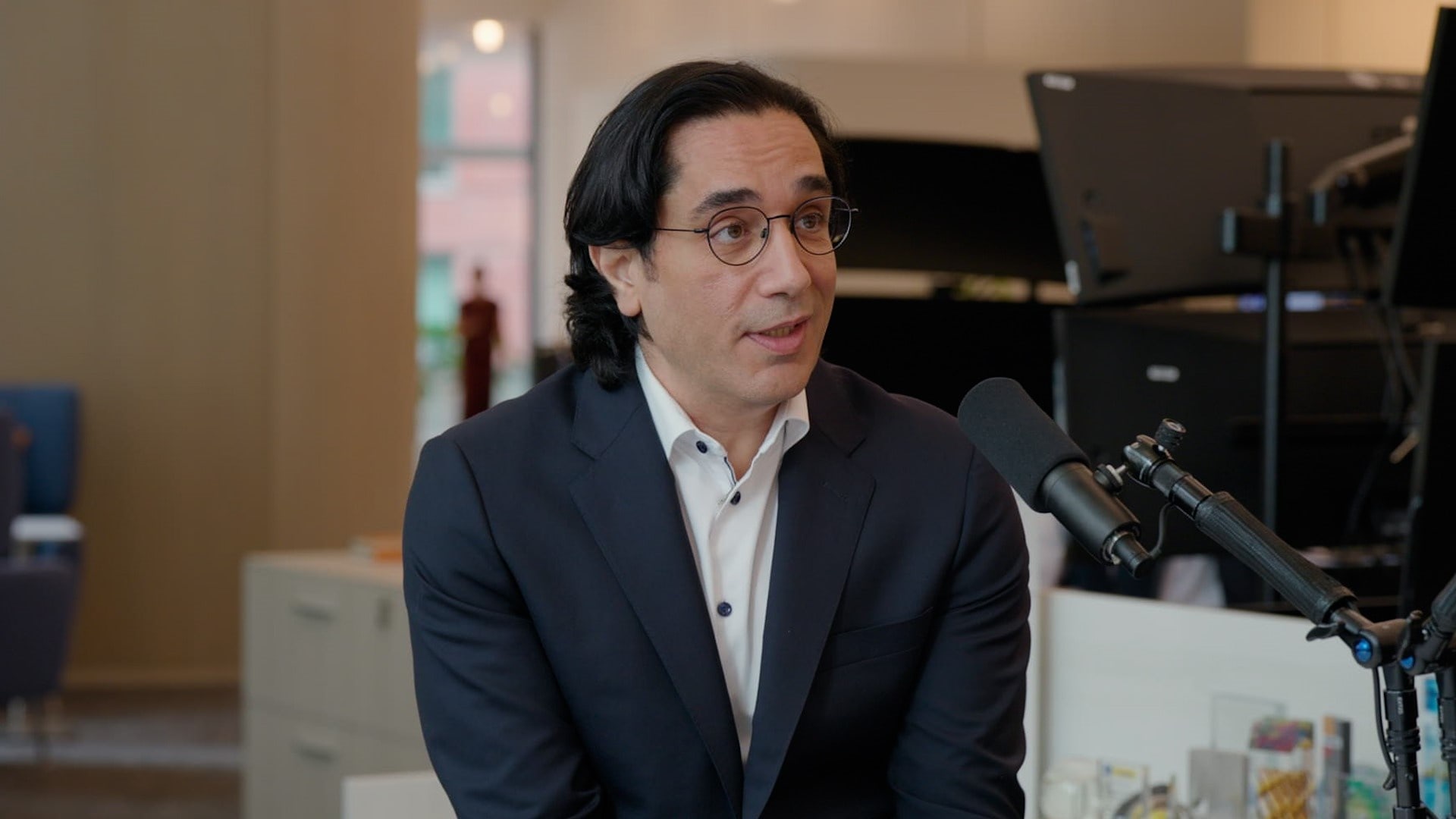
Despite recent wobbles in the US equity market, Muhammad Qubbaj, co-head of US Interest Rate Products in Goldman Sachs Global Banking & Markets, believes the rally is on firm footing. He discusses the outlook for stocks and bonds, and explains why he’s not yet concerned about the rising issuance of bonds by tech companies and the US government, in this conversation with Chris Hussey.
Transcript:
Chris Hussey: This is The Markets. I'm Chris Hussey and today is Thursday, June 11th. And we're here on the Goldman Sachs trading floor Muhammad Qubbaj, who is co-head of US Interest Rate Products within Global Banking & Markets.
Q, thanks so much for joining us.
Muhammad Qubbaj: Thanks for having me.
Chris Hussey: Okay. So, last Friday's payroll. This week's CPI. We've gotten a lot of data. The market took a little shudder. What do you make of it all?
Muhammad Qubbaj: Well, first of all, I'm surprised you want to talk about anything other than the Knicks right now.
Chris Hussey: Well, I don't. But we've got to.
Muhammad Qubbaj: Especially being in New York. The payroll's number was great. CPI was one that didn't add volatility. And it did a couple of things. We're in a situation here that we had a big shift from a market that was pricing in eases over the past few months, all the way to where we were pricing in a hike. The market is aligned with the data set. Things are looking resilient in the economy out there. And resilient for now. So, we feel that the market is fairly pricing what the FOMC path should be here on a probability-adjusted basis.
Now, a lot of people were pointing to the big sell-off in equities that we had. I want to be careful with the causation there. It wasn't just one story. Sure, when rates go up, that means that the rates boost to the equity market comes down. But there were several other things. The Middle East conflict continues to be top of mind, unfortunately, and that adds uncertainty and volatility to the asset markets.
And then finally, we've had, you know, a good run in terms of momentum and a high level of positioning. So, we saw a little bit of a reset in that as well. I think it was a confluence of four things that brought about the tape, as opposed to just the NFP number.
Chris Hussey: No, great point. So, you've got the NFP and the rates. You've got geopolitical risk, and you've got a stretched marketplace. All of those things, though, are operating still here. Is the rally going to get killed?
Muhammad Qubbaj: Well, this is my opinion. I think the AI journey that brought about 30 percent plus returns in equities so far is, one, it's a generational opportunity. And it's going to continue. But two, a lot of the funding for it has happened with debt capital. When you're borrowing from the future and trying to outperform the cost of borrowing, that's a situation where you're going to be, you know, at the whim of sentiment changes in the market. And it's going to be exacerbated by positioning in the market backdrop.
But the trend continues to be here. I still see a lot of value in the AI trade. I see a lot of value in equities. If we look at where forward PEs are for the market right now, they're not that expensive, especially when you use a metric like the dotcom era. I think the AI trend continues. We're going to see some wobbles here and there. Healthy gyrations. Keeps the market going. And healthy resets and positioning. And crowding is something you expect to see.
Chris Hussey: Let's play to a core of your day to day, which is rates, here for a second. Where do rates go from here? Are they going to put pressure on all that AI funding?
Muhammad Qubbaj: I think to start, we've seen a reconciliation, particularly in the front end in terms of rates lining up with the situation on the ground. A resilience in the labor markets. And a CPI or inflation market that continues to be sticky above the current target rate for the Fed.
I think we're supposed to be in a range here, it's a range-bound market here, as we deliberate the future data set, oncoming data set that's going to tell us are the tailwinds from the first half going to dissipate to a point that we see disappointing H2 growth? Or are we going to continue to see the dividends of capex spending and the stock value of fiscal spending continue to be a strong tailwind for the economy here? So, it's a range-bound market. I'm not worried. I don't think there's an asymmetry right now in the rates market. It seems to be fairly priced to me.
Chris Hussey: Okay, so a range-bound market sounds pretty benign to me. But, you know, talk to us a little bit about what you were talking about, the AI being sort of a debt-funded market as well.
Muhammad Qubbaj: Yes, absolutely.
Chris Hussey: How does that complicate matters here?
Muhammad Qubbaj: Well, the AI trade's happening. The funding is going to get funded because there is a need. So, we know the supply is coming. The question is about demand. And on the supply front, are the borrowing rates low enough so that the cost of capital still makes these projects viable? And are they high enough to continue attracting the margin bid from households and continue to bring in inflows into the bond market?
What we've seen is in the beginning of this credit cycle that credits are at the cyclical tight right now. Credit spreads. But we've seen some expansion in term premium in the underlying rate markets. When investors are saying, like, we're fine with the credit risk, but maybe you want to compensate us a little bit for the duration risk - that's healthy. That's fine. We continue to see that to be the story until we get deeper into the credit cycle and you might see the credit market ask for a little bit more return here.
But on an absolute basis for yield-based buyers, we continue to see strong inflows into bond funds. And things continue to be copacetic. If I want to roll the tape forward a little bit, eyes are going to be on 2027 where we're going to get deeper into this capex cycle. We're going to get deeper into the credit cycle. And the US Treasury will likely up its issuance on the coupon side. That, basically, triangulation over there could exact a little bit more of a cost on the borrowing side, both in term premium and in spreads.
Chris Hussey: I love the way you make markets sound so polite. You know? They may ask for a bigger return. Yeah. That may be all it takes. But we saw the private credit markets ask for a larger return earlier this year. It created a little bit of angst within the AI trade. Will the credit markets be as sort of forgiving as the equity markets have been to the AI trade? If we get credit extended in the AI market, will the credit market shut it off faster than what we've seen in the equity market?
Muhammad Qubbaj: I think there are a couple things that will feed into that. One, we're starting to see a little bit of equity funding come to market. What does equity funding mean? That means it reduces the leverage on balance sheet and gives room for more debt funding on the follow. So, I think that's very, very healthy. That's something that we've seen. And that's likely to be a continued trend from here, especially in a well received market for the primaries and secondaries.
Secondly, we're in the beginning part of a credit cycle where the amount of leverage in the economy is at a low. You can just draw examples to many different parts where we were prior to the GFC. The level of leverage is so low that it's a clean start to a credit cycle. I would worry more when you start seeing new issue concessions popping up and people not showing up to take down parts of new issuances. I think we're 12 to 18 months away from that part of the credit cycle. So, I don't feel that that's going to be an issue any time soon.
Chris Hussey: Yeah, of course, some of the companies that are borrowing this money are some of the best credits in the world.
Muhammad Qubbaj: Not only the best credits in the world, when you compare it to the dotcom era, we actually have real earnings, not just eyeballs and clicks right now. We have real earnings. And the returns are coming in immediately.
Chris Hussey: Yeah, follow the cash flows. Okay, let's put a bow on it. What's the trade?
Muhammad Qubbaj: Well, I've been talking a lot about AI. So, I may stick to that theme. A little bit about AI implementation rather than AI concentration. What I mean by that is that I want to be involved in the next part of AI where we bring it away from our laptops to the real world, to your home, to your car, to your refrigerator, to your work and your day to day. So, I want to be part of the segment of the market which allows you to deploy that and deploy that safely, whether it's enterprise two lanes, whether it's integrators. Any of those kinds of plays I want to be involved in right here.
Again, I want to be about AI adoption, not just AI euphoria. I don't want to short anything AI. I just want to be short the idea that AI has to be concentrated in just a handful of stocks.
Chris Hussey: Okay, put your rates hat back on. What are we looking at for the rest of June?
Muhammad Qubbaj: I think three things continue to be top of mind. One is the Middle East conflict. Fingers crossed for an MOU. We need to reduce the volatility. We need to reduce the uncertainty. Time has become a macro variable, especially when you link it to market fatigue and you link it to the price of oil. So, that continues to be top of mind. We're watching the headlines ping pong as we speak right now.
Secondly, I want to see how the supply digestion happens in market. It means that the allocators are going to have to move things around intra asset and inter asset classes. So, it brings around a lot of opportunities. That's going to be very high focus for us right now.
And three, it's Warsh's inaugural FOMC. Now, he's going to be coming in. Will he basically lay a stake and come in fighting? Or is he going to be conciliatory, consensus building, and calming? Definitely think it should be the latter. I definitely hope it's the latter. And that's what we think is going to happen.
Chris Hussey: Good stuff. Hey, we led with the Knicks. Let's end with the World Cup because I know you're a huge football fan. And I don't mean American football. Who's your World Cup pick?
Muhammad Qubbaj: Brazil. Brazil. I fell in love with the Brazilian team since I was a kid. I'll always be a Brazil fan.
Chris Hussey: False. It's Argentina. That does it for this week's episode of The Markets. I'm Chris Hussey, thanks for listening.
The opinions and views expressed herein are as of the date of publication, subject to change without notice, and may not necessarily reflect the institutional views of Goldman Sachs or its affiliates. The material provided is intended for informational purposes only, and does not constitute investment advice, a recommendation from any Goldman Sachs entity to take any particular action, or an offer or solicitation to purchase or sell any securities or financial products. This material may contain forward-looking statements. Past performance is not indicative of future results. Neither Goldman Sachs nor any of its affiliates make any representations or warranties, express or implied, as to the accuracy or completeness of the statements or information contained herein and disclaim any liability whatsoever for reliance on such information for any purpose. Each name of a third-party organization mentioned is the property of the company to which it relates, is used here strictly for informational and identification purposes only and is not used to imply any ownership or license rights between any such company and Goldman Sachs.
A transcript is provided for convenience and may differ from the original video or audio content. Goldman Sachs is not responsible for any errors in the transcript. This material should not be copied, distributed, published, or reproduced in whole or in part or disclosed by any recipient to any other person without the express written consent of Goldman Sachs.
Disclosures applicable to research with respect to issuers, if any, mentioned herein are available through your Goldman Sachs representative or at http://www.gs.com/research/hedge.html
Goldman Sachs does not endorse any candidate or any political party.
Copyright 2026. All rights reserved.
Subscribe to Briefings
Our weekly newsletter delivers the latest insights on economic forces shaping markets—from Goldman Sachs leaders, economists, and investors around the world.
You can unsubscribe at any time. For information about how your personal data will be used, visit Privacy Information and Resources.