
The Markets
Why the US Dollar Could Continue to Strengthen
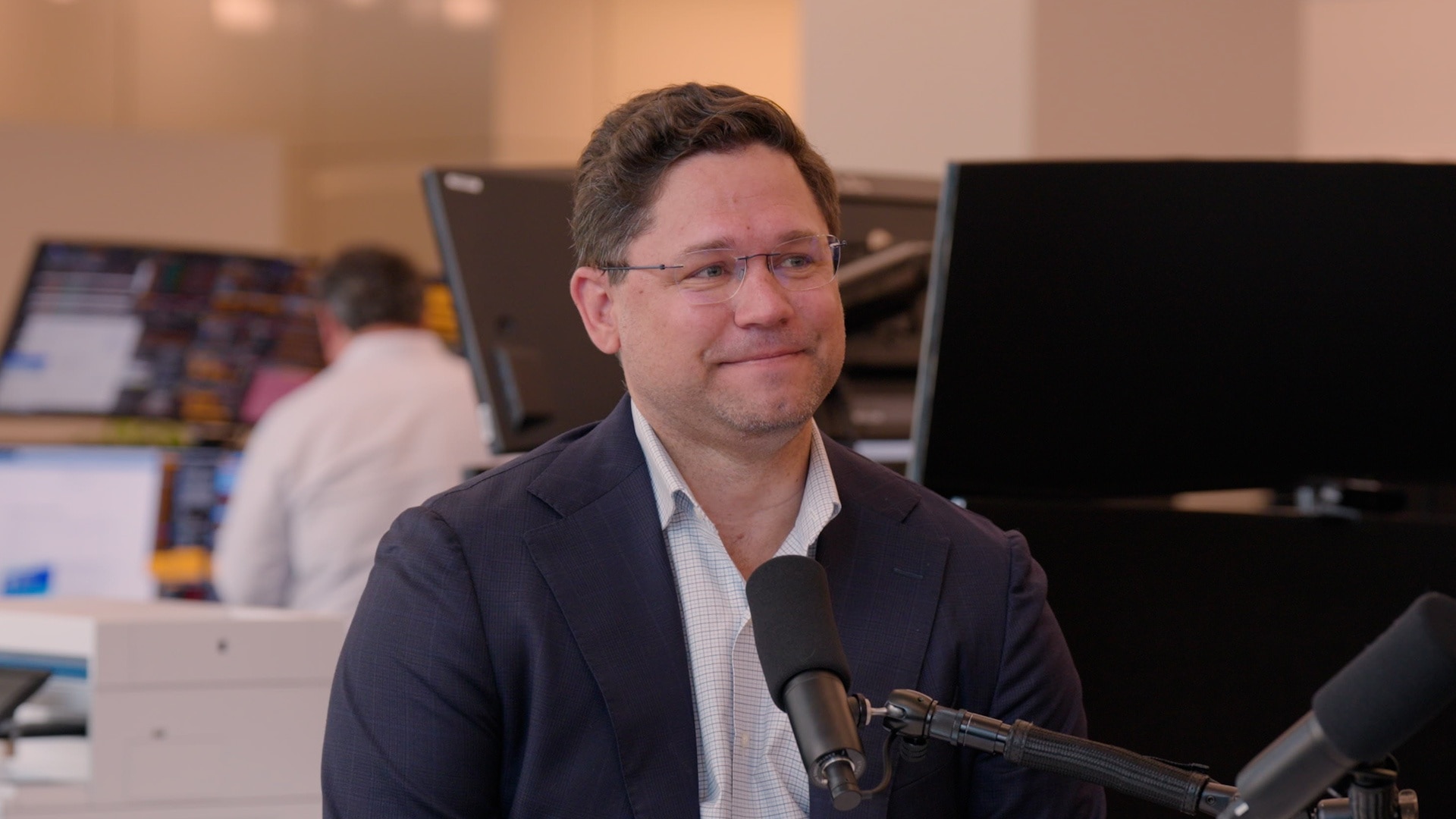
Could the US dollar keep rising from here? Brian Dunne, head of Americas Foreign Exchange Options Trading in Goldman Sachs Global Banking & Markets, says that interest rate differentials, Fed policy, and geopolitical factors could continue to boost the greenback. He also shares his views on how best to play the potential dollar momentum in this conversation with Chris Hussey.
Transcript:
Chris Hussey: This is The Markets. I'm Chris Hussey and today is Thursday, July 9th, and I'm here on the Goldman Sachs trading floor with Brian Dunne, who is head of Americas Foreign Exchange Options Trading within Global Banking & Markets. Brian, thanks so much for joining us.
Brian Dunne: Thanks for having me.
Chris Hussey: Okay, what's going on with the dollar here? Is this a strong dollar year?
Brian Dunne: It seems like it's shaping up to be. If I look at the second quarter and the small amount that we've had in the third quarter so far, I think there are three things that have really driven dollar strength. The first has been the conflict between the US and Iran. The second part has been, you know, the AI trade has largely remained intact. And so, that's more of a story about US exceptionalism given that most of the major companies on the forefront of the AI boom are denominated in the US and corporate earnings have remained exceptionally strong.
And then third, which is the most recent development, has been a potential shift in Fed rate path to a more hawkish approach that's focused on price stability rather than, you know, also recognizing the downside tails to growth because, largely, the labor market, you know, has been very strong.
Chris Hussey: Yeah, let's talk about the Fed for a second here because we just got the Fed meeting minutes this week, which was interesting. Is the Fed as hawkish as markets thought a month ago?
Brian Dunne: Well, I think we'll see. My instinct was that the moves that we saw immediately after chairman Warsh's first press conference was a little bit of a positioning led move. We've seen a decent reversion in pricing. But we still have six or seven basis points priced for July. And I think we have a little bit more than a full hike priced for the end of the year.
I don't think we know yet. What we do really know is that the committee has shifted materially more hawkish in terms of where they've put their dots in the dot plot from the summary of economic projections which we get roughly quarterly. You know, that has gone from having no voter putting in a hike, which was in March, to in June having nine voters for at least one hike, if not more.
Chris Hussey: Big change.
Brian Dunne: And so, you know, I think the jury is still out on Warsh's comments over in Sintra were a little bit less hawkish than what he presented at the press conference. What I would say or the way that we're
thinking about it on the desk is that the distribution of outcomes where the Fed does shift to a more hawkish policy are still underpriced.
Chris Hussey: Yeah. And Warsh’s comments were coming at a conference that he attended. Just sticking on that inflation and the Fed side here. Obviously, the dollar trades a little bit with rates. So, the Fed raises rates, the dollar gets stronger, people want to own dollars, they get a higher return. If the Fed doesn't raise rates, does the dollar just not go as strong?
Brian Dunne: Yes. But there are levels to that statement. I think that for the dollar to have a material appreciation from here, one of two things need to happen. Either there needs to be a hawkish shift from the Fed. Or there needs to be a more dovish shift, or a less good growth outlook, for rest of world. So far we haven't really downgraded our growth forecast for rest of world. But we have seen a pretty dovish shift in places like the ECB, places like the BOE where you had very high expectations for rate hikes in the sort of peak fear from the US and Iran conflict. That has almost completely been taken out in terms of pricing.
So, what I would say is if you look at rate differentials, particularly if you strip out inflation, so we call that real rate differentials, you know, those actually still point towards the dollar having appreciation value going into the end of the year, even if the reaction function is just that the Fed is on hold.
Chris Hussey: All right. So, we've talked about inflation. We've talked about the Fed. Let's talk about that other one you had, which was US exceptionalism, and that's tied into a debasement trade, potentially. That always has China in it a little bit as well. What are you thinking? Is there any sort of cracks in the US exceptionalism, or as you said because of the Iran situation it's actually gone away?
Brian Dunne: Yeah, so, I mean, we could even go back to the last time I was on this podcast. But I think there've been two things that have really gotten the market worried about the idea of a debasement in the US dollar. One was, you know, I would say mostly a story for last year in 2025, which was about US tariff policy putting what was effectively a global tariff on goods. I would say that while we see reserve diversification continuing over time, it hasn't increased substantially from the investor basis that we would have otherwise expected.
And then the second thing is the concern over the petrodollar. So, energy is denominated in dollars. And that has been largely a function or a reason that people have pointed to the dollar remaining strong for the last multiple decades. With the US conflict in Iran, there was a concern that Iran-- and there still is, I should say, but you know, there's a concern that Iran would actually start charging for transport through the Strait of Hormuz. And if that was true, it would likely not be denominated in US dollars. It would likely be denominated in Chinese yuan.
If that's true, does that change the global order of things in terms of where the demand for currency is? So far, we haven't seen that at all. So, I would say on the whole, you know, there are of course risks. It does seem like a diversification of reserves over time is the path of least resistance. But in terms of actual, you know, supplanting the dollar in terms of reserve currency supremacy, that's not on the radar in the near term.
Chris Hussey: Okay, Brian. One more market I want to talk about is Japan. The central bank's trying to raise rates. That should be supportive of the yen. What's your view?
Brian Dunne: So, it's true that Japanese rates are at the highest level they've been in either 30 or 40 years. I would say that the market continues to think that, relative to levels of inflation in Japan, they're still pursuing an easy monetary policy. And so, even though yields are higher, they're not high enough to create appreciation pressure on the currency.
Where you've seen the biggest moves in Japanese yields over the course of the last, let's say six months, has really more so been in the back end of the curve. And that's more so driven by inflation expectations than it is by monetary policy.
Our house view is that in the absence of Japan, the Japanese government, so both fiscal and monetary, pursuing more hawkish policies, there will continue to be weakening pressure on the Japanese yen. With that said, there are a couple of things that could change that. And the thing that's most notable is that, you know, if the investment policy within the Japanese pension system changes to be less dollar focused and more domestic focused, that would potentially have a pretty big impact on their exchange rate. But for right now, we're of the view that the yen continues to have weakening pressure with episodic intervention. Because we are, you know, similar to where yields are, we are at the weakest level that the Japanese yen has been in a couple decades.
Chris Hussey: All right, let's put a bow on it. What's the trade?
Brian Dunne: So, I think the market's very set up for carry going into the summer. I think that is reflected across a bunch of different asset classes. And for sure in FX there are places within emerging markets that you can get quite a decent amount of carry. Places like Brazil. Places like Egypt. You know, which we are bullish.
For me, the trade I think is actually long dollars against G10. And I specifically like it against funders. My rationale is you still get 3 to 4 percent of annualized carry by being long dollars versus the funders in G10. And I think the two tales for me in terms of where currencies could have an outsized move over the next three to six months is really on the dollar higher side of the distribution. And that's driven by, maybe, a reescalation of the conflict between the US and Iran in the Middle East, which would cause energy prices to go back up. Or two, you have a more hawkish shift from the Fed. I think that that's a real risk. And if that is true and the market, you know, is worried about having to price in multiple hikes or an entire hiking cycle going into the turn of next year, that's really positive for the dollar.
So, I guess I'd leave you guys with two things. As a trade, I really like dollar higher versus Swiss. As a hedge, I really like dollar higher versus China. Falls are-- yeah, they're within somewhere sub 10 percentile of the last five years across almost every developed market currency pair. I really like using options to express that. So dollar Swiss call spreads, you can get things like seven to eight times payout for year end call spreads. I think that's great. And then CNH I go a little bit further out. I'd own one year dollar CNH calls with strikes anywhere above seven.
Chris Hussey: Very cool trades there. I want to just drill one second on the carry trade because a carry trade is usually a trade when you think the dollar's going to be pretty flat. You know? Because if it moves too much you could get wiped out of that interest rate differential pretty quickly. So, are you sort of saying that, yeah, I just think the dollar's kind of settling in here, even though there's a lot of volatility in the world?
Brian Dunne: Yeah. We look at valuations and we look at flows. I would say if you look at where real interest rates are-- so, again, interest rate differentials stripping out inflation, it's very supportive for dollar. I mean, the dollar should be two, three, four percent higher depending on the currency that you're looking at.
Chris Hussey: Brian, thanks so much for joining us.
Brian Dunne: Thanks, Chris. I appreciate it.
Chris Hussey: That does it for this week's episode of The Markets. I'm Chris Hussey, thanks for listening in.
Recorded on July 9, 2026.
The opinions and views expressed herein are as of the date of publication, subject to change without notice, and may not necessarily reflect the institutional views of Goldman Sachs or its affiliates. The material provided is intended for informational purposes only, and does not constitute investment advice, a recommendation from any Goldman Sachs entity to take any particular action, or an offer or solicitation to purchase or sell any securities or financial products. This material may contain forward-looking statements. Past performance is not indicative of future results. Neither Goldman Sachs nor any of its affiliates make any representations or warranties, express or implied, as to the accuracy or completeness of the statements or information contained herein and disclaim any liability whatsoever for reliance on such information for any purpose. Each name of a third-party organization mentioned is the property of the company to which it relates, is used here strictly for informational and identification purposes only and is not used to imply any ownership or license rights between any such company and Goldman Sachs.
A transcript is provided for convenience and may differ from the original video or audio content. Goldman Sachs is not responsible for any errors in the transcript. This material should not be copied, distributed, published, or reproduced in whole or in part or disclosed by any recipient to any other person without the express written consent of Goldman Sachs.
Disclosures applicable to research with respect to issuers, if any, mentioned herein are available through your Goldman Sachs representative or at http://www.gs.com/research/hedge.html
Goldman Sachs does not endorse any candidate or any political party.
Views of the interviewee do not necessarily reflect the views of Goldman Sachs.
Copyright 2026. All rights reserved.
Subscribe to Briefings
Our weekly newsletter delivers the latest insights on economic forces shaping markets—from Goldman Sachs leaders, economists, and investors around the world.
You can unsubscribe at any time. For information about how your personal data will be used, visit Privacy Information and Resources.