

Chairman and CEO David Solomon Joins CNBC to Discuss Second-Quarter Earnings, the Deal-Making Environment, and AI Investment
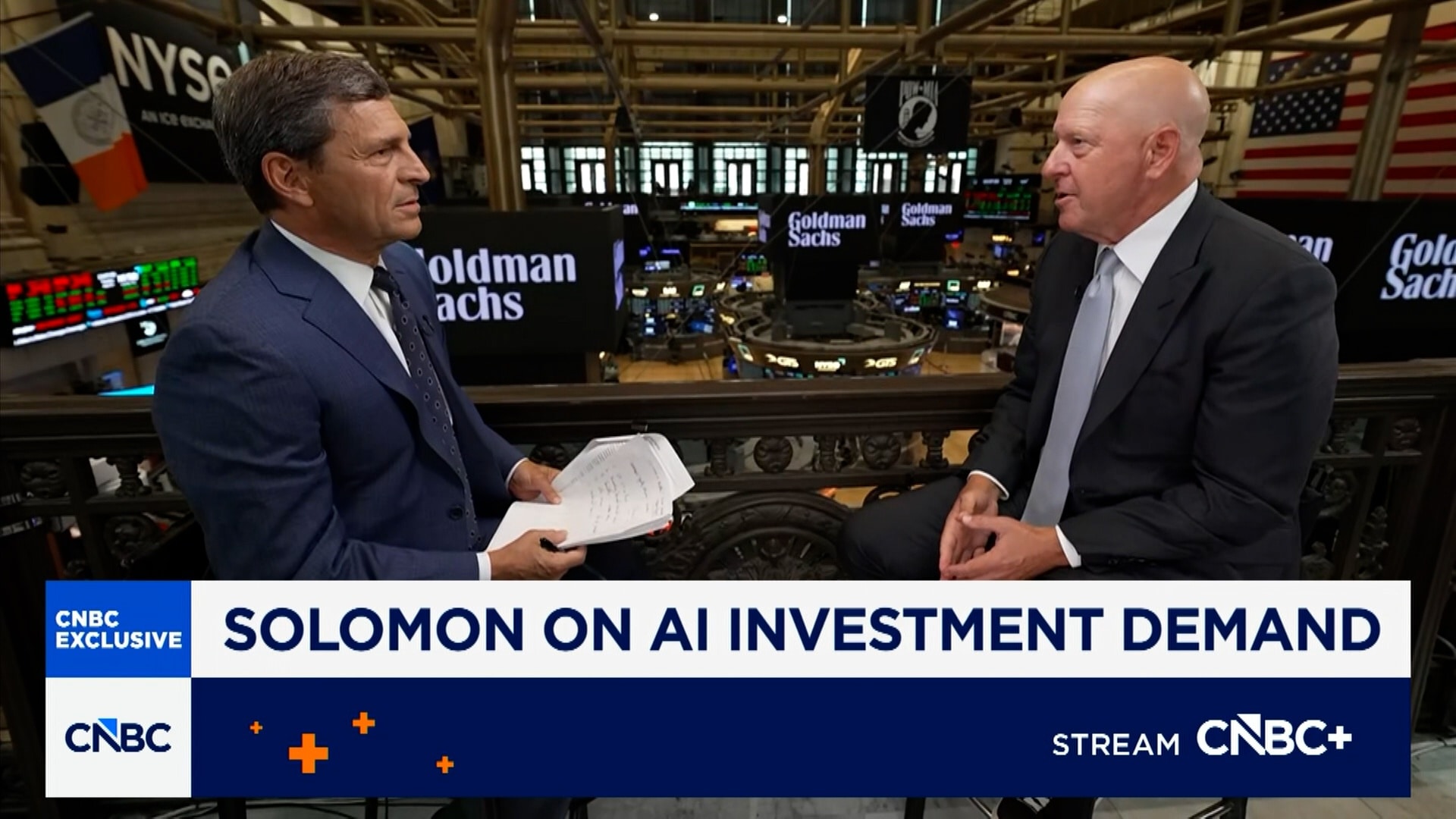
David Solomon joined CNBC to share his views on the firm’s second-quarter earnings, its strong positioning, and the outlook for AI investment. He described the current environment as well aligned with the strengths of Goldman Sachs—across the M&A and IPO landscape, capital formation, and client activity, while emphasizing the firm’s focus on continued growth.
Transcript:
David Faber:
Net revenues were up 39% year-over-year, 18% sequentially. Earnings up 78% year-over-year, 18% sequentially, and on and on from there in terms of ROE and return on tangible equity and everything else. David, I guess the question really is, is this a one-time peak as a result of this unique moment we find ourselves in, or can this really be something you expect to be a new baseline?
David Solomon:
Well, I appreciate the focus, and we had a lot of focus on the earnings call today about the path forward from here. First of all, I'm so proud of our team, our people, and the work they've done with our clients. I think the firm is in a position where this moment and this environment are just super aligned with what we do really well. We're in a technology super-cycle that's accelerating. There's enormous demand for capital formation, and we sit at the center of that with our franchises. There's a lot of strategic M&A as clients are really thinking about scale and how they can execute at scale. Those are all things that create an environment that is highly aligned with our business and the way our business is positioned.
What I think we're all, as a leadership team, really proud of, David, is that we've spent a lot of time over the last 7 or 8 years investing in the growth of our franchise, the growth of our client footprint, and our wallet shares through our One Goldman Sachs ethos of serving our clients in a really, really distinct way. That has put the firm in a strong position. We've grown the revenues of the firm very materially, there's no question, and we highlighted this on the earnings call today. This environment is a very strong environment for our business, but the firm is also bigger and more diverse. When we look out over the next three, five, or seven years and consider the environment we're operating in, I'm not smart enough to tell you what's going to happen in the markets in the next 3 to 6 months.
David Faber:
But you've seen plenty of cycles, David.
David Solomon:
There will be cycles, but we're going to grow the firm.
David Faber:
But, you know, this seems to be a somewhat unique moment. And I mention that because of $1 trillion in capex from six companies. We just saw Alphabet issue $85 billion in equity—one of the most profitable companies the world has ever seen, choosing to go to the equity markets. I mean, there are those who say, "Wait a second, this is getting a little weird." And I would even reference your own comments where you talked on the call: "There continues to be far more demand across the client segment than we're willing to engage with. There's more demand for financing than there is supply."
David Solomon:
That was Denis, my CFO.
David Faber:
Excuse me. I got the wrong attribution, but...
David Solomon:
You know, it's true. We're in an environment where the need for capital formation is great. We have a significant franchise position where we have the ability to lean into our clients and their demand, but there's more demand than we can meet. That is a pretty robust environment that gives pricing power leverage in the business, for sure.
I think the cycle of this capital formation for the AI infrastructure build is in the early innings right now. That doesn't mean it's going to be a straight line. That doesn't mean that every valuation of every stock or every business, or the trajectory of demand, is going to move perfectly along. But when you step back and you say, "Five years from now, is there going to be a lot of growth and a lot of productivity gains in the economy because of the deployment of this?" Absolutely. And the firm is very well positioned to capitalize on it. Will there be some bumps along the way? I think so.
David Faber:
Well, there have to be, don't there? But the bigger bump would be if suddenly everybody comes to a realization that says, "Wait a second, we're not going to get an adequate return on this capital."
David Solomon:
I don't think it's that simple. I think there is capital that we're going to get an adequate return on, and there is capital that we're not. That has been the case in any technology expansion. There are great companies that are created, and there are some companies that are stood up that don't meet the test of time and fade away. I'm sure we'll see both of those things in this environment.
But the underlying technology, the ability for that technology to be deployed broadly in enterprises, and the productivity gains it will create in the economy—I think that's real. It has got a lot of legs, and I think that's very good for Goldman Sachs.
David Faber:
So to those who would characterize this period as a bubble, you would say...
David Solomon:
I would say that you can always have recalibrations and resetting when you have extremely fast movements in markets. But the deployment of capital to invest in this technology and have it become more embedded in enterprises and in our economy—I don't think that's a bubble. I think that's a trend that's going to have long secular legs. Whether we get the pricing right of all the capital every minute of the day, I don't know. I'm sure we'll get some stuff wrong. You made the point about Google. Google did this very, very large.
David Faber:
It surprised an awful lot of people who've been doing this for a very long time.
David Solomon:
But just step back. One of the things that's interesting is people are talking about how robust the equity markets are. The IPO market was very active in the second quarter. But still, when you look at IPOs year-to-date, they're running around or under the ten-year average.
David Faber:
I saw you talked about that.
David Solomon:
Market cap matters. You've got companies now where, when people look at the size of these things, you have to remember they're underpinned by companies that—because of their earning power—are justifying three, four, or $5 trillion valuations. So it's not surprising, therefore, that the capital needs are large.
David Faber:
Are enormous. But by the way, a SpaceX IPO, which obviously you are lead manager on, can go a long way in terms of generating fees. One Anthropic IPO or one OpenAI IPO is far larger than all the smaller ones.
David Solomon:
The SpaceX IPO obviously was a big IPO, but when you look at our $20 billion of revenue in the quarter, the SpaceX IPO was immaterial to that $20 billion of revenue. It's just part of a puzzle of lots of client activity. You have a confluence of strategic M&A really turning on. We've got an environment from a regulatory perspective where CEOs feel they have a right to really explore strategically what they can do. That's not the way they felt four years ago, right? That's positive.
You have all this capital formation around the AI cycle. You have growth for people who own assets and for people that are stewarding assets. In the asset management business, you have growth in assets because of market cap expansion, so they are balancing their portfolios and redeploying. Those are all really positive things. And then look at the wealth creation going on in the world; all of that has to go into wealth management franchises.
David Faber:
Without a doubt, I get it. Somebody said the blast radius of just $1 trillion of capex spending is kind of what you're describing right there. It's enormous. But I guess, are we building up a risk in the system that ultimately, if for some reason this thing takes a significant hiccup, we're going to see very significant dislocations?
David Solomon:
We will see dislocations. When you say "very significant," I look at the test of time. We have an incredible ability and an incredible nimbleness as an economy to take the speed bumps, reorient, and adjust. I'm sure there are going to be speed bumps, whether they're significant or not. Of course, in the future, if you look at an unlimited timeline, there will be significant speed bumps. But I think we've got a great ability to navigate and move forward.
I do think the US economy is just very well positioned in all this, given our capital markets, our leadership position in capital formation around the world, our technology innovation, and the concentration of the largest, most important companies that are here. That kind of ecosystem, combined with entrepreneurship and a unique culture—which is very different than other places in the world—is a real positive. Americans want to take risk and participate. If you go to Europe, you don't see that; Europeans don't buy single stocks to take risk, but Americans do. That is part of that positive ecosystem. So there will be bumps, but we've got a really versatile economy, and I think it's an exciting time when I look out.
David Faber:
Is there enough capital? I mean, I know it kind of seems like a crazy question to ask, but even your CFO said, "We have more demand than..." I do wonder.
David Solomon:
There is $9 trillion in U.S. money market funds.
David Faber:
I'm aware.
David Solomon:
There's a lot of capital out there. Whether or not every financial institution deploys every quarter to exactly meet demand—no, of course not. In every quarter, there are going to be constraints because people want to manage risk appropriately. One of the things we're spending a lot of time thinking about at the firm is how we manage risk in a complex environment like this. But there's a lot of capital out there, and I'm not concerned about the ability for capital to be available for things that make sense. Does everything make sense? No, but there's plenty of capital out there to support this kind of investment in technology and the economy.
Recorded on July 14, 2026.
The opinions and views expressed herein are as of the date of publication, subject to change without notice, and may not necessarily reflect the institutional views of Goldman Sachs or its affiliates. The material provided is intended for informational purposes only, and does not constitute investment advice, a recommendation from any Goldman Sachs entity to take any particular action, or an offer or solicitation to purchase or sell any securities or financial products. This material may contain forward-looking statements. Past performance is not indicative of future results. Neither Goldman Sachs nor any of its affiliates make any representations or warranties, express or implied, as to the accuracy or completeness of the statements or information contained herein and disclaim any liability whatsoever for reliance on such information for any purpose. Each name of a third-party organization mentioned is the property of the company to which it relates, is used here strictly for informational and identification purposes only and is not used to imply any ownership or license rights between any such company and Goldman Sachs.
A transcript is provided for convenience and may differ from the original video or audio content. Goldman Sachs is not responsible for any errors in the transcript. This material should not be copied, distributed, published, or reproduced in whole or in part or disclosed by any recipient to any other person without the express written consent of Goldman Sachs.
Subscribe to Briefings
Our weekly newsletter delivers the latest insights on economic forces shaping markets—from Goldman Sachs leaders, economists, and investors around the world.
You can unsubscribe at any time. For information about how your personal data will be used, visit Privacy Information and Resources.