



About This Report
This report outlines insights and applications identified during Goldman Sachs’ membership in the MIT-IBM Watson AI Lab (“the Lab”), exploring how artificial intelligence (AI) can help improve biodiversity measurement¹. While the power and precision of these AI models continue to evolve, the research demonstrates initial proofs of concept and potential applications: improved biodiversity data can help enhance business, financial, and regulatory decision-making, which could expand risk management capabilities, identify new business opportunities, and support innovative nature-based financial solutions.
Key Findings
- Deep Occupancy Modeling improved species occupancy estimate reliability by 27% across 16 species,³ producing higher-confidence baseline estimates that could potentially support sustainability-linked financial products and may help improve market credibility while reducing manual fieldwork costs
- Distribution Modeling paired sparse on-the-ground data with expert knowledge and satellite imagery to map biodiversity where traditional surveys are infeasible, which could enable earlier insight into nature-related risks and dependencies to help inform portfolio and supply chain decisions
- TerraMind Foundation Model achieved 95% accuracy in peatland identification,⁴ detecting ~12 hectares of peatland loss from a 2022 wildfire, illustrating how foundation models may support scalable ecosystem monitoring to help promote the integrity of carbon and biodiversity markets
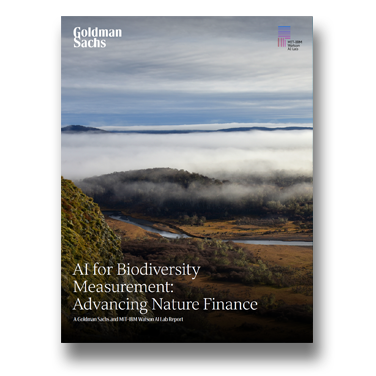
A Goldman Sachs and MIT-IBM Watson AI Lab Report
1 All research and pilots included in this report were conducted by the MIT-IBM Watson AI Lab. Goldman Sachs, a member of the MIT-IBM Watson AI Lab, provided financial sponsorship for this report and its related research. Goldman Sachs did not conduct any research or pilots contained in this report.
2 Results, interpretations, and recommendations are subject to refinement as additional data are incorporated or analyses mature. Scientific claims and model outputs will undergo standard peer review in separate, formal publications, and should be treated as provisional until that process is complete. Future engagement is part of an ongoing research phase and does not imply commercialization or integration into Goldman Sachs or IBM products or services.
3 bioRxiv, Seeing Above and Below the Canopy: Modeling and Interpreting Species Occupancy with Multimodal Habitat Representations, 2026.
4 arXiv, Ecological mapping with geospatial foundation models, 2026.
Subscribe to Briefings
Our weekly newsletter delivers the latest insights on economic forces shaping markets—from Goldman Sachs leaders, economists, and investors around the world.
You can unsubscribe at any time. For information about how your personal data will be used, visit Privacy Information and Resources.